Mastering Pressing Schemes: A Tactical Breakdown for 2026
Anúncios
Mastering Pressing Schemes: A Tactical Breakdown of 3 Successful Systems for 2026
In the fast-evolving world of modern football, the ability to effectively press an opponent has become a cornerstone of success. Gone are the days when defensive solidity was solely about sitting deep and absorbing pressure. Today, top teams proactively disrupt opposition build-up, force turnovers in dangerous areas, and transition rapidly from defense to attack. This intricate dance of coordinated movement, anticipation, and aggression defines contemporary football. Understanding and implementing successful football pressing schemes is no longer an option but a necessity for any team aspiring to compete at the highest level.
The year 2026 is rapidly approaching, and with it, the continuous refinement of tactical approaches. Coaches are constantly seeking innovative ways to gain an edge, and pressing remains a fertile ground for tactical ingenuity. This comprehensive article delves into the art and science of pressing, offering a detailed breakdown of three highly effective football pressing schemes that are set to dominate the tactical landscape. We’ll explore their core principles, practical implementation, and the specific scenarios where each system thrives, providing coaches, players, and enthusiasts with invaluable insights.
Anúncios
The Evolution of Pressing: From Gegenpressing to Zonal Traps
Before we dissect specific systems, it’s crucial to understand the historical context and evolution of pressing. While high-intensity pressing gained mainstream prominence with Jürgen Klopp’s ‘Gegenpressing’ at Borussia Dortmund and later Liverpool, its roots can be traced back to the Dutch Total Football of the 1970s and Arrigo Sacchi’s AC Milan in the late 1980s. These pioneers understood that defense wasn’t just about individual duels but about collective spatial control and denying the opponent time and space.
Modern pressing has become more nuanced. It’s not just about running tirelessly; it’s about intelligent pressing triggers, coordinated movements, and understanding when to press and when to drop. The emphasis has shifted from purely man-oriented pressing to more zonal or hybrid approaches, where players press specific zones or passing lanes, forcing the opponent into predictable areas. The goal of any football pressing scheme is multifaceted: to win the ball back quickly, to disrupt the opponent’s rhythm, to create immediate attacking opportunities, and to conserve energy by pressing intelligently rather than indiscriminately.
Anúncios
Success in pressing hinges on several key factors:
- Collective Understanding: Every player must know their role and how it interlocks with their teammates’.
- Physical Conditioning: High-intensity pressing demands exceptional stamina and repeated sprint ability.
- Technical Proficiency: Players must be comfortable making quick decisions and executing precise tackles or interceptions.
- Communication: Constant verbal and non-verbal communication is vital for coordinated movements.
- Pressing Triggers: Identifying specific cues (e.g., a bad pass, an opponent’s head down, a pass to a weak foot) to initiate the press.
With this foundation, let’s explore three prominent and effective football pressing schemes that will continue to shape the beautiful game in the coming years.
System 1: The High Block & Counter-Press (The Kloppian Model)
Core Principles:
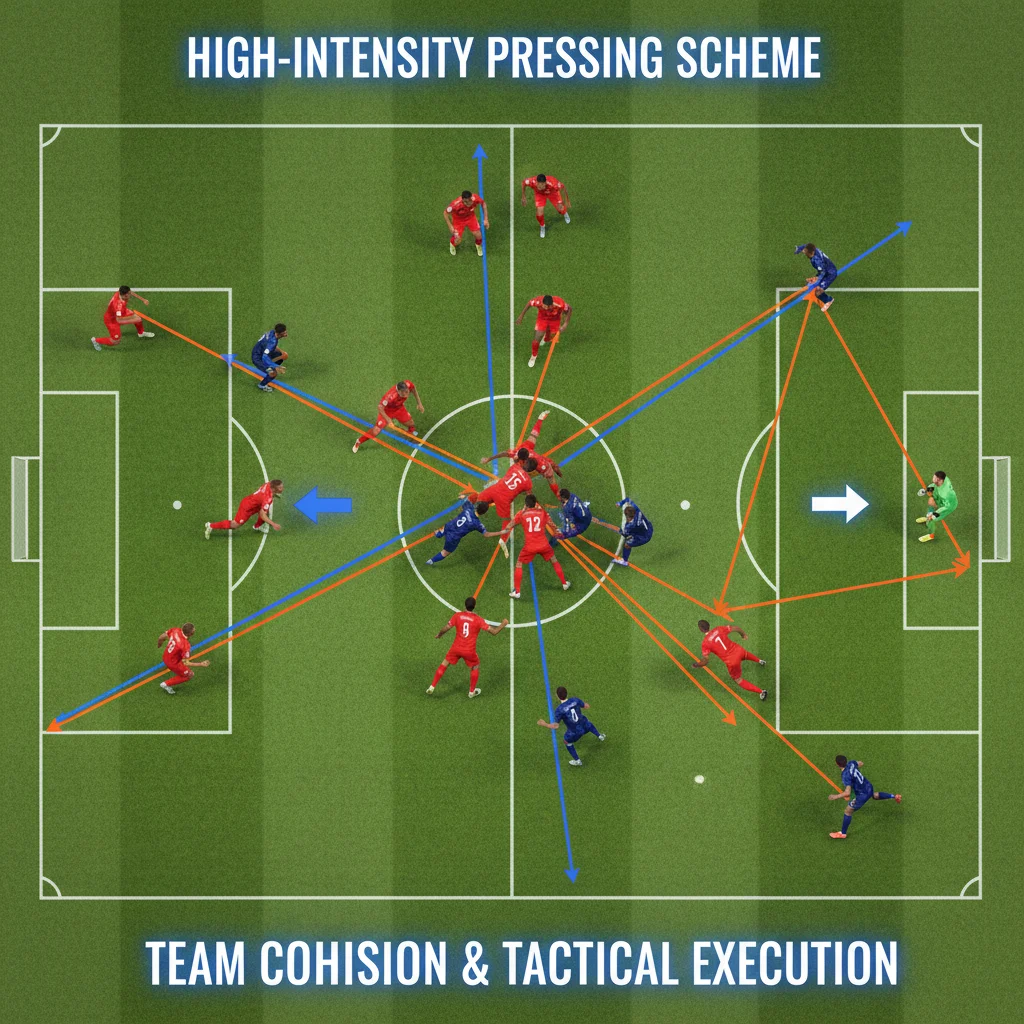
The high block and counter-press, often synonymous with Jürgen Klopp’s teams, is arguably the most aggressive and physically demanding football pressing scheme. Its primary objective is to win the ball back as close to the opponent’s goal as possible, often within 5 seconds of losing possession. This system doesn’t just aim to recover the ball; it aims to recover it in positions that immediately facilitate dangerous attacking transitions.
Key tenets include:
- Immediate Reaction: As soon as possession is lost, the nearest players swarm the ball carrier.
- Compactness: The team maintains a very narrow and high defensive line, squeezing the pitch and reducing space for the opponent.
- Forcing Mistakes: The intensity of the press aims to panic the opponent, leading to rushed decisions, misplaced passes, or clearances.
- Cover Shadows: Players position themselves to block passing lanes to other opponents, effectively creating ‘cover shadows’ that limit options.
- Numerical Superiority: Overloading the area around the ball to ensure a higher chance of winning tackles or interceptions.
Practical Implementation:
Implementing this football pressing scheme requires meticulous training and a specific player profile. Forwards and attacking midfielders are not just goal scorers; they are the first line of defense, initiating the press with relentless energy. Defensive midfielders are crucial for screening passes and winning second balls, while the full-backs are often tasked with pushing high to support the press and prevent wide outlets.
The defensive line plays exceptionally high, often near the halfway line, which demands brave and quick center-backs capable of defending vast spaces behind them. The goalkeeper acts as a ‘sweeper-keeper,’ ready to rush out and clear any balls played over the top.
Training Drills: Small-sided games with specific rules (e.g., ‘win the ball back in 5 seconds,’ ‘score within 3 passes of winning possession’), pressing triggers, and shadow pressing exercises are vital. Developing players’ ‘game intelligence’ to read situations and anticipate passes is paramount.
Strengths:
- Creates numerous high-quality scoring chances from turnovers in dangerous areas.
- Mentally exhausts and frustrates opponents, forcing them into long balls or clearances.
- Can dominate possession by winning the ball back quickly after losing it.
- Excites fans with its high-energy, attacking style.
Weaknesses:
- Extremely physically demanding; requires exceptional fitness and squad depth.
- Vulnerable to long balls over the top if the defensive line is not perfectly coordinated or if opponents have fast attackers.
- Can be bypassed by teams with exceptional technical quality and composure under pressure.
- Risk of players becoming isolated if the press is not cohesive, leading to numerical disadvantages.
System 2: The Mid-Block & Zonal Press (The Simeone/Conte Approach)
Core Principles:
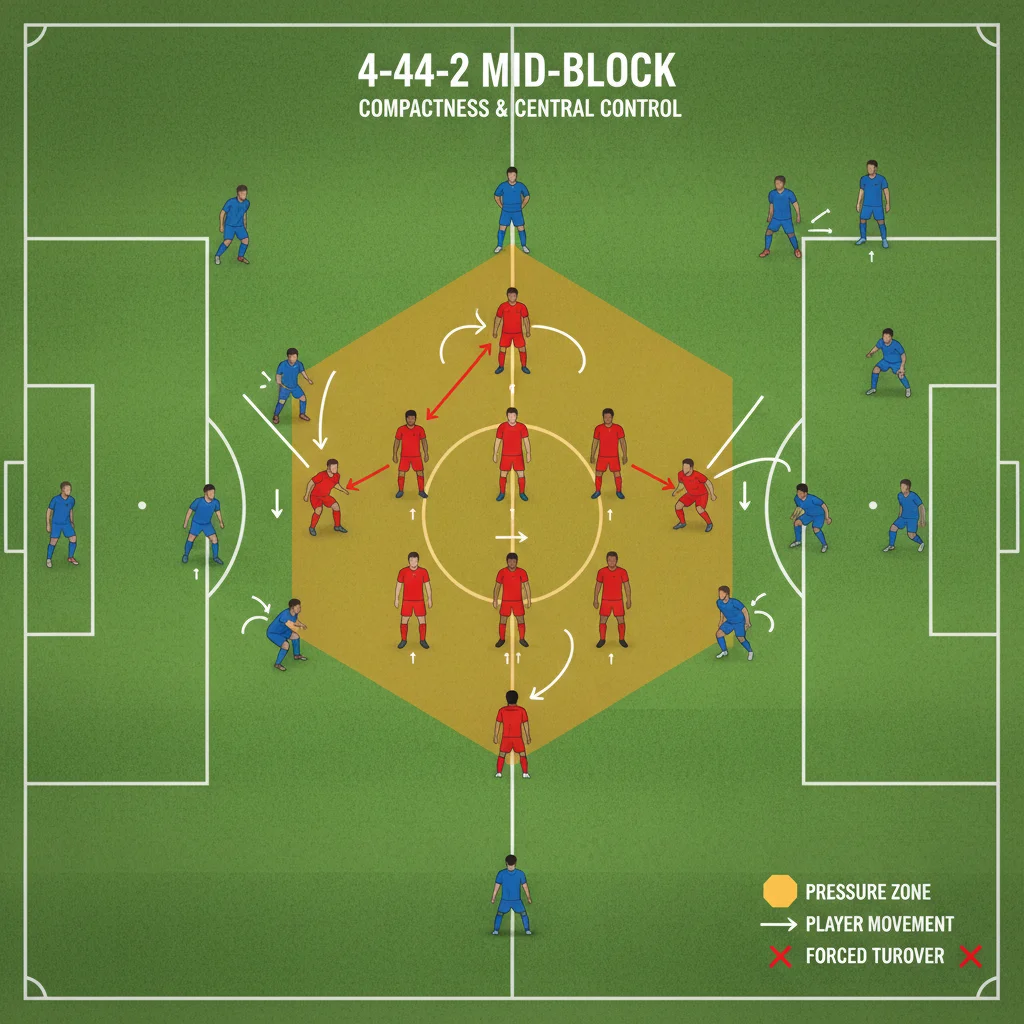
In contrast to the relentless aggression of the high block, the mid-block and zonal press prioritizes defensive solidity and tactical discipline. This football pressing scheme aims to deny the opponent space in central areas, forcing them wide or into predictable passing patterns, before springing a trap. It’s less about winning the ball back immediately after losing it and more about controlling the opponent’s progression and patiently waiting for the right moment to engage.
Key characteristics include:
- Compact Shape: The team sits in a compact shape (e.g., 4-4-2 or 5-3-2) in the middle third of the pitch, denying central passing options.
- Zonal Marking: Players primarily mark space and passing lanes rather than individual opponents.
- Pressing Triggers: The press is initiated when the ball enters a specific ‘pressing zone’ (e.g., a wide channel, or when an opponent receives the ball facing their own goal).
- Funneling: Opponents are funneled into predetermined areas of the pitch, often wide, where they can be outnumbered and dispossessed.
- Patience and Discipline: Players must maintain their shape and resist the urge to chase the ball indiscriminately.
Practical Implementation:
This football pressing scheme demands exceptional tactical discipline and a deep understanding of positional play. The midfield and defensive lines move as a unit, shifting horizontally and vertically to maintain compactness. The forwards often drop deep to form a narrow front two, blocking passes into central midfielders and forcing play wide.
When the ball is played wide, the nearest winger and full-back often engage in a coordinated press, while the central midfielders shift across to provide cover. The objective is to trap the opponent near the touchline, using the sideline as an extra defender. Once the ball is won, the transition to attack is often rapid, utilizing quick passes or direct balls to exploit the opponent’s stretched shape.
Training Drills: Focus on shape maintenance, defensive shifting, understanding pressing triggers in specific zones, and rapid transitions from defense to attack. Shadow play without opponents, where players move according to ball location, is highly effective.
Strengths:
- Provides excellent defensive stability and is less susceptible to being played through centrally.
- Conserves energy compared to a high press, allowing for sustained tactical execution over 90 minutes.
- Effective against technically superior teams who thrive on central possession.
- Can lead to dangerous counter-attacking opportunities when the ball is won in wide areas.
Weaknesses:
- Can be criticized for being ‘negative’ or overly defensive, especially if the team struggles to transition effectively.
- Requires immense tactical discipline; one player out of position can compromise the entire structure.
- May allow opponents to have more possession in their own half, which some teams dislike.
- Vulnerable to quick switches of play if the defensive unit is slow to shift.
System 3: The Man-Oriented & Situational Press (The Bielsa/Nagelsmann Hybrid)
Core Principles:
The man-oriented and situational press is a more fluid and adaptable football pressing scheme that blends elements of man-marking with intelligent zonal principles. While not a pure man-marking system, it involves players taking responsibility for specific opponents in certain zones, particularly when the opponent enters the team’s half or when specific pressing triggers occur. It’s often associated with coaches like Marcelo Bielsa or Julian Nagelsmann, who demand high tactical intelligence and positional versatility from their players.
Key tenets include:
- Aggressive Man-Orientation: Players aggressively track and engage opponents in their vicinity, especially when the ball is played to them.
- Situational Triggers: The press is not constant but activated by specific cues, such as a back pass, a heavy touch, or a player receiving the ball in a tight space.
- Numerical Overloads: Creating local numerical superiority around the ball carrier by having multiple players converge.
- Flexible Shapes: The team’s shape can adapt dynamically based on the opponent’s formation and ball possession.
- High-Risk, High-Reward: When executed perfectly, it can completely suffocate an opponent; when executed poorly, it can leave large spaces.
Practical Implementation:
This football pressing scheme requires players who are not only physically fit but also tactically astute. Each player must understand not only their primary marking assignment but also when to leave their man to press the ball, and when to drop back into a zonal shape. It often involves a high defensive line and a very active midfield, constantly shuffling and engaging.
For example, if an opponent’s center-back receives the ball, a forward might aggressively press them, while the nearest attacking midfielder drops to mark the opponent’s defensive midfielder. Other players might shift to cover passing lanes or mark other nearby opponents. The key is the rapid decision-making and coordination among players to maintain balance while applying intense pressure.
Training Drills: Emphasis on 1v1, 2v1, and 2v2 pressing situations, decision-making under pressure, and quick transitions. Role-playing specific scenarios and encouraging players to communicate constantly are vital.
Strengths:
- Can effectively nullify an opponent’s key playmakers by denying them time and space.
- Highly adaptable to different opponent formations and tactical approaches.
- Can lead to spectacular ball recoveries and immediate attacking opportunities.
- Engages players mentally, demanding constant focus and tactical awareness.
Weaknesses:
- Requires extremely intelligent and versatile players with high work rates.
- If a player is beaten in a 1v1 situation, it can leave large gaps for the opponent to exploit.
- Can be susceptible to quick passing combinations and intelligent movement that drags players out of position.
- Risk of fatigue if players are constantly chasing opponents across the pitch.
Choosing the Right Football Pressing Scheme for Your Team
The selection of the most appropriate football pressing scheme is not a one-size-fits-all decision. It depends heavily on several critical factors:
- Player Profile: Do your players possess the physical attributes (stamina, speed) and tactical intelligence required for a high-intensity press, or are they better suited to a more disciplined, compact approach?
- Opponent Analysis: What are the opponent’s strengths and weaknesses? Do they struggle under high pressure? Are they good at playing through the lines? Do they rely on long balls?
- Team Philosophy: Does the pressing scheme align with the overall attacking and defensive philosophy of the coach and the club?
- Game State: The pressing intensity and approach might change depending on whether your team is winning, losing, or drawing, and the time remaining in the match.
- Fitness Levels: The ability to sustain a high-intensity press for 90 minutes is a significant challenge and requires careful management of player fitness and rotation.
Many successful teams in 2026 will likely employ a hybrid approach, capable of switching between different pressing schemes within a single match or even within different phases of play. For instance, a team might start with a high block, drop into a mid-block if the opponent successfully bypasses the initial press, and then trigger a man-oriented press in specific areas of the pitch.
Training Methodologies for Effective Pressing
Regardless of the chosen football pressing scheme, effective training is paramount. Here are some key training methodologies:
- Rondos and Positional Play: These drills improve ball retention, quick passing, and spatial awareness, which are crucial for both initiating and breaking a press.
- Small-Sided Games (SSGs): SSGs with specific constraints (e.g., limited touches, pressing zones, quick transitions) are excellent for developing decision-making under pressure and improving pressing coordination.
- Shadow Pressing: Practicing pressing movements without opponents to ensure players understand their roles, angles of approach, and cover responsibilities.
- Video Analysis: Reviewing game footage to highlight successful and unsuccessful pressing moments, allowing players to learn from their actions and the opponent’s reactions.
- Physical Conditioning: Incorporating high-intensity interval training (HIIT) and repeated sprint ability (RSA) drills to ensure players have the physical capacity to execute the press throughout the game.
- Communication Drills: Encouraging constant verbal and non-verbal communication during all drills to build cohesive pressing units.
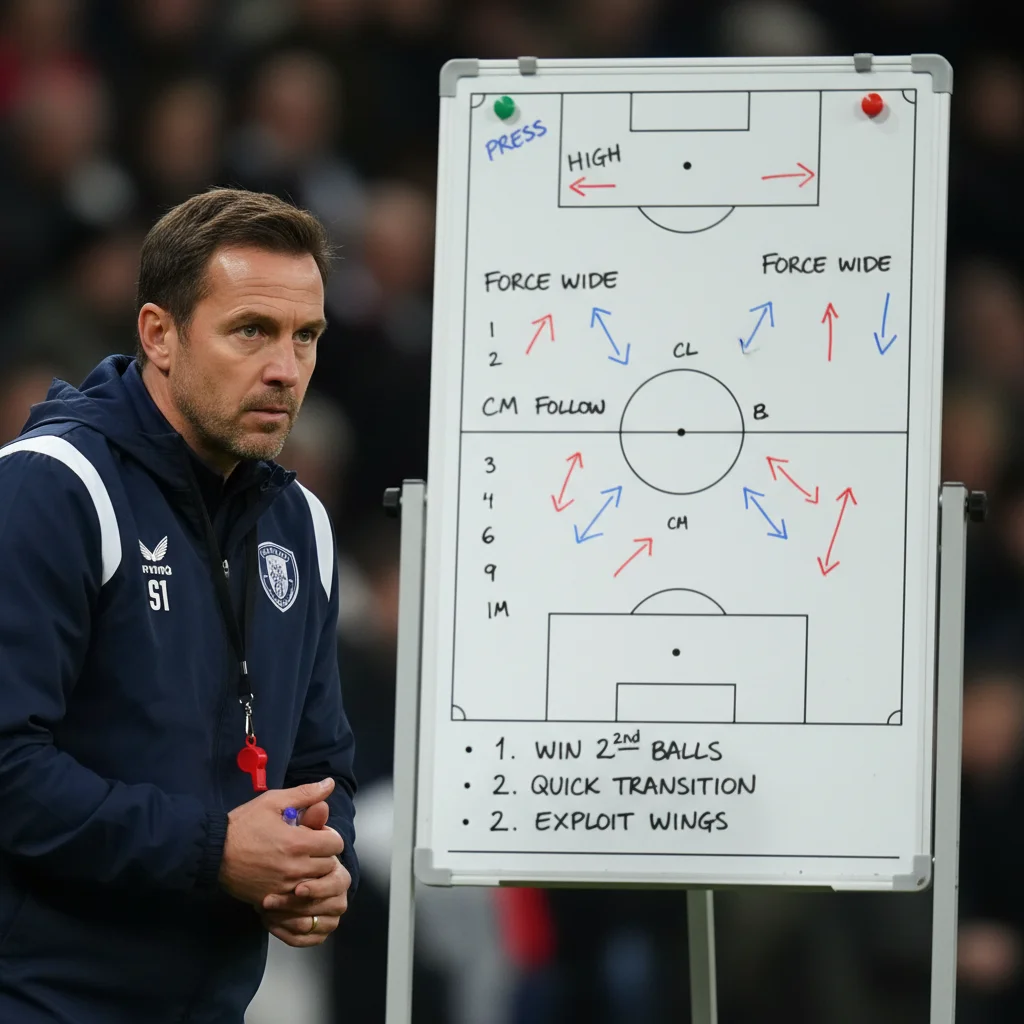
Coaches should focus on developing players’ ‘reading of the game’ – their ability to anticipate passes, recognize pressing triggers, and make split-second decisions. This tactical intelligence is what separates a good pressing team from a truly elite one.
The Future of Football Pressing Schemes
As football continues its relentless march forward, football pressing schemes will undoubtedly evolve further. We can anticipate an even greater emphasis on:
- Data Analytics: Using advanced metrics to identify opponent weaknesses, optimize pressing triggers, and analyze player performance in pressing situations.
- Individualized Pressing Roles: Tailoring pressing responsibilities to individual player strengths and weaknesses, rather than a rigid, one-size-fits-all approach.
- AI-Powered Scouting: Leveraging artificial intelligence to predict opponent build-up patterns and design specific pressing traps.
- Dynamic Switching: Teams becoming even more adept at seamlessly transitioning between different pressing intensities and structures based on the flow of the game.
- Goalkeeper Involvement: The role of the sweeper-keeper will become even more critical in supporting the high defensive line and initiating attacks after ball recovery.
The goal will always remain the same: to control the game without the ball, dictate the opponent’s actions, and create opportunities. The methods, however, will continue to be refined, making the tactical battle on the sidelines as compelling as the action on the pitch.
Conclusion
Mastering football pressing schemes is a complex yet rewarding endeavor for any modern football team. Whether it’s the high-octane aggression of the high block, the disciplined solidity of the mid-block, or the intelligent adaptability of the man-oriented situational press, each system offers unique advantages and challenges. The key to success lies in a deep understanding of core principles, meticulous training, and the ability to adapt to the ever-changing dynamics of the game.
As we look towards 2026 and beyond, the teams that can effectively implement and fluidly switch between these sophisticated pressing strategies will be the ones that consistently find themselves at the pinnacle of the sport. The tactical arms race in football is relentless, and pressing remains one of the most potent weapons in a coach’s arsenal. By studying these systems, coaches can equip their teams with the tools to dominate possession, disrupt opponents, and ultimately, achieve victory.