Mastering Footvolley Drill Intensity: Boost Performance 18% in 6 Weeks
Footvolley, a captivating blend of football and volleyball, demands an extraordinary combination of athleticism, skill, and strategic thinking. For aspiring players and seasoned veterans alike, the pursuit of peak performance is a constant journey. While talent and dedication are foundational, a critical, often underestimated, factor in unlocking significant improvements is the intelligent management of footvolley drill intensity. This comprehensive guide will delve into the science and art of manipulating training intensity to achieve remarkable gains, specifically aiming for an 18% improvement in performance within a focused six-week period. We will explore how understanding, measuring, and adjusting intensity can transform your training, leading to enhanced agility, power, endurance, and technical precision.
The allure of footvolley lies in its dynamic nature, requiring explosive movements, sustained rallies, and delicate ball control. To excel, players must develop a robust physiological foundation alongside refined technical skills. Simply practicing more is not enough; the effectiveness of practice hinges on how intensely and intelligently it is executed. Ignoring footvolley drill intensity can lead to plateaus, overtraining, or suboptimal development. Conversely, a well-structured approach to intensity can accelerate learning, adapt the body more efficiently, and ultimately, elevate your game to new heights.
Anúncios
This article aims to provide actionable insights for coaches and players. We will cover the fundamental principles of training intensity, practical methods for its measurement, and strategies for its application in various footvolley drills. By the end, you will have a clear roadmap to optimize your training regimen, ensuring every session contributes meaningfully to your performance goals.
Understanding the ‘Why’ Behind Footvolley Drill Intensity
Before diving into the ‘how,’ it’s crucial to grasp ‘why’ footvolley drill intensity is such a pivotal element in training. The human body adapts specifically to the demands placed upon it – a principle known as Specific Adaptation to Imposed Demands (SAID). If your training consistently lacks the intensity required for competitive play, your body will adapt to that lower level, hindering your ability to perform under pressure. Conversely, excessive intensity without proper recovery can lead to burnout, injury, and diminished returns.
Anúncios
The Physiological Impact of Intensity
Varying levels of footvolley drill intensity elicit different physiological responses:
- Low Intensity: Primarily focuses on recovery, technical repetition without fatigue, and building aerobic base. It’s crucial for active recovery and reinforcing motor patterns without stress.
- Moderate Intensity: Enhances aerobic capacity, improves muscular endurance, and allows for sustained technical execution under light fatigue. This is often the zone for developing consistency and tactical understanding.
- High Intensity: Develops anaerobic power, speed, agility, and the ability to perform explosive movements repeatedly. This level of intensity mirrors game-like situations, stressing the cardiovascular system and muscular strength. It’s vital for improving reaction time, jumping ability, and powerful strikes.
- Maximal Intensity: Pushes the body to its absolute limits, targeting peak power output and speed. While brief, these efforts are critical for developing explosive strength and top-end speed, directly translating to powerful serves, acrobatic saves, and quick transitions.
By strategically cycling through these intensity levels, players can achieve a well-rounded development that addresses all facets of footvolley performance. The goal is to create a training stimulus that is challenging enough to provoke adaptation but not so overwhelming that it causes harm or prevents recovery.
Psychological Benefits
Beyond the physical, footvolley drill intensity also plays a significant psychological role. Training at higher intensities simulates the pressure of a match, helping players develop mental fortitude, focus, and resilience. It teaches them to perform under fatigue, make quick decisions, and maintain composure when the stakes are high. Regularly pushing boundaries in training builds confidence, preparing athletes for the demands of competition.
Measuring and Monitoring Footvolley Drill Intensity
To effectively manage footvolley drill intensity, you need reliable methods for measuring and monitoring it. This isn’t about guesswork; it’s about objective and subjective data that informs your training decisions.
Subjective Measures: RPE (Rate of Perceived Exertion)
The Rate of Perceived Exertion (RPE) scale is a widely used, simple, and effective subjective measure of intensity. Players rate their effort on a scale, typically 1 to 10 (Borg RPE Scale), where 1 is very light activity and 10 is maximal effort. For footvolley, this can be applied to individual drills or entire training sessions.
- RPE 1-3: Light warm-up, active recovery, basic technical drills with minimal movement.
- RPE 4-6: Moderate intensity, sustained drills, tactical practice, building endurance.
- RPE 7-8: Hard intensity, game-like drills, high-volume explosive movements, simulating match play.
- RPE 9-10: Maximal effort, short bursts of explosive power, specific conditioning drills pushing physical limits.
Coaches should educate players on how to accurately use the RPE scale, ensuring consistency. By tracking RPE daily or per session, coaches can gauge player fatigue, monitor training load, and adjust subsequent sessions to prevent overtraining or undertraining.
Objective Measures: Heart Rate and GPS Tracking
For a more precise quantification of footvolley drill intensity, objective measures are invaluable.
- Heart Rate (HR): Heart rate monitors provide real-time data on cardiovascular exertion. Training zones can be established based on a player’s maximum heart rate (MHR).
- Zone 1 (50-60% MHR): Very light, recovery.
- Zone 2 (60-70% MHR): Light, aerobic base.
- Zone 3 (70-80% MHR): Moderate, aerobic fitness.
- Zone 4 (80-90% MHR): Hard, anaerobic threshold.
- Zone 5 (90-100% MHR): Maximal, peak performance.
- GPS Tracking and Accelerometers: Wearable GPS devices and accelerometers offer sophisticated data on player movement, speed, distance covered, accelerations, decelerations, and even jump height. This data can directly inform footvolley drill intensity:
- Total Distance: Overall workload.
- High-Speed Running Distance: Intensity of sprints and fast movements.
- Number of Sprints/Accelerations: Explosive effort.
- Metabolic Power: A more advanced metric combining speed and acceleration to estimate the energy expenditure of movements.
By defining target heart rate zones for specific drills, coaches can ensure players are working at the desired physiological intensity. For instance, a high-intensity defensive drill might aim for Zone 4 or 5, while a technical passing drill might stay in Zone 2 or 3.
Analyzing these metrics post-session allows coaches to understand the physical demands of different drills and tailor future sessions. For example, if a drill consistently shows low high-speed running distance but high total distance, it might be more endurance-focused than explosive. Adjustments can then be made to increase the intensity of specific movement patterns.
Designing Drills for Optimal Footvolley Drill Intensity
Once you understand how to measure intensity, the next step is to design drills that effectively manipulate it. The key is to vary the complexity, volume, and recovery periods within your training sessions.
Manipulating Variables to Adjust Intensity
Several variables can be adjusted to control footvolley drill intensity:
- Number of Players: Fewer players often mean more touches and higher individual workload, increasing intensity. More players can reduce individual load but increase tactical complexity.
- Court Size: Smaller areas demand quicker reactions, more frequent changes of direction, and higher intensity. Larger areas can emphasize endurance and strategic positioning.
- Duration of Repetitions/Sets: Longer work periods increase endurance demands; shorter, more explosive periods emphasize power and speed.
- Rest Intervals: Shorter rest periods increase the metabolic demand and cardiovascular intensity. Longer rest periods allow for full recovery, enabling maximal effort on subsequent repetitions, crucial for power development.
- Ball Volume/Speed: Receiving more balls in a shorter time or balls delivered with higher speed increases reaction time and technical intensity.
- Opponent Pressure: Adding passive, semi-active, or active defenders significantly increases cognitive and physical intensity, simulating game situations.
- Specific Constraints: Limiting touches, requiring specific types of attacks (e.g., only bicycle kicks), or setting scoring conditions can elevate cognitive and physical intensity.
Examples of Intensity Variation in Drills
Low-Intensity Technical Drills:
- Description: Basic passing and receiving drills with a partner, focusing on clean contact and control. Minimal movement.
- Intensity Goal: RPE 3-4, HR Zone 2.
- Purpose: Warm-up, technical refinement, motor learning, active recovery.
Moderate-Intensity Tactical Drills:
- Description: 2v2 or 3v3 half-court games with specific tactical objectives (e.g., always attack the deep corner, defensive rotations). Sustained rallies with moderate movement.
- Intensity Goal: RPE 5-6, HR Zone 3.
- Purpose: Tactical understanding, decision-making under light fatigue, muscular endurance.
High-Intensity Game Simulation Drills:
- Description: Full-court 2v2 games with live scoring, short rest periods between points. Emphasizes explosive movements, quick transitions, and high-pressure decision-making.
- Intensity Goal: RPE 7-8, HR Zone 4.
- Purpose: Anaerobic capacity, game-specific endurance, mental toughness, performance under fatigue.
Maximal-Intensity Power Drills:
- Description: Repetitive jump training (e.g., continuous bicycle kick attempts with immediate reset), shuttle runs with sudden changes of direction, or reactive defensive drills where players must cover large areas quickly. Short bursts, full recovery.
- Intensity Goal: RPE 9-10, HR Zone 5 (briefly).
- Purpose: Explosive power, speed, agility, reaction time.
Periodization of Footvolley Drill Intensity for 18% Gain in 6 Weeks
Achieving an 18% performance gain in a relatively short timeframe like six weeks requires a structured approach to footvolley drill intensity, known as periodization. Periodization involves systematically varying training load and intensity over time to optimize performance peaks and prevent overtraining. For a six-week cycle, a microcycle approach (weekly variation) within a mesocycle (the six-week block) is ideal.
Key Principles of Periodization
- Progressive Overload: Gradually increasing the demands on the body over time. This could mean more repetitions, longer durations, shorter rests, or higher RPE/HR zones.
- Specificity: Training should be relevant and specific to the demands of footvolley.
- Variation: Changing stimuli to prevent adaptation plateaus and maintain engagement.
- Recovery: Adequate rest and recovery are as crucial as the training itself for adaptation.
Proposed 6-Week Intensity Periodization Plan
This plan is a template and should be adjusted based on individual player fitness, skill level, and recovery capacity. Assume 3-4 training sessions per week, with specific intensity targets for each session.
Weeks 1-2: Foundation and Aerobic Base (Building Work Capacity)
- Focus: Establish a solid aerobic base, refine fundamental techniques under moderate intensity, introduce new tactical concepts.
- Footvolley Drill Intensity: Predominantly low to moderate (RPE 4-6, HR Zone 2-3).
- Drill Examples: High-volume passing drills, controlled 2v2 half-court games, light defensive positioning drills, sustained rallies.
- Goal: Improve general endurance, ensure proper technique without fatigue, and prepare the body for higher loads.
- Progression: Gradually increase drill duration and ball volume.
Weeks 3-4: Intensity and Anaerobic Development (Pushing Limits)
- Focus: Introduce higher intensity drills to develop anaerobic capacity, power, and speed. Simulate game-like conditions with increased pressure.
- Footvolley Drill Intensity: Moderate to high (RPE 6-8, HR Zone 3-4). Incorporate short bursts of maximal intensity (RPE 9-10) with adequate rest.
- Drill Examples: Full-court 2v2/3v3 games with tactical constraints, repetitive explosive jump drills (bicycle kicks, diving saves), short shuttle runs with ball control, offensive attack drills under pressure.
- Goal: Enhance explosive power, improve reaction time, build game-specific endurance, and develop mental resilience under fatigue.
- Progression: Shorten rest intervals, increase drill complexity, introduce active defenders.
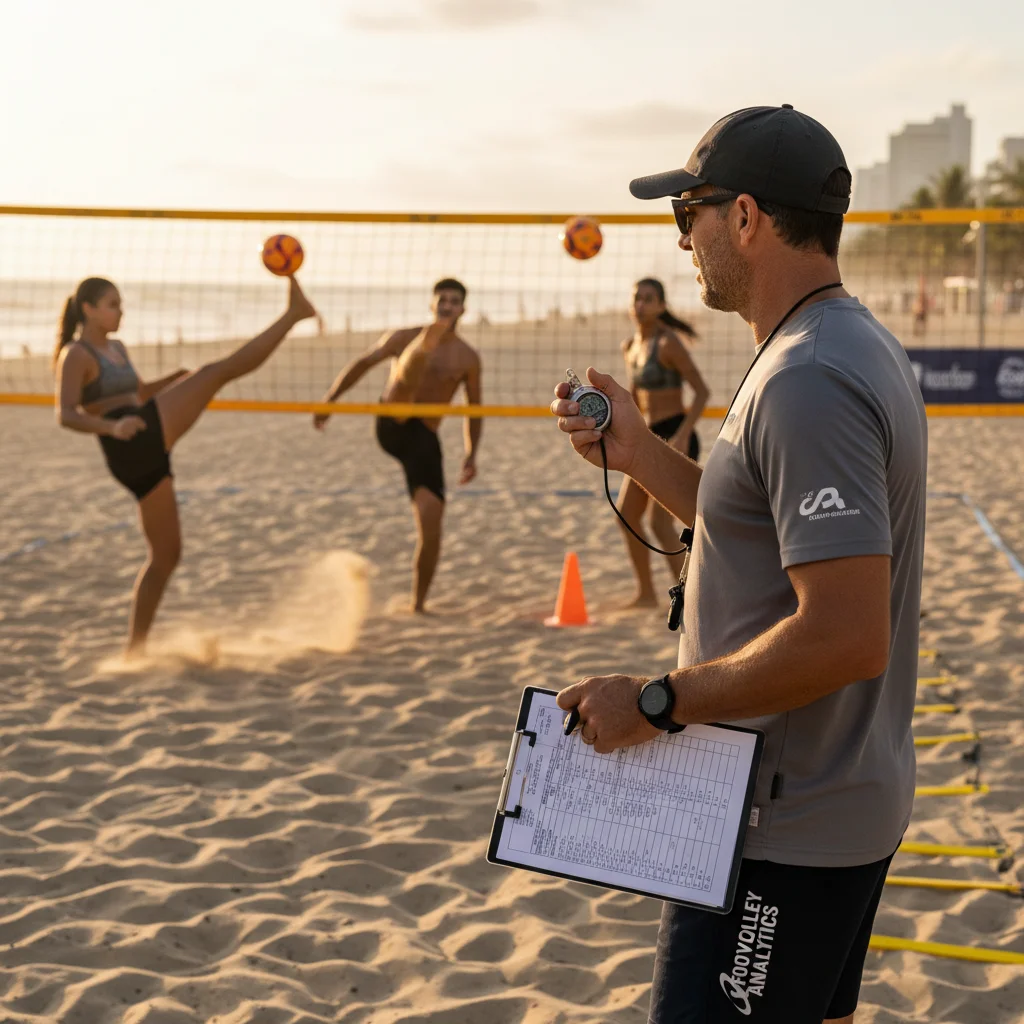
Weeks 5-6: Peak Performance and Tapering (Refinement and Readiness)
- Focus: Refine all aspects of play, reduce overall training volume while maintaining or slightly increasing intensity, and ensure players are fresh and ready for competition.
- Footvolley Drill Intensity: High to maximal for specific drills (RPE 7-9), but overall training volume is reduced. Emphasis on quality over quantity.
- Drill Examples: Highly specific game scenarios, competitive 2v2 games, focused power drills with full recovery, mental visualization. Minimal long, exhaustive sessions.
- Goal: Peak physical and mental readiness, sharpen tactical execution, prevent fatigue, and ensure optimal performance.
- Progression: Focus on precision, decision-making under simulated match pressure, and maintaining high quality in every action.
Integrating Recovery and Nutrition
An 18% performance gain in six weeks is ambitious and relies heavily on effective recovery and nutrition. Without these, even the most perfectly periodized footvolley drill intensity plan will fail.
- Active Recovery: Light activities like swimming, walking, or low-intensity technical drills on off days.
- Passive Recovery: Adequate sleep (7-9 hours), stretching, foam rolling, massage.
- Nutrition: A balanced diet rich in carbohydrates for energy, protein for muscle repair, and healthy fats for overall health. Hydration is paramount. Consider professional guidance for personalized nutrition plans.
- Monitoring: Continuously monitor RPE, sleep quality, mood, and muscle soreness. Adjust training intensity or volume if signs of overtraining appear.
Advanced Strategies for Optimizing Footvolley Drill Intensity
Beyond the basic periodization, several advanced strategies can further fine-tune your approach to footvolley drill intensity.
Small-Sided Games (SSGs)
Small-sided games are excellent tools for manipulating intensity. By changing the number of players, the size of the playing area, and the rules, coaches can precisely control the physical and cognitive demands. For instance, a 1v1 on a very small court will be extremely high intensity, focusing on quick reactions and explosive power, while a 3v3 on a slightly larger court might emphasize sustained rallies and tactical positioning.
SSGs naturally integrate technical, tactical, and physical components, making them highly effective for developing game-specific fitness. Coaches can use heart rate monitors or RPE to ensure the SSGs are hitting the desired intensity zones.
Complex Training and Contrast Training
- Complex Training: Involves pairing a strength exercise with a biomechanically similar plyometric exercise. For footvolley, this could be a heavy squat followed by box jumps, or a medicine ball throw followed by a bicycle kick attempt. The goal is to potentiate the nervous system, leading to greater power output in the plyometric movement. This directly enhances explosive actions critical in footvolley.
- Contrast Training: Similar to complex training but involves alternating between heavy resistance training and light, high-speed movements. For example, a set of heavy leg presses followed by rapid footwork drills or short sprints. This helps improve the rate of force development and speed.
These methods are advanced and should be introduced gradually, with proper form and supervision, to maximize benefits and minimize injury risk. They are highly effective for improving the maximal footvolley drill intensity capabilities.
Integrating Cognitive Load
Intensity isn’t just physical; it’s also cognitive. Footvolley demands rapid decision-making, spatial awareness, and anticipation. Drills that increase cognitive load alongside physical demands prepare players more effectively for match play.
- Random Practice: Instead of block practice (repeating the same skill), random practice intersperses different skills or tasks, forcing players to constantly adapt and make decisions. E.g., alternating between defensive saves, offensive setups, and partner serves within the same drill.
- Conditional Drills: Drills with specific ‘if-then’ scenarios. E.g., ‘if the ball goes left, player A attacks; if it goes right, player B attacks.’ This enhances reactive decision-making.
- Pressure Drills: Adding time limits, scoring systems, or consequences for mistakes (e.g., losing a point means extra push-ups) increases psychological intensity.
By increasing cognitive load, you enhance the overall footvolley drill intensity, preparing players to perform under the multi-faceted pressures of competition.
Common Pitfalls and How to Avoid Them
While optimizing footvolley drill intensity offers immense benefits, there are common mistakes to avoid:
- Overtraining: Pushing too hard, too often, without adequate recovery. Symptoms include chronic fatigue, decreased performance, increased injury risk, irritability, and poor sleep. Listen to your body and incorporate deload weeks or active recovery sessions.
- Undertraining: Not providing sufficient stimulus for adaptation. If drills are consistently too easy, progress will stagnate. Regularly assess if the intensity is appropriate for your goals.
- Lack of Specificity: Training intensely but in ways that don’t directly translate to footvolley. Ensure your high-intensity drills mimic game movements and scenarios.
- Ignoring Individual Differences: Not all players respond to intensity the same way. What’s high intensity for one might be moderate for another. Individualize training plans as much as possible.
- Poor Technique Under Fatigue: Pushing intensity to the point where technique breaks down. While training under fatigue is important, there’s a balance. Prioritize good form, especially in complex movements, even if it means slightly reducing intensity.
- Inconsistent Monitoring: Failing to regularly track RPE, heart rate, or other metrics means you’re flying blind. Consistent data collection is vital for making informed adjustments.
Conclusion: Maximizing Your Footvolley Potential
The journey to becoming a formidable footvolley player is paved with deliberate and intelligent training. The strategic manipulation of footvolley drill intensity is not merely an optional add-on; it is a fundamental pillar of effective performance enhancement. By understanding the physiological and psychological impacts of different intensity levels, employing objective and subjective measurement tools, and periodizing your training effectively, you can unlock significant gains.
Aiming for an 18% improvement in just six weeks is an ambitious but achievable goal when intensity is managed with precision. This requires a commitment to progressive overload, specific training, sufficient variation, and, critically, prioritized recovery. Remember that footvolley is a dynamic sport, and your training should reflect that dynamism. Integrate complex and contrast training, leverage small-sided games, and always challenge both the physical and cognitive aspects of your performance.
By consistently applying these principles, monitoring your progress, and making data-driven adjustments, you will not only elevate your game within the six-week timeframe but also establish a sustainable framework for continuous improvement. Embrace the challenge, train smarter, and watch your footvolley skills soar to unprecedented levels. The court awaits your enhanced performance!