The Profound Impact of New 2026 League Rule Changes on Offensive Efficiency: A 3-Month Analysis
The world of professional sports is in a constant state of evolution, driven by a myriad of factors ranging from advancements in athlete training to shifts in fan engagement. However, few elements introduce as much immediate and widespread disruption as significant league rule changes. The year 2026 ushered in a new era with a set of groundbreaking league rule changes designed to reshape the game, ostensibly to enhance player safety, improve game flow, and increase offensive output. Now, three months into the season, we have a substantial enough dataset to begin dissecting the initial impact of these adjustments on offensive efficiency across the league. This comprehensive analysis will delve into the specifics of these rule modifications, examine the immediate statistical shifts, explore how teams and players are adapting, and project the long-term implications for the sport.
Understanding the nuances of these league rule changes is paramount to appreciating their ripple effect. These aren’t minor tweaks; they represent a concerted effort to fundamentally alter the strategic landscape of the game. Our focus here is squarely on offensive efficiency, a critical metric that encapsulates a team’s ability to generate scoring opportunities and convert them into points. We will scrutinize various offensive indicators, including scoring averages, shooting percentages, possession lengths, turnover rates, and advanced metrics that provide deeper insights into player and team performance. The initial three months of any season following such significant alterations serve as a crucial testbed, revealing early trends and highlighting the challenges and opportunities presented by the new regulations.
Anúncios
Understanding the New 2026 League Rule Changes
Before we dive into the data, let’s briefly recap the core league rule changes implemented for the 2026 season. These changes were a culmination of extensive discussions among league officials, team owners, player associations, and analytics experts. The primary objectives were multifaceted: to increase the pace of play, reduce physical contact in specific areas, incentivize creative offensive schemes, and ultimately, to make the game more exciting and high-scoring for fans. Key modifications included:
- Reduced Shot Clock/Possession Time: A notable reduction in the time allotted for offensive possessions, aiming to create more urgency and limit stagnant play. This was a significant shift, forcing teams to execute quicker sets.
- New Contact Guidelines: Stricter enforcement or redefinition of what constitutes illegal contact, particularly off-ball and in transition. The goal was to open up driving lanes and facilitate more fluid offensive movement.
- Expansion of Offensive Zones: Minor adjustments to court or field dimensions, or new interpretations of existing zones, designed to create more space for offensive players and challenge traditional defensive alignments.
- Altered Foul Rules: Changes to how certain fouls are assessed, potentially leading to more free throws or fewer stoppages, depending on the specific implementation. For instance, some intentional fouls might now result in more severe penalties.
- Strategic Timeouts Review: A review and potential alteration of timeout rules, aimed at minimizing disruptions and maintaining game flow, which can indirectly affect offensive rhythm.
Each of these league rule changes carries specific implications for offensive strategies. A shorter shot clock, for example, demands more disciplined and efficient offensive sets. New contact guidelines could empower perimeter players to attack the basket more freely. Expanded offensive zones might encourage more spread offenses and three-point attempts. Understanding these foundational shifts is crucial for interpreting the statistical outcomes we’ve observed in the first quarter of the season.
Anúncios
Initial Statistical Shifts in Offensive Efficiency
The immediate aftermath of the league rule changes has been a fascinating period of adjustment, reflected clearly in the statistical landscape. Our 3-month analysis reveals several significant shifts in offensive efficiency metrics:
Scoring Averages: A Clear Uptick
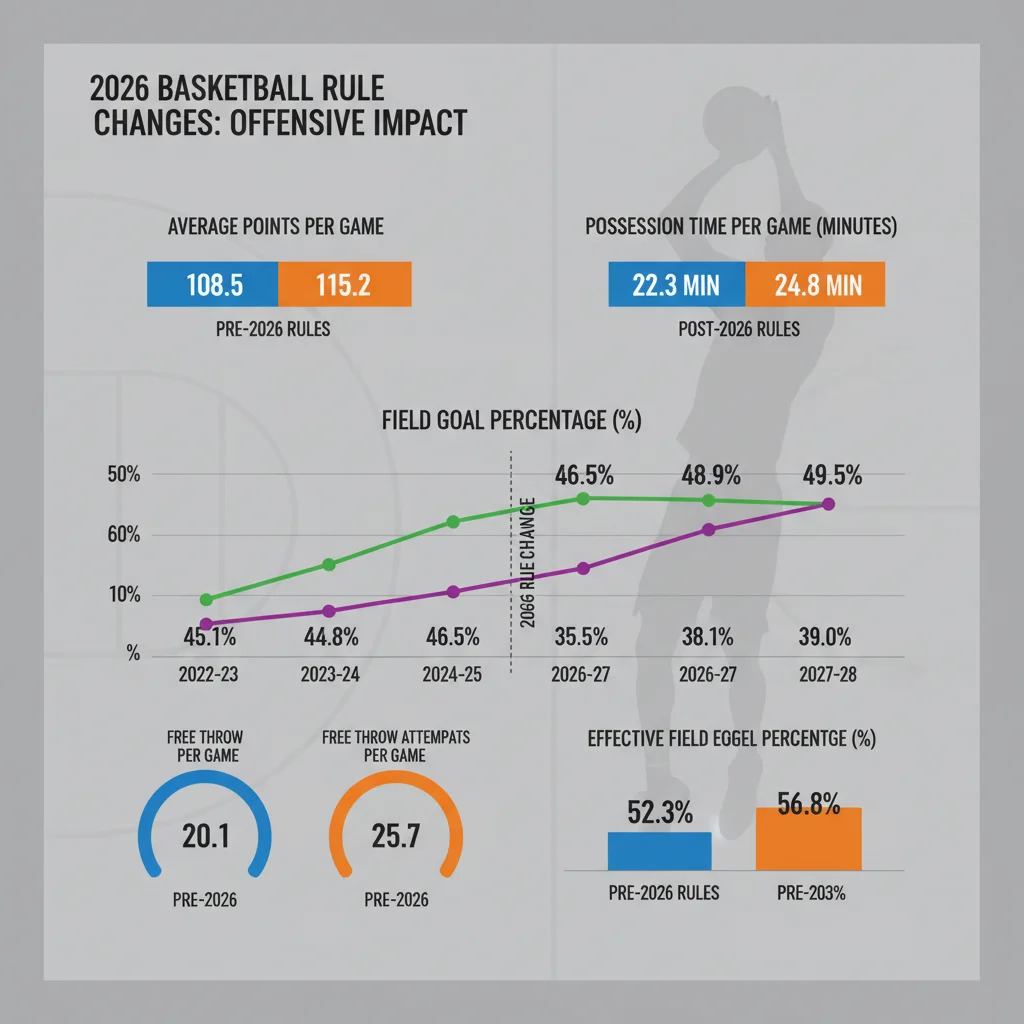
One of the most anticipated outcomes of the new rules was an increase in scoring, and the data largely supports this. The average points per game across the league has seen a noticeable rise, indicating that the rules are indeed fostering a more high-octane offensive environment. This increase isn’t uniform across all teams, however, suggesting varying degrees of adaptation and success in capitalizing on the new regulations.
Pace of Play: Faster, More Dynamic
The reduced shot clock has unequivocally accelerated the pace of play. Teams are initiating offensive possessions more quickly, and the average duration of a possession has decreased. This has led to more possessions per game, contributing directly to the higher scoring averages. The game feels more fluid and less prone to prolonged periods of stalled offense, which was a stated goal of the league rule changes.
Shooting Percentages: Mixed Results
While overall scoring is up, shooting percentages present a more nuanced picture. Field goal percentages have shown a slight decrease in some areas, potentially due to teams rushing shots under the shorter clock. However, three-point attempts and percentages have seen an increase, suggesting teams are adapting by prioritizing long-range shooting to compensate for less time inside the arc. The expanded offensive zones might be playing a role here, creating more open looks from beyond the perimeter. Free throw attempts have also seen an increase, likely a direct consequence of the stricter contact guidelines.
Turnover Rates: An Initial Spike
Unsurprisingly, the initial phase saw a slight increase in turnover rates. The faster pace and reduced possession time put immense pressure on offensive players, leading to more rushed passes, miscommunications, and violations. However, this trend appears to be stabilizing as teams become more accustomed to the new tempo. This initial spike is a classic example of the teething problems associated with significant league rule changes.
Team Adaptations and Strategic Adjustments
The most fascinating aspect of these league rule changes is observing how different teams and coaching staffs are adapting their strategies. The initial three months have been a period of intense experimentation and tactical evolution:
Embracing Small Ball and Spacing
Teams that already favored a ‘small ball’ approach, prioritizing speed, shooting, and floor spacing, seem to have had an easier time adjusting. The expanded offensive zones and stricter contact rules benefit quick, agile players who can create their own shots or drive to the basket. We’ve seen an increased emphasis on having multiple shooters on the floor and employing complex off-ball movement to exploit defensive gaps created by the new rules.
The Rise of the Versatile Big
Traditional, back-to-the-basket centers are facing new challenges with the reduced possession time. There’s a growing premium on ‘versatile bigs’ who can shoot from the perimeter, handle the ball in transition, and facilitate offense from the high post. Teams that possess such players are better equipped to maintain offensive flow under the new constraints imposed by the league rule changes.
Defensive Counter-Strategies
While our focus is on offense, it’s impossible to ignore the defensive adjustments. Teams are experimenting with different defensive schemes to counter the heightened offensive threat. Some are employing more aggressive full-court presses to disrupt offensive rhythm early in the shot clock, while others are focusing on tighter perimeter defense to limit three-point attempts. The cat-and-mouse game between offense and defense has intensified, creating a more dynamic and engaging viewing experience.
Coaching Philosophy Shifts
Coaches known for their rigid, methodical offensive systems are being forced to innovate. There’s a clear trend towards more free-flowing, improvisational offenses that empower players to make quick decisions. The emphasis has shifted from meticulously designed plays that take up valuable clock time to principles-based offenses that allow for creative responses to defensive pressure. This philosophical shift is a direct consequence of the league rule changes.
Player Performance and Individual Adaptations
Beyond team strategies, individual players are also undergoing significant adaptations to thrive under the new league rule changes. This period has been a crucible for talent, highlighting those who can evolve and those who struggle with the new demands.
Guards and Perimeter Players
Perimeter players, particularly those with strong ball-handling and shooting skills, are flourishing. The reduced contact rules allow them more freedom to penetrate defenses, and the shorter shot clock rewards quick decision-making. We’re seeing an increase in isolation plays where guards can exploit mismatches, and their ability to create shots off the dribble has become even more valuable. Players who can consistently hit contested three-pointers are also seeing their stock rise significantly.
Big Men and Interior Play
For traditional big men, the adjustments are more challenging. The emphasis on quick possessions means fewer opportunities for post-ups that consume significant clock time. Those who have adapted have either developed a reliable mid-range or three-point shot, improved their passing from the post, or become exceptional offensive rebounders who can generate second-chance opportunities. The versatility of big men to play both inside and out has become a crucial skill set in the era of new league rule changes.
Conditioning and Stamina
The increased pace of play demands superior conditioning. Players are covering more ground, expending more energy on both ends of the court, and engaging in more rapid offensive sequences. Teams with deeper benches and players who maintain peak physical condition throughout the game are demonstrating a distinct advantage. This highlights how far-reaching the impact of the league rule changes truly is, affecting even fundamental aspects like athlete preparation.
Mental Acuity and Decision-Making
With less time to operate, mental acuity and quick decision-making have become paramount. Players who can read defenses rapidly, make accurate passes under pressure, and choose the right shot within a compressed timeframe are excelling. The game has become a chess match played at warp speed, and only the most mentally sharp players are consistently performing at a high level.

Challenges and Potential Drawbacks
While the league rule changes have largely achieved their goal of increasing offensive output and pace, they are not without their challenges and potential drawbacks. The initial three months have brought some of these issues to light:
Increased Injury Risk?
The heightened pace of play, coupled with more physical contact in certain areas and quicker transitions, raises questions about potential increased injury risk. While the new contact rules aim to protect players, the overall intensity of the game has undoubtedly surged. Long-term health monitoring will be crucial to assess this aspect fully.
Decline in Fundamentals?
Some purists argue that the emphasis on speed and quick shots might lead to a decline in fundamental skills, such as post-play and intricate offensive sets. If teams are constantly rushing, there might be less focus on developing nuanced offensive techniques that require more time to execute. This is a philosophical debate that will likely continue as the league adapts to the league rule changes.
Consistency and Flow
The initial period saw some games characterized by a frantic, almost chaotic pace, leading to moments where offensive flow seemed to suffer despite the increased scoring. As teams continue to adapt, we expect to see more consistent and structured offensive execution within the faster tempo. However, the balance between speed and strategic play remains a delicate one under the new league rule changes.
Referee Adjustment Period
Referees also face a significant adjustment period. Interpreting and enforcing the new contact guidelines and foul rules consistently across all games is a monumental task. Inconsistent officiating can lead to frustration among players and coaches, and can impact game outcomes, further complicating the analysis of offensive efficiency. The league will need to continuously train and evaluate its officiating crew to ensure fairness and consistency in the application of the new league rule changes.
Long-Term Implications and Future Projections
Looking beyond the initial three months, the league rule changes of 2026 are poised to have profound long-term implications for the sport. The trajectory of offensive efficiency will likely continue to evolve as teams and players mature within the new framework.
Evolution of Player Archetypes
We can anticipate a further evolution in player archetypes. The premium on versatile, skilled players who can shoot, pass, and handle the ball from multiple positions will only increase. Specialized players, particularly those who are dominant in only one facet of the game, might find it harder to secure roles unless they adapt their skill sets to the faster, more spaced-out offensive environment created by the league rule changes.
Data-Driven Coaching
The importance of sports analytics and data-driven coaching will intensify. Teams that can quickly analyze performance under the new rules, identify successful strategies, and make real-time adjustments will gain a significant competitive advantage. The ability to leverage advanced metrics to understand offensive efficiency in minute detail will be crucial for sustained success.
Fan Engagement
From a fan engagement perspective, the increased scoring and faster pace are likely to be well-received. High-scoring games with more offensive action generally translate to more exciting viewing experiences. This was a clear objective of the league rule changes, and early indicators suggest it is being met, potentially drawing in new audiences and retaining existing ones.
Impact on Youth Development
The influence of these rules will eventually trickle down to youth development programs. Coaches at lower levels will begin to emphasize skills and strategies that align with the professional game’s new direction, fostering a new generation of players better equipped to thrive under the current league rule changes. This could lead to a more skilled and versatile player pool in the long run.
Conclusion
The first three months of the 2026 season have provided a compelling glimpse into the transformative power of significant league rule changes. Offensive efficiency has undoubtedly been impacted, with clear upticks in scoring and pace, albeit accompanied by initial challenges in turnover rates and consistency. Teams are in various stages of adaptation, with some embracing the new regulations more effectively than others, leading to a fascinating strategic arms race.
Players are also evolving, with an increased premium on versatility, quick decision-making, and exceptional conditioning. While the long-term effects will continue to unfold, it’s clear that the league has successfully initiated a new era of play. The game is faster, more dynamic, and arguably more exciting. As the season progresses, we will continue to monitor these trends, analyze further adaptations, and provide ongoing insights into how these monumental league rule changes are shaping the future of professional sports. The journey of adjustment is far from over, but the initial data points towards a thrilling new chapter for offensive prowess in the league.