Mastering Footvolley: Essential Conditioning Drills for Stamina and 3-Set Match Victory
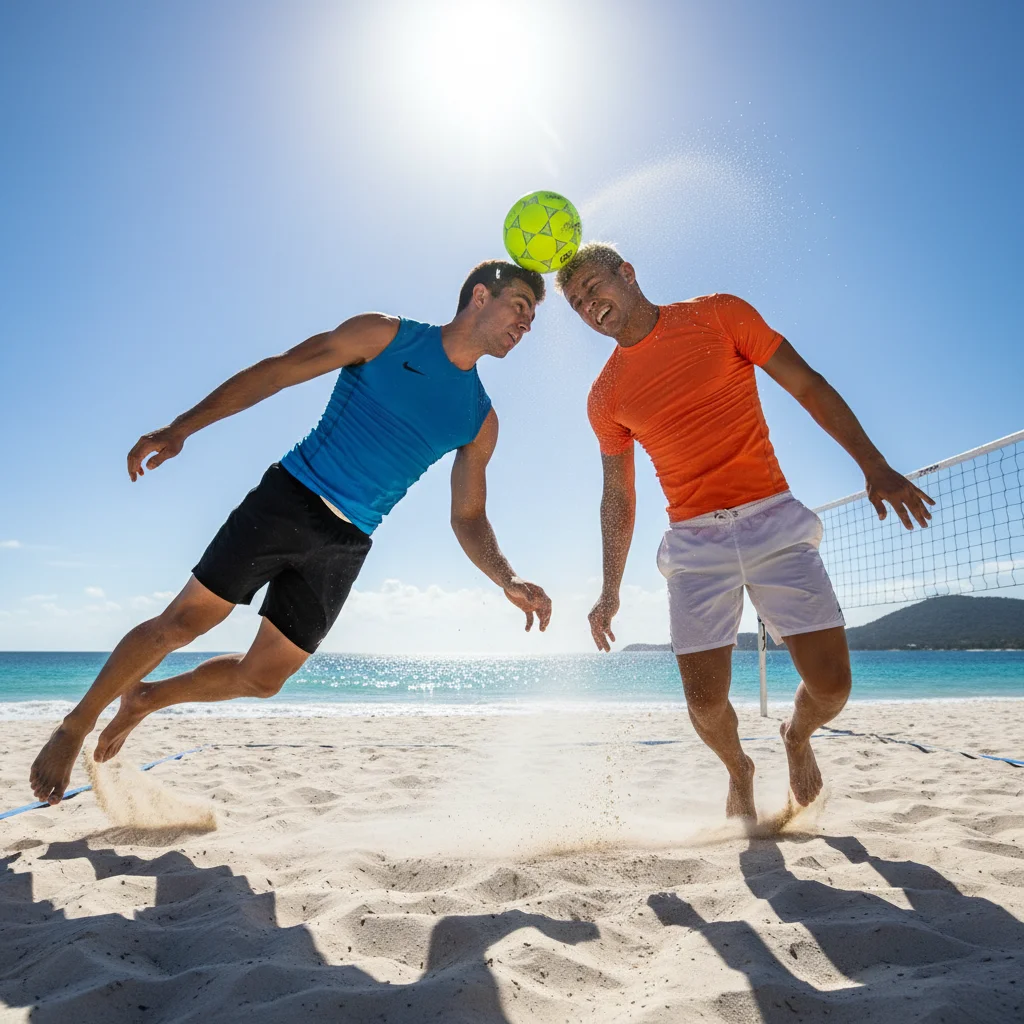
Footvolley, a captivating blend of football and volleyball, demands an extraordinary level of athleticism. The dynamic nature of the sport, characterized by explosive sprints, powerful jumps, intricate ball control, and sustained rallies, makes superior physical conditioning not just an advantage, but a necessity. As the current season progresses, players are increasingly finding themselves in grueling 3-set matches, where stamina, agility, and mental fortitude are tested to their limits. This comprehensive guide delves into the most effective footvolley conditioning drills designed to build unparalleled stamina, enhance agility, and prepare you to dominate every point, every set, and ultimately, every match.
The journey to becoming a footvolley champion isn’t solely about mastering technical skills; it’s equally about building a robust physical foundation that can withstand the rigors of competitive play. Imagine the final set, tied at 13-13, with the sun beating down and your muscles screaming. It’s in these moments that your conditioning truly shines, allowing you to execute that perfect bicycle kick or make that diving save. Without proper preparation, fatigue sets in, decision-making falters, and performance inevitably declines. Therefore, integrating targeted footvolley conditioning drills into your training regimen is paramount for sustained success.
Anúncios
Understanding the Demands of Footvolley: Why Conditioning Matters
Before diving into specific drills, it’s crucial to understand the physiological demands of footvolley. A typical match involves short bursts of high-intensity activity followed by brief recovery periods. This intermittent nature places significant stress on both anaerobic and aerobic energy systems. Players need explosive power for jumping, spiking, and quick directional changes, as well as endurance to maintain this intensity over multiple sets. Furthermore, playing on sand adds an extra layer of challenge, requiring more energy expenditure for every movement and greater stability from core and leg muscles.
- Anaerobic Power: Essential for explosive movements like jumping for a header, sprinting to retrieve a ball, or quick lateral shuffles. These actions rely on the body’s ability to produce energy without oxygen.
- Aerobic Endurance: Crucial for sustaining high-intensity efforts throughout a long match, preventing early fatigue, and ensuring quick recovery between rallies. This system uses oxygen to generate energy.
- Agility: The ability to change direction quickly and efficiently is vital for covering the court, reacting to opponents’ shots, and positioning for offensive plays.
- Balance and Stability: Playing on an uneven sand surface demands superior core strength and proprioception to maintain balance during dynamic movements.
- Muscular Endurance: The capacity of muscles to perform repeated contractions over an extended period, preventing muscle fatigue in the legs, core, and even neck (for headers).
Neglecting any of these components can lead to a significant drop in performance, especially in crucial 3-set matches where mental toughness is often tied to physical resilience. By focusing on comprehensive footvolley conditioning drills, you not only improve your physical capabilities but also build mental stamina, knowing your body is ready for anything the game throws at you.
Anúncios
Phase 1: Building Foundational Stamina and Aerobic Capacity
The first step in any effective conditioning program is to establish a solid aerobic base. This foundation will allow you to perform high-intensity drills more effectively and recover faster between points and sets. Think of it as the engine size of your footvolley machine – a bigger engine can run longer and harder.
1. Long-Duration Steady-State Cardio (LSD)
While footvolley is not a marathon, LSD training helps improve your cardiovascular efficiency. This means your heart and lungs become more effective at delivering oxygen to your working muscles, delaying fatigue.
- Activity: Jogging on sand, brisk walking in water, cycling, or swimming.
- Duration: 30-60 minutes.
- Frequency: 2-3 times per week.
- Intensity: Moderate, where you can hold a conversation but are slightly out of breath.
- Benefits: Improves cardiovascular health, increases capillary density in muscles, enhances fat-burning efficiency, and builds mental endurance.
Incorporating LSD into your weekly routine will significantly boost your overall stamina, making those extended rallies feel less taxing. It’s a fundamental aspect of any robust footvolley conditioning drills program.
2. Interval Training on Sand
Once you have a decent aerobic base, interval training on sand is excellent for mimicking the stop-and-go nature of footvolley. It trains both your aerobic and anaerobic systems.
- Drill: Sprint 30-60 seconds (high intensity), then walk/jog 60-90 seconds (active recovery).
- Duration: 20-30 minutes (excluding warm-up and cool-down).
- Frequency: 1-2 times per week.
- Repetitions: 8-12 cycles.
- Benefits: Improves V02 max, enhances lactate threshold, and significantly boosts stamina for repeated high-intensity efforts. This is a core component of effective footvolley conditioning drills.
The key here is the ‘on-sand’ component, as it directly translates to game-specific demands, strengthening the stabilizer muscles in your ankles and knees that are crucial for playing on soft surfaces.
Phase 2: Enhancing Agility, Speed, and Explosive Power
With a solid stamina base, the next step is to refine your ability to move quickly, change direction rapidly, and generate explosive power – all non-negotiable attributes for high-level footvolley.
3. Agility Ladder Drills on Sand
Agility ladders are fantastic for improving foot speed, coordination, and quick changes of direction. Performing these on sand amplifies the challenge and makes them highly specific to footvolley.
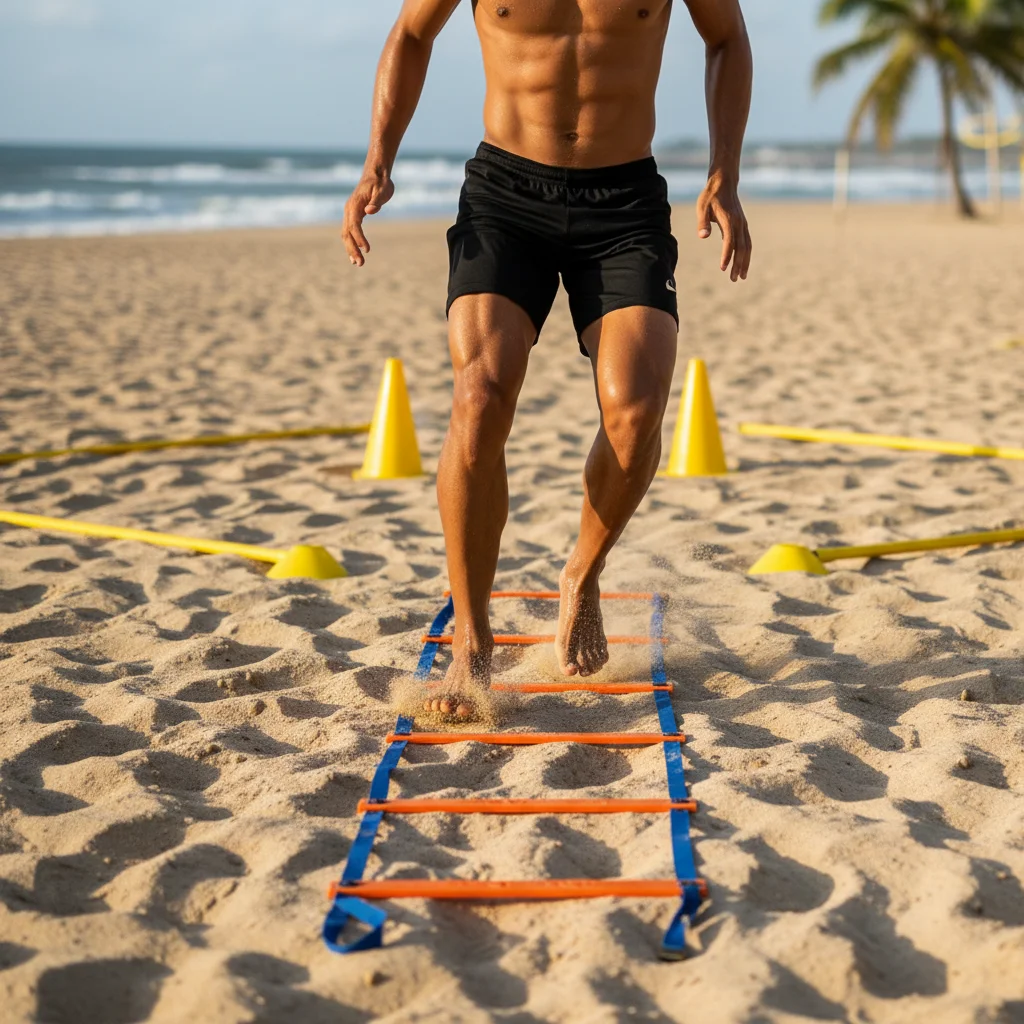
- Drills: In-and-outs, Icky Shuffle, lateral shuffles, hopscotch, etc.
- Duration: 15-20 minutes.
- Frequency: 2 times per week.
- Repetitions: 3-5 sets of each drill, with short rest between sets.
- Benefits: Improves quickness, coordination, balance, and the ability to react faster to the ball. These are fundamental footvolley conditioning drills for court coverage.
Focus on light, quick feet and maintaining a low center of gravity. The sand will naturally force you to engage your core and stabilizing muscles more intensely.
4. Cone Drills and Shuttle Runs
Cone drills are excellent for simulating game-like movements, such as sprinting, stopping, changing direction, and accelerating again. They directly translate to the reactive movements seen in footvolley.
- Drills: T-Drill, Pro Agility Shuttle (5-10-5), Box Drill.
- Setup: Use cones to mark out a specific pattern (e.g., a T-shape, a square).
- Duration: 15-20 minutes.
- Frequency: 2 times per week.
- Repetitions: 3-4 sets of each drill, focusing on maximal effort.
- Benefits: Enhances lateral speed, forward/backward acceleration, deceleration, and multi-directional agility. Essential footvolley conditioning drills for court coverage and defensive plays.
Vary the distances and patterns to keep your body adapting and to simulate different game scenarios. Always perform these drills with full intensity to maximize their effectiveness.
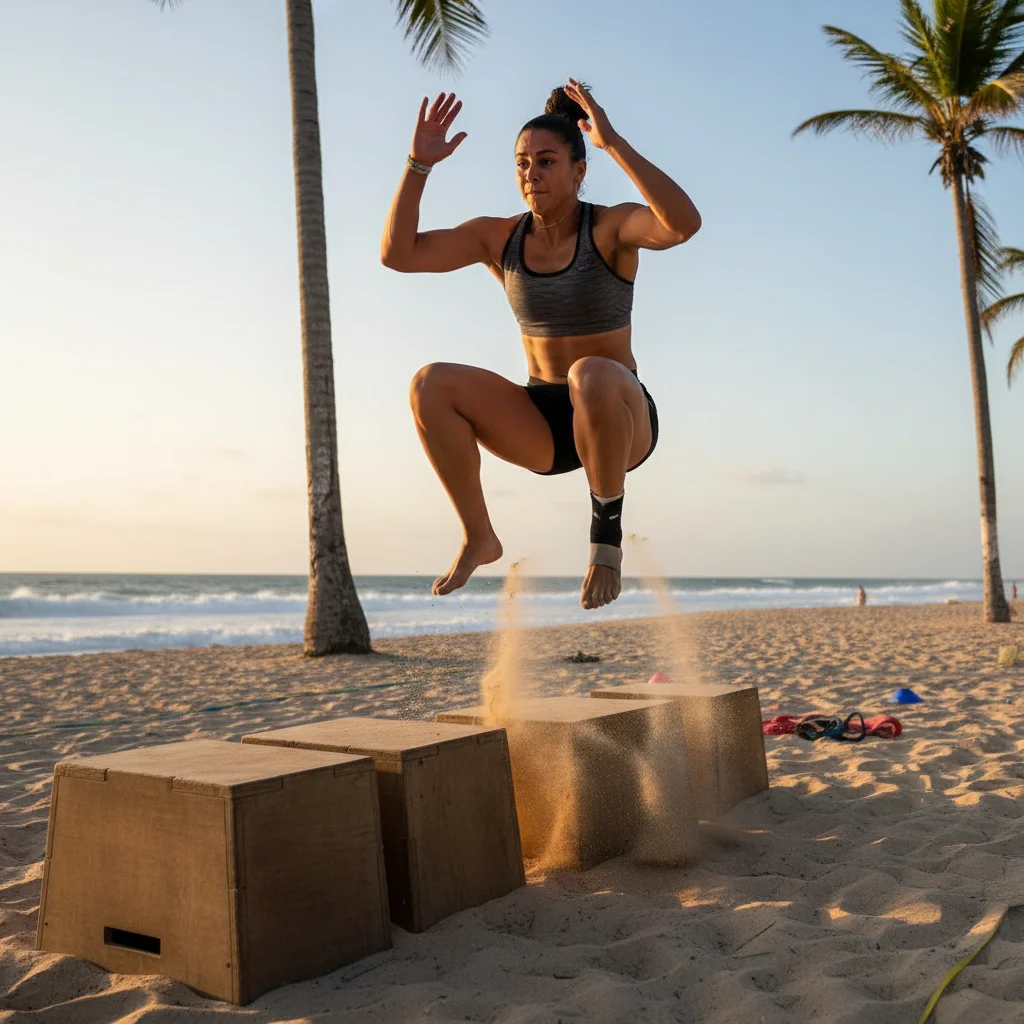
5. Plyometric Training (Jump Training)
Plyometrics are key for developing explosive power, which is critical for jumping high for headers, spikes, and blocks. The sand provides a softer landing, which can be easier on the joints, but also requires more power for takeoff.
- Drills: Box jumps (onto a stable surface next to the sand), broad jumps, single-leg hops, depth jumps, vertical jumps.
- Duration: 10-15 minutes (after a thorough warm-up).
- Frequency: 1-2 times per week (allow 48-72 hours recovery).
- Repetitions: 3-5 sets of 5-8 repetitions for each drill.
- Benefits: Increases vertical jump height, improves reaction time, and builds explosive power in the legs. These are high-impact footvolley conditioning drills for offensive play.
Start with lower intensity jumps and gradually progress. Proper landing technique (soft knees, absorbing impact) is crucial to prevent injury. Plyometrics are demanding, so ensure adequate rest.
Phase 3: Building Muscular Endurance and Core Strength
Strong muscles, particularly in the core and legs, are vital for maintaining power throughout a match, preventing injuries, and executing complex movements like bicycle kicks with precision.
6. Sand-Specific Strength Training
Training on sand itself acts as a resistance multiplier. Simple bodyweight exercises become much harder and more effective for building footvolley-specific strength and endurance.
- Drills:
- Sand Squats/Lunges: Perform traditional squats and lunges, but with the added instability of sand. Focus on deep range of motion. (3 sets of 10-15 reps)
- Calf Raises on Sand: Essential for explosive push-offs and ankle stability. (3 sets of 15-20 reps)
- Burpees on Sand: A full-body exercise that combines strength, cardio, and agility. (3 sets of 8-12 reps)
- Push-ups/Planks on Sand: Engages core and upper body, with sand adding an extra stability challenge. (3 sets to failure for push-ups, 3 sets of 30-60 sec hold for planks)
- Frequency: 2 times per week.
- Benefits: Builds functional strength directly applicable to playing on sand, improves muscular endurance, and reduces injury risk. These footvolley conditioning drills are crucial for sustained power.
These exercises not only strengthen the primary movers but also heavily engage the smaller stabilizing muscles, which are often neglected in traditional gym settings.
7. Core Strength and Stability
A strong core is the powerhouse of all athletic movements. It connects your upper and lower body, providing stability for powerful shots, agile movements, and protecting your spine.
- Drills:
- Plank Variations: Standard plank, side plank, plank with leg lifts. (3 sets of 30-60 sec holds)
- Russian Twists: With or without a medicine ball, focusing on oblique strength. (3 sets of 15-20 twists per side)
- Bicycle Crunches: Targets upper and lower abs, mimicking leg movements. (3 sets of 15-20 reps per side)
- Bird-Dog: Improves core stability and balance. (3 sets of 10-12 reps per side)
- Frequency: 3-4 times per week.
- Benefits: Improves power transfer, enhances balance and coordination, reduces back pain, and allows for more controlled, precise movements on the court. A strong core is integral to all footvolley conditioning drills.
Remember to engage your core throughout these exercises, drawing your navel towards your spine. Quality over quantity is key for core training.
Integrating and Periodizing Your Training Program
To maximize the effectiveness of these footvolley conditioning drills, it’s essential to integrate them into a structured training program that includes periodization. Periodization involves varying your training intensity and volume over time to optimize performance and prevent overtraining.
Sample Weekly Training Schedule:
- Monday: LSD Cardio (30-45 min) + Core Strength (15 min)
- Tuesday: Agility Ladder & Cone Drills (20 min) + Sand-Specific Strength (30 min)
- Wednesday: Rest or Active Recovery (light swim/stretch)
- Thursday: Interval Training on Sand (25 min) + Plyometrics (15 min) + Core Strength (15 min)
- Friday: Footvolley Skill Practice / Scrimmage (focused on game play, not just drills)
- Saturday: LSD Cardio (45-60 min) or another Footvolley Skill Practice
- Sunday: Full Rest
This is a sample, and should be adjusted based on your current fitness level, match schedule, and personal recovery needs. Always include a thorough warm-up before each session (dynamic stretches, light cardio) and a cool-down afterwards (static stretches, foam rolling).
Nutrition, Hydration, and Recovery: The Unsung Heroes of Conditioning
No amount of footvolley conditioning drills will be effective without proper attention to nutrition, hydration, and recovery. These elements are the bedrock upon which your physical performance is built.
Nutrition for Peak Performance
- Carbohydrates: Your primary fuel source. Prioritize complex carbs like whole grains, fruits, and vegetables to sustain energy levels.
- Protein: Essential for muscle repair and growth. Include lean meats, fish, eggs, legumes, and dairy in your diet.
- Healthy Fats: Important for hormone production and overall health. Avocados, nuts, seeds, and olive oil are great sources.
- Micronutrients: Ensure a wide variety of fruits and vegetables to get all necessary vitamins and minerals for optimal bodily function.
Timing your meals around your training sessions is also crucial. A pre-workout snack (e.g., banana) and a post-workout meal rich in protein and carbs (e.g., chicken and rice) will aid recovery and replenish energy stores.
Hydration is Non-Negotiable
Playing footvolley on sand, often under the sun, leads to significant fluid loss. Dehydration can severely impair performance, leading to fatigue, reduced coordination, and increased risk of heat-related illness.
- Drink water consistently throughout the day, not just during training.
- Electrolyte drinks can be beneficial during and after intense, prolonged sessions.
- Monitor urine color – aim for a pale yellow.
Prioritizing Recovery
Recovery is where your body adapts and gets stronger. Neglecting it is a surefire way to plateau or even regress in your training.
- Sleep: Aim for 7-9 hours of quality sleep per night. This is when most muscle repair and hormonal regulation occurs.
- Active Recovery: Light activities like walking, swimming, or gentle stretching on rest days can improve blood flow and reduce muscle soreness.
- Stretching and Foam Rolling: Improves flexibility, range of motion, and helps release muscle knots.
- Massage: Can aid in muscle recovery and reduce stiffness.
Listening to your body is crucial. If you feel overly fatigued or experience persistent soreness, take an extra rest day or reduce your training intensity. Pushing through excessive fatigue can lead to injury and burnout.
Mental Toughness: The Final Piece of the Puzzle
While physical conditioning is paramount, mental toughness is what often separates good players from great ones, especially in those decisive 3-set matches. Your footvolley conditioning drills not only build physical resilience but also contribute to mental fortitude.
- Visualization: Mentally rehearse successful plays and strategies.
- Goal Setting: Set clear, achievable short-term and long-term goals.
- Positive Self-Talk: Challenge negative thoughts and replace them with empowering affirmations.
- Focus and Concentration: Practice staying present in the moment, point by point.
- Resilience: Learn to bounce back from mistakes and tough points without letting them affect your next play.
The discipline required to consistently perform demanding footvolley conditioning drills directly translates to mental strength on the court. When your body is prepared, your mind is free to focus on strategy and execution, rather than battling fatigue.
Conclusion: Dominate the Sand with Superior Conditioning
Excelling in footvolley, particularly in the current season’s demanding 3-set matches, requires a holistic approach that goes beyond mere technical skill. It demands a robust physical foundation built upon targeted footvolley conditioning drills. By systematically developing your stamina, agility, speed, explosive power, and core strength, you will not only enhance your performance but also significantly reduce your risk of injury.
Remember that consistency is key. Integrating these drills into a well-structured, periodized training program, coupled with diligent attention to nutrition, hydration, and recovery, will unlock your full potential on the sand. Embrace the challenge, commit to your conditioning, and watch as you transform into a more resilient, dynamic, and dominant footvolley player, ready to conquer every rally and secure victory in the most intense of matches. The sand is your arena, and with the right conditioning, you’re poised to rule it.