Master Footvolley Agility: 6 Drills to Boost Reaction Time by 0.5 Seconds in 2 Months
In the exhilarating world of footvolley, where every millisecond counts, superior agility and lightning-fast reaction times are not just advantages—they are necessities. Whether you’re a seasoned pro or an enthusiastic beginner, enhancing your ability to anticipate, move, and react can dramatically elevate your game. Imagine shaving a crucial half-second off your reaction time; that’s the difference between a point scored and a point lost, a spectacular save and a missed opportunity. This comprehensive guide delves into footvolley agility drills specifically designed to help you achieve just that. Over the next two months, by diligently incorporating these six targeted exercises into your training regimen, you can expect to see a remarkable improvement in your on-court responsiveness, making you a more formidable and effective player.
Footvolley, a captivating blend of soccer and volleyball played on sand, demands a unique combination of athleticism: explosive power, precise ball control, exceptional spatial awareness, and, critically, unparalleled agility. The soft, shifting surface of the sand court adds another layer of challenge, requiring even greater strength and stability from your lower body. Without sharp reflexes and the ability to change direction instantly, even the most skilled player can be caught flat-footed. This article will break down why agility is so vital in footvolley, introduce you to the science behind improving reaction time, and then present six actionable, progressive drills that promise tangible results. Get ready to transform your game and leave your opponents wondering how you got to that ball so fast!
Anúncios
The Science Behind Reaction Time and Agility in Footvolley
Before diving into the drills, it’s crucial to understand the physiological and neurological underpinnings of reaction time and agility. Reaction time isn’t just about moving fast; it’s about processing information, making a decision, and executing a movement—all in a fraction of a second. In footvolley, this involves visually tracking the ball, anticipating your opponent’s next move, deciding on your response (e.g., block, pass, attack), and then initiating the correct motor pattern.
Components of Reaction Time:
- Perception: The ability to accurately see and interpret visual cues (e.g., ball trajectory, opponent’s body language).
- Cognition: The brain’s processing of these cues, decision-making, and planning of the motor response.
- Motor Response: The physical execution of the chosen action, involving neural pathways activating muscles.
Agility, on the other hand, is the ability to rapidly change direction or speed without losing balance or control. It’s a complex skill that integrates speed, coordination, balance, and proprioception (your body’s awareness in space). On sand, agility is even more demanding, as the unstable surface requires greater muscle activation and stabilization, particularly in the ankles, knees, and hips.
Anúncios
Why Agility Matters in Footvolley:
- Defensive Coverage: Quickly moving to cover open court space, blocking shots, or retrieving challenging balls.
- Offensive Positioning: Rapidly adjusting your position to receive a pass, set up for an attack, or create space for a spike.
- Anticipation: Combining perception and quick movement to intercept passes or block shots before they become threats.
- Injury Prevention: Stronger, more agile muscles and joints are better equipped to handle the sudden stresses of quick changes in direction, reducing the risk of sprains and strains.
Our goal is to train all these components. By focusing on specific footvolley agility drills, we aim to enhance the efficiency of your neural pathways, strengthen the stabilizing muscles, and improve your overall movement economy on the sand.
Setting Up Your 2-Month Training Plan
Consistency is key. To achieve a 0.5-second reduction in reaction time, a structured and consistent approach is non-negotiable. We recommend integrating these drills into your regular training schedule 2-3 times per week, allowing for adequate rest and recovery. Remember to always warm up thoroughly before starting any agility drills and cool down afterwards.
General Guidelines:
- Warm-up (10-15 minutes): Light cardio (jogging on sand), dynamic stretches (leg swings, arm circles, torso twists), and movement prep (grapevine, high knees, butt kicks).
- Drill Execution: Focus on quality over quantity. Perform each drill with maximum effort and proper form.
- Rest: Allow sufficient rest between sets and drills to ensure you can maintain intensity. For agility, short, intense bursts followed by rest are more effective than prolonged, moderate activity.
- Cool-down (5-10 minutes): Static stretches, holding each stretch for 20-30 seconds.
- Progression: Start with basic versions and gradually increase speed, complexity, and resistance as you improve.
- Listen to Your Body: If you feel pain, stop. Modify drills as needed.
Now, let’s explore the six powerful footvolley agility drills that will transform your game.
The 6 Essential Footvolley Agility Drills
Drill 1: Cone Shuffle Sprints
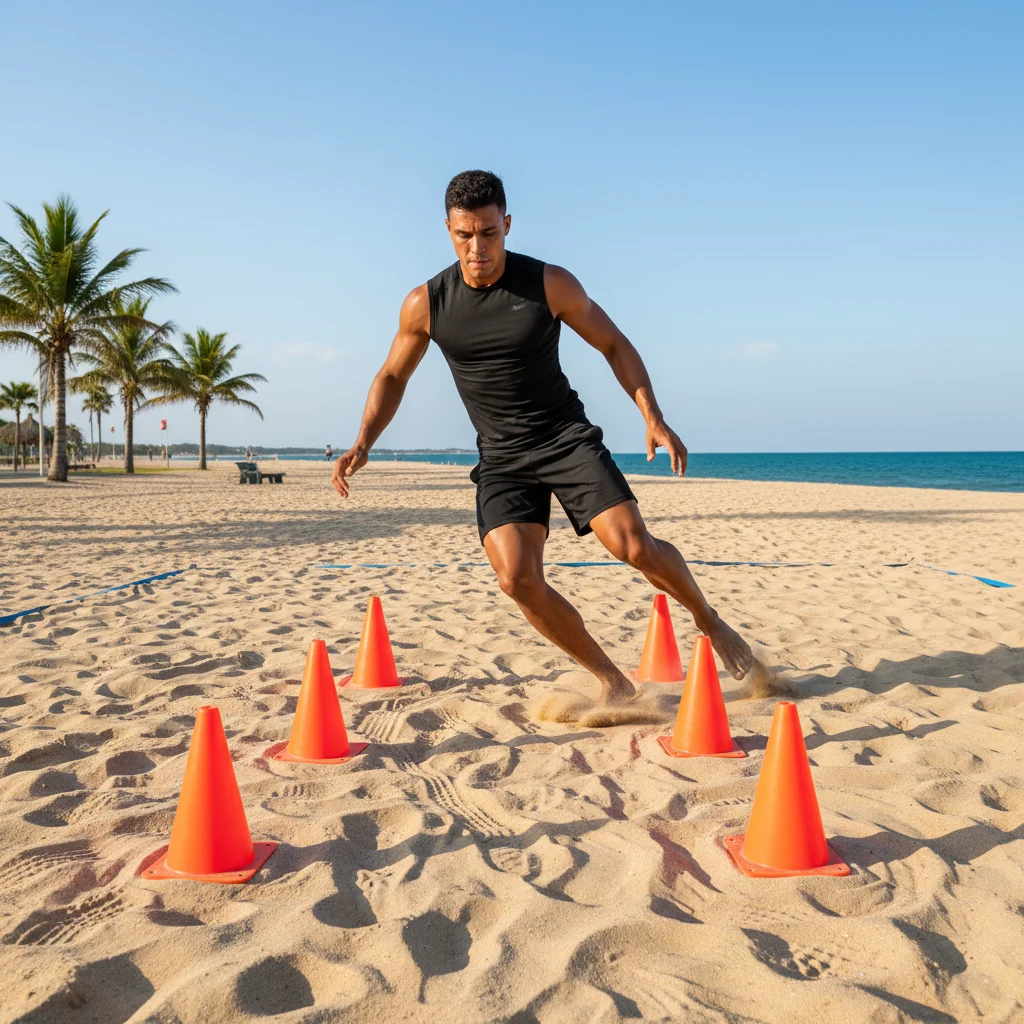
This drill focuses on lateral movement, quick changes of direction, and explosive acceleration—all critical for covering the court in footvolley. It simulates the rapid side-to-side movements required to defend or attack.
Setup: Place 3-5 cones in a straight line, approximately 3-5 meters apart on the sand. The distance can be adjusted based on your fitness level and court size.
Execution:
- Start at one end cone.
- Shuffle sideways to the next cone, touching the ground beside it with your hand.
- Immediately shuffle back to the previous cone, touching the ground.
- Continue this pattern down the line of cones and back.
- Focus on keeping your hips low, chest up, and maintaining quick, controlled footwork.
- Explode off the outside leg to change direction rapidly.
Sets & Reps: 3-4 sets of 2-3 full passes (down and back), with 60-90 seconds rest between sets.
Progression: Increase the distance between cones, add a sprint at the end of each pass, or incorporate a partner throwing a ball for a touch at each cone.
Drill 2: T-Drill with Ball Touch
The T-Drill is a classic agility test that combines forward, lateral, and backward movements, simulating the multi-directional demands of footvolley. Adding a ball touch enhances reaction time and ball control.
Setup: Place four cones in a ‘T’ shape. Cone A is the starting cone. Cones B and C are 5 meters from Cone A, forming the crossbar of the T. Cone D is 10 meters directly in front of Cone A.
Execution:
- Start at Cone A.
- Sprint forward to Cone D.
- At Cone D, shuffle laterally to Cone B, touching the ground beside it.
- Shuffle laterally across to Cone C, touching the ground beside it.
- Shuffle back to Cone D, touching the ground.
- Backpedal or sprint backward to Cone A.
- For the ‘ball touch’ variation: Have a partner toss a soft footvolley ball to you at each cone (B, C, D) for a controlled touch before moving to the next segment.
Sets & Reps: 3-4 sets, performing the full T-drill once per set, with 90-120 seconds rest between sets.
Progression: Increase the speed of execution, reduce rest time, or vary the type of ball touch required (e.g., knee, chest, head).
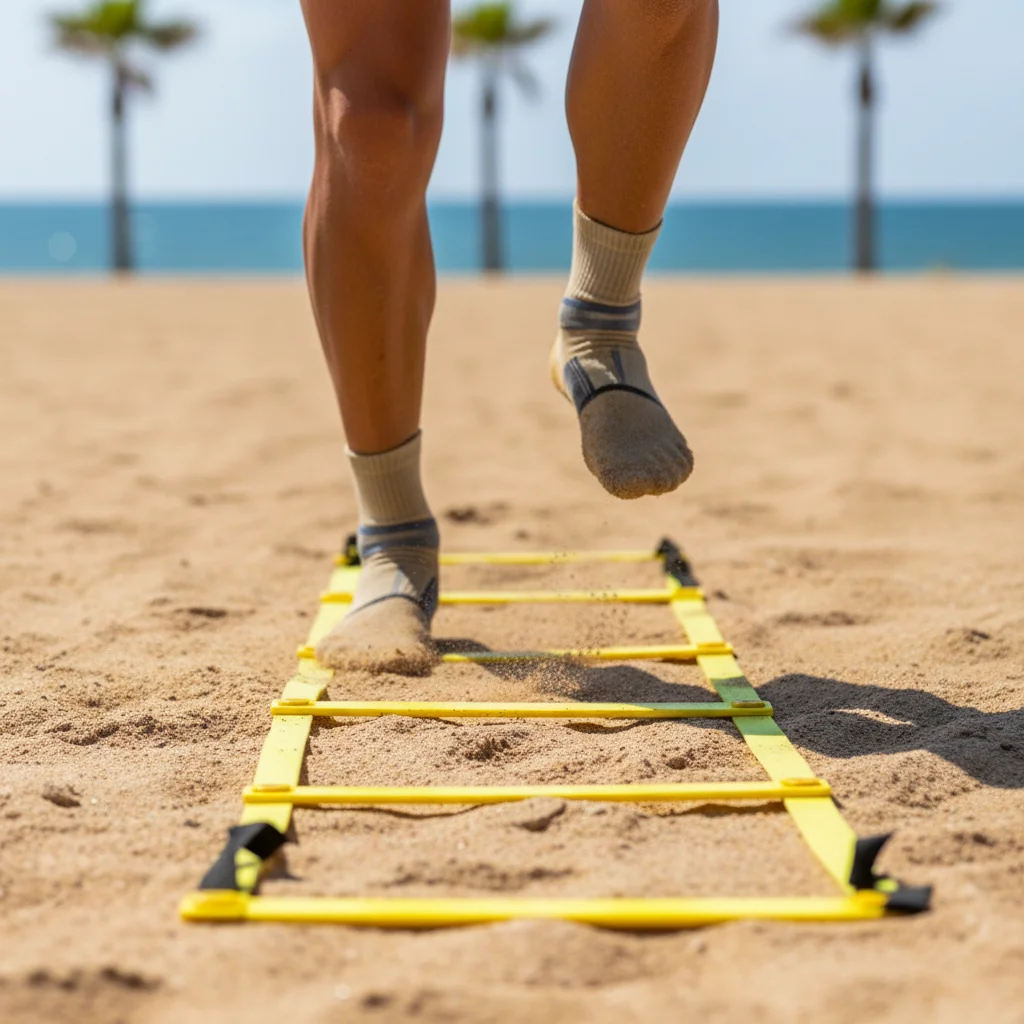
Drill 3: Agility Ladder Footwork on Sand
While often used on hard surfaces, an agility ladder can be surprisingly effective on sand. It forces precise foot placement and rapid foot turnover, improving coordination and quickness. You can use a physical ladder or mark out squares in the sand.
Setup: Lay an agility ladder (or mark out 10-15 squares) on a flat section of sand.
Execution (Examples):
- Two-Feet In: Run through the ladder, placing both feet in each square. Focus on high knees and quick steps.
- Icky Shuffle: Step right foot in, left foot in, right foot out, left foot out (alternating sides for each square).
- Lateral Shuffle: Face sideways, step into each square laterally with quick, small steps.
- Single Leg Hops: Hop through the ladder on one leg, then switch.
Sets & Reps: Perform 3-5 different ladder patterns, 2-3 times each, with 30-45 seconds rest between repetitions. Focus on speed and precision.
Progression: Increase the speed, combine different patterns, or add a ball touch or jump at the end of the ladder.
Drill 4: Reactive Shuttle Run
This drill specifically targets reaction time by introducing an unpredictable element. It’s excellent for simulating game-like situations where you must respond to an external cue.
Setup: Place two cones 10-15 meters apart. You’ll need a partner or a pre-recorded audio cue.
Execution:
- Start at one cone, facing your partner (or facing away from the audio source if using cues).
- Your partner will call out a direction (e.g., “right,” “left,” “forward,” “back”) or a color if you have colored cones.
- Upon hearing the cue, react as quickly as possible, sprinting to the designated cone or direction.
- If using a single shuttle: Sprint to the opposite cone and back after the cue.
- If using multiple cones: Have cones in various directions and react to the specific call.
Sets & Reps: 3-4 sets of 6-8 reactive sprints, with 60-90 seconds rest between sets. The partner should vary the cues unpredictably.
Progression: Increase the distance between cones, add a ball control element after reaching the cone, or use visual cues (e.g., partner pointing) instead of verbal cues.
Drill 5: Box Jump and Lateral Shuffle
This drill combines explosive power (vertical jump) with lateral agility, mimicking the movements needed for jumping blocks or spikes followed by quick court coverage.
Setup: You’ll need a stable, appropriately sized plyometric box or a raised platform that is safe to jump on and off on the sand. Place two cones 3-5 meters to either side of the box.
Execution:
- Stand facing the box.
- Perform an explosive box jump, landing softly on the box.
- Immediately jump down from the box (either forward or backward, depending on preference and safety).
- Upon landing on the sand, immediately shuffle laterally to one of the cones, touching the ground.
- Shuffle back to the center (where you landed from the box) and then shuffle to the other cone, touching the ground.
- Repeat the entire sequence.
Sets & Reps: 3-4 sets of 4-6 repetitions (one repetition is a jump and shuffle to both cones), with 90-120 seconds rest between sets.
Progression: Increase the height of the box, increase the distance of the lateral shuffles, or add a controlled ball pass after the final shuffle.
Drill 6: Mirror Drill with Ball Simulation
The mirror drill is a fantastic way to improve reactive agility, spatial awareness, and anticipation. Adding a ball simulation element makes it highly specific to footvolley.
Setup: This drill requires a partner. Designate one person as the ‘leader’ and the other as the ‘mirror.’ Mark out a small square or rectangle on the sand (e.g., 5×5 meters).
Execution:
- Both players start facing each other within the designated area, about 1-2 meters apart.
- The leader performs various footvolley-specific movements: shuffles, sprints, backpedals, quick stops, and even simulated jumps or kicks.
- The mirror player’s goal is to perfectly mimic the leader’s movements as quickly and accurately as possible, maintaining the distance.
- Ball Simulation: Occasionally, the leader will mimic a pass or spike. The mirror player must react as if receiving or blocking the ball (e.g., quick defensive stance, head touch, chest pass simulation).
Sets & Reps: 3-5 sets, with each set lasting 60-90 seconds. Switch roles after each set. Rest for 60 seconds between sets.
Progression: Increase the intensity and speed of movements, introduce more complex footvolley-specific actions, or reduce the size of the designated area to demand even quicker reactions.
Integrating Drills for Maximum Impact
To truly reduce your reaction time by 0.5 seconds in two months, these footvolley agility drills must be part of a holistic training approach. This means:
- Strength Training: Focus on lower body power (squats, lunges, calf raises, plyometrics) and core strength. Stronger muscles mean more explosive movements and better stability on sand.
- Cardiovascular Fitness: High-intensity interval training (HIIT) on sand can improve your ability to sustain repeated bursts of effort.
- Footvolley Specific Practice: Apply your improved agility directly to game situations. Practice defensive slides, offensive transitions, and quick ball recoveries during drills and scrimmages.
- Nutrition and Recovery: Fuel your body with a balanced diet and ensure adequate sleep. Recovery is when your body adapts and gets stronger.
- Mental Toughness: Agility isn’t just physical; it’s also about focus and anticipation. Practice visualizing plays and staying mentally engaged throughout your training and games.
Track your progress! While measuring a 0.5-second improvement precisely might require specialized equipment, you can gauge your progress through subjective observations (do you feel quicker?), objective measures (can you cover more court?), and, most importantly, your performance in actual footvolley games. You’ll notice yourself getting to balls you previously couldn’t, reacting faster to opponent’s moves, and feeling more confident and in control on the sand.
Conclusion: Unlock Your Full Footvolley Potential
The journey to becoming a more agile and reactive footvolley player is a challenging yet incredibly rewarding one. By committing to these six targeted footvolley agility drills over the next two months, you are not just performing exercises; you are fundamentally rewiring your body and mind for peak performance on the sand. The ability to react instinctively, change direction explosively, and maintain balance under pressure will not only shave crucial milliseconds off your reaction time but will also elevate your entire game.
Remember, consistency, proper form, and a progressive approach are your best allies. Embrace the challenge, push your limits safely, and celebrate every small improvement. Soon, you’ll be experiencing the thrill of making those incredible, game-changing plays that only truly agile players can achieve. Step onto the court with newfound confidence, knowing that you’ve put in the work to become faster, sharper, and more dominant. Your opponents won’t know what hit them!
Start today, and in two months, you’ll be a different player. The sand is waiting for your enhanced agility!