Master Footvolley: Sharpen Your Reflexes by 30% with Dynamic Reaction Drills
Footvolley, a captivating blend of soccer and volleyball, demands not only exceptional athletic prowess but also lightning-fast reflexes and split-second decision-making. In a sport where the ball can travel at incredible speeds and trajectories, a fraction of a second can mean the difference between a spectacular save and a lost point. This is why mastering footvolley reaction drills is not just an advantage, but a necessity for anyone serious about elevating their game. Imagine being able to anticipate your opponent’s moves with uncanny accuracy, reacting to spikes and serves with newfound speed and precision. This article will guide you through a comprehensive set of footvolley reaction drills designed to sharpen your reflexes by an impressive 30%, leading to faster plays, improved court coverage, and ultimately, more victories on the sand.
The dynamic nature of footvolley means players are constantly adjusting to unpredictable ball movements, varying spin, and the challenging sandy terrain. Traditional training often focuses on technical skills like passing, setting, and spiking, but neglects the fundamental element of reaction time. Without superior reflexes, even the most technically gifted player will struggle to keep up with the pace of a high-level game. Our focus here is to bridge that gap, providing you with targeted footvolley reaction drills that specifically address the unique demands of this exhilarating sport. By consistently incorporating these drills into your regimen, you’ll develop a heightened sense of spatial awareness, quicker muscular responses, and an almost intuitive understanding of the game’s flow. Get ready to transform your game and leave your opponents wondering how you always seem to be one step ahead.
Anúncios
Understanding the Science Behind Reaction Time in Footvolley
Before diving into specific footvolley reaction drills, it’s crucial to understand what reaction time entails and how it impacts your performance. Reaction time is essentially the elapsed time between the presentation of a sensory stimulus and the subsequent behavioral response. In footvolley, this involves a complex interplay of visual perception, cognitive processing, and motor execution. When an opponent serves, your eyes detect the ball’s trajectory, your brain processes this information, anticipates its landing spot, and then sends signals to your muscles to move your body into position for a return.
Several factors influence reaction time, including age, fitness level, attention, and practice. While some aspects are inherent, a significant portion of reaction time can be improved through dedicated training. For footvolley players, this means not just physical conditioning, but also cognitive training that enhances anticipation and decision-making under pressure. The faster your brain can process information and send commands to your muscles, the quicker your response will be. This is where specialized footvolley reaction drills come into play, targeting these specific neurological pathways to create a more efficient and rapid response system. Improving your reaction time isn’t just about moving faster; it’s about seeing more, understanding faster, and acting decisively. This holistic approach is what will truly set you apart on the footvolley court.
Anúncios
Visual Acuity and Tracking: The First Line of Defense
The ability to accurately track the ball from the moment it leaves an opponent’s foot is paramount. Poor visual acuity or tracking can lead to misjudgments, delayed reactions, and ultimately, missed plays. Many footvolley reaction drills incorporate visual stimulation to enhance this critical skill. This isn’t just about having 20/20 vision; it’s about dynamic visual acuity – the ability to see clearly while objects (and you) are in motion. Training your eyes to quickly adjust focus, track fast-moving objects, and perceive subtle spins on the ball can give you precious milliseconds of extra time to react. Consider drills that involve tracking multiple objects or objects with unpredictable movement patterns. This trains your brain to process visual information more efficiently, a cornerstone of effective footvolley reaction drills.
Anticipation and Pattern Recognition: Playing Chess on the Sand
True mastery in footvolley isn’t just about reacting to what’s happening; it’s about anticipating what’s going to happen. Experienced players often seem to be everywhere at once, not because they’re physically faster, but because they’ve developed a superior ability to read the game. This involves recognizing patterns in opponent’s serves, attacks, and defensive setups. By understanding common tendencies and player habits, you can often predict where the ball is going before it even leaves their foot. Incorporating anticipation-focused footvolley reaction drills helps train your brain to quickly identify these patterns, allowing you to move into position proactively rather than reactively. This predictive ability significantly reduces your effective reaction time, giving you a considerable advantage.
Key Components of Effective Footvolley Reaction Drills
To design truly effective footvolley reaction drills, we need to break down the complex act of reacting into its core components. Each drill should ideally target one or more of these elements, gradually increasing in complexity and intensity. The goal is to simulate game-like situations as closely as possible, ensuring that the improvements you make in training translate directly to your performance on the court.
1. Speed and Agility: The Foundation of Quick Movement
Before you can react quickly, you need to be able to move quickly. Speed and agility are the physical bedrock upon which all other reaction skills are built. Drills focusing on lateral movement, quick changes of direction, and explosive bursts are essential. These aren’t just about running fast in a straight line; they’re about accelerating, decelerating, and changing direction efficiently on the challenging sandy surface. Incorporate ladder drills, cone drills, and shuttle runs into your routine. These physical conditioning exercises, while not directly involving the ball, lay the groundwork for your body to respond rapidly when performing specific footvolley reaction drills later on.
2. Hand-Eye/Foot-Eye Coordination: Precision in Motion
While footvolley primarily uses the feet, head, and chest, the term ‘hand-eye coordination’ broadly applies to the ability to coordinate visual input with body movement. For footvolley, it’s more accurately ‘foot-eye coordination’ and ‘head-eye coordination’. This involves precisely timing your body’s contact with the ball based on its speed and trajectory. Drills that require precise touches, volleys, and headers from various angles and speeds are crucial. Think about juggling drills where the ball’s height and spin are varied, or drills where a partner throws the ball to unpredictable locations, forcing you to adjust your body and make accurate contact. These are fundamental footvolley reaction drills for developing touch and control under pressure.
3. Auditory and Visual Cues: Training Your Senses
In a fast-paced game, players don’t just rely on seeing the ball. They also pick up on auditory cues (like the sound of an opponent’s foot striking the ball) and visual cues from an opponent’s body language (shoulder orientation, hip rotation). Incorporating drills that require responses to non-ball stimuli can significantly enhance overall reaction time. For example, a partner might call out a direction or a color, and you have to react by moving to a specific cone or performing a specific action. This forces your brain to process information from multiple sensory inputs, a key aspect of advanced footvolley reaction drills.
Top 5 Footvolley Reaction Drills to Sharpen Your Reflexes
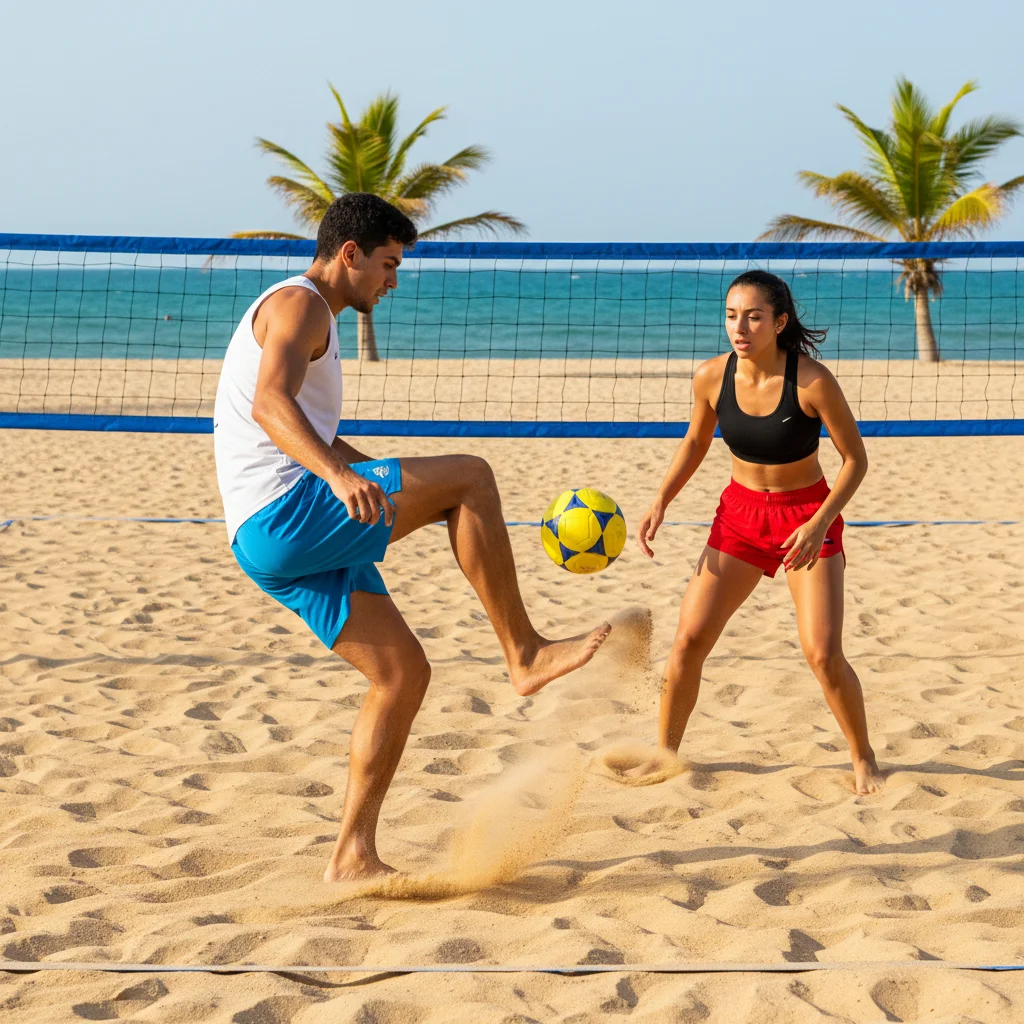
Now, let’s get into the practical application. These footvolley reaction drills are designed to be progressive, starting with foundational elements and building up to more complex, game-specific scenarios. Remember to always warm up thoroughly before starting and cool down afterward. Consistency is key; aim to incorporate these drills into your training sessions at least 2-3 times a week.
Drill 1: The Random Direction Touch
Objective: Improve lateral agility, quick decision-making, and foot-eye coordination for unpredictable ball movements.
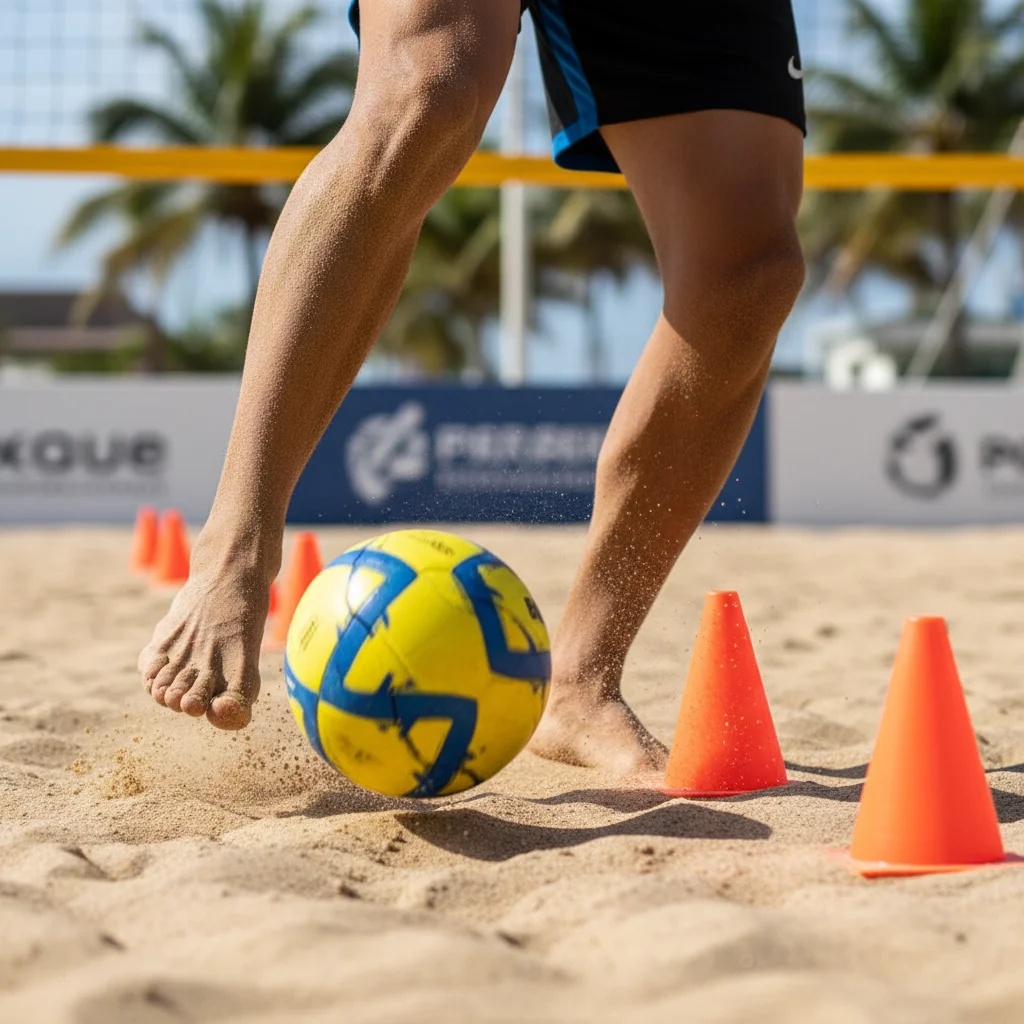
Setup: Place 4-6 cones in a semi-circle about 3-4 meters from you. Your partner stands opposite you with a footvolley ball.
Execution: Your partner will lightly kick or throw the ball towards one of the cones, calling out the cone’s color or number just as they release the ball. Your task is to quickly move to that cone, control the ball with a single touch (using any legal body part, typically foot or chest), and send it back to your partner. Immediately return to the center position, ready for the next call. The partner should vary the speed and trajectory of the ball.
Progression: Increase the number of cones, decrease the distance, or have the partner only point to the cone (no verbal cue) to force visual processing. You can also add a secondary action after the touch, like heading the ball to a target.
Drill 2: Reaction Wall Volleys
Objective: Enhance rapid-fire foot-eye coordination, quick touches, and sustained reactive ability.
Setup: Find a sturdy wall. Stand 2-3 meters away with a footvolley ball.
Execution: Volley the ball against the wall using various legal body parts (laces, sole, chest, head). The key is to keep the ball in play for as long as possible, reacting quickly to its rebound. Focus on precise touches to control the ball and set yourself up for the next volley. Vary the power and angle of your initial volley to create unpredictable rebounds.
Progression: Increase the speed and power of your volleys. Try to keep the ball within a designated area on the wall. Introduce a partner who also volleys against the wall, creating a dynamic, two-player reactive exercise. This is one of the most effective footvolley reaction drills for continuous engagement.
Drill 3: Partner Blind Drop Reaction
Objective: Develop quick acceleration from a static position and immediate ball control.
Setup: You stand with your back to your partner, about 5-7 meters away. Your partner holds a footvolley ball at chest height.
Execution: Your partner will drop the ball without warning. As soon as you hear the ball hit the sand, you must spin around, sprint to the ball, and control it before it bounces twice. Return the ball to your partner and reset. The surprise element makes this one of the most effective footvolley reaction drills for developing explosive first steps.
Progression: Your partner can vary the drop height, making the ball bounce differently. They can also feign a drop to test your patience and anticipation. Introduce multiple balls, dropping them in quick succession.
Drill 4: Serve Return Anticipation (Live Simulation)
Objective: Improve anticipation, visual tracking, and tactical decision-making under pressure, mimicking a live game scenario.
Setup: One player serves from a realistic distance. The receiver stands in the ready position on their side of the court.
Execution: The server executes various types of serves: soft, powerful, short, deep, with different spins. The receiver’s goal is not just to return the serve but to anticipate its trajectory and landing spot as early as possible. Focus on reading the server’s body language, the ball’s initial flight path, and making quick adjustments. After receiving, aim for a specific target on the server’s side.
Progression: Introduce a second receiver to practice communication and court coverage. The server can add fakes or deceptive movements. This drill is crucial for translating isolated reaction skills into actual game performance, making it a cornerstone of advanced footvolley reaction drills.
Drill 5: Multi-Ball Chaos
Objective: Overload sensory input, force rapid transitions, and enhance decision-making under extreme pressure.
Setup: You are in the middle of a small area (e.g., 5×5 meters). Two partners stand outside this area with several footvolley balls each.
Execution: Partners simultaneously or sequentially kick/throw balls into the area from different directions and at varying speeds. Your task is to control each ball with a single touch and return it to the partner who sent it, then immediately shift your focus to the next incoming ball. This drill is chaotic by design, forcing continuous reactive movement and immediate decision-making. Don’t worry about perfection; focus on quick responses.
Progression: Increase the number of partners, the speed of ball delivery, or reduce the size of the playing area. Introduce a rule where you must use a specific body part for each return (e.g., ‘return with chest’ or ‘return with laces’). This is the ultimate test of your cultivated footvolley reaction drills.
Integrating Reaction Drills into Your Training Regimen
Simply knowing the drills isn’t enough; you need a structured approach to integrate them effectively into your overall footvolley training regimen. Consistency and variety are paramount. Avoid doing the same drills every session; instead, rotate through them to challenge different aspects of your reaction time and prevent stagnation.
Warm-up and Cool-down
Always begin any session involving footvolley reaction drills with a dynamic warm-up that includes light cardio, dynamic stretching, and specific movements that mimic footvolley actions. This prepares your muscles and nervous system for intense activity. Conclude with a proper cool-down, including static stretches, to aid recovery and prevent injury.
Frequency and Intensity
For significant improvement, aim to perform these footvolley reaction drills 2-4 times per week. The intensity should be high, pushing you to react as quickly and accurately as possible. Short, sharp bursts of activity followed by brief recovery periods are more effective than long, drawn-out sessions. Think quality over quantity when it comes to reactive training.
Progressive Overload
Just like strength training, reaction training benefits from progressive overload. This means gradually increasing the difficulty of the drills over time. This could involve: increasing ball speed, reducing reaction time allowed, adding more variables, shrinking the playing area, or introducing distractions. Continuously challenging your reactive capabilities is how you’ll achieve that 30% improvement and beyond.
Mental Focus and Visualization
Reaction time isn’t purely physical; it has a strong mental component. During your footvolley reaction drills, practice intense focus and concentration. Visualize successful reactions before they happen. During breaks, mentally replay successful (and unsuccessful) reactions to learn from them. A calm yet focused mind can significantly enhance your ability to process information and react quickly.
Beyond the Drills: Lifestyle Factors Affecting Reaction Time
While dedicated footvolley reaction drills are crucial, your overall lifestyle plays a significant role in your cognitive and physical responsiveness. Neglecting these broader factors can undermine even the most rigorous training program.
Adequate Sleep
Lack of sleep impairs cognitive function, reduces alertness, and slows down reaction times. Aim for 7-9 hours of quality sleep per night to ensure your brain and body are well-rested and ready to perform at their peak. A well-rested mind is a reactive mind.
Nutrition and Hydration
A balanced diet rich in complex carbohydrates, lean proteins, and healthy fats provides the energy needed for intense training and optimal brain function. Staying well-hydrated is also critical, as dehydration can lead to fatigue and decreased cognitive performance, directly impacting your ability to execute footvolley reaction drills effectively.
Stress Management
High stress levels can lead to mental fatigue and reduced concentration, both of which negatively affect reaction time. Incorporate stress-reducing activities like meditation, yoga, or spending time in nature into your routine. A calm and clear mind is more capable of rapid processing and response.
Cross-Training and Other Sports
Engaging in other sports that demand quick reflexes, such as table tennis, badminton, or even video games (specifically those requiring fast hand-eye coordination), can offer supplementary benefits to your footvolley reaction time. These activities train different neural pathways and keep your mind sharp in varied contexts, further enhancing the gains from your targeted footvolley reaction drills.
Measuring Your Progress and Staying Motivated
To truly see that 30% improvement in your reflexes, it’s important to have some way of measuring your progress. While precise scientific measurement might require specialized equipment, you can use practical methods to track your development over time with your footvolley reaction drills.
Baseline Testing
Before you start, perform a simple reaction test. For example, time how many consecutive volleys you can make against a wall in 30 seconds, or how many blind drops you can successfully control in a minute. Record these baseline numbers. Periodically re-test yourself (e.g., every 4-6 weeks) to see how much you’ve improved.
Video Analysis
Record your training sessions and game play. Watching yourself back can provide invaluable insights into your reaction speed, decision-making, and areas for improvement. You might notice subtle delays or patterns in your reactions that you weren’t aware of in real-time. This objective feedback is a powerful tool for refining your approach to footvolley reaction drills.
Peer Feedback
Train with partners who can offer constructive criticism. An outside perspective can often spot improvements or areas that need more work. Ask them to specifically observe your reaction time during drills and game situations.
Celebrate Small Victories
Improvement is a journey, not a destination. Acknowledge and celebrate the small gains you make along the way. Did you make a save you wouldn’t have a month ago? Did you anticipate a serve perfectly? These small victories reinforce positive habits and keep you motivated to continue with your footvolley reaction drills.
Conclusion: Unleash Your Full Reactive Potential on the Sand
The quest for excellence in footvolley is an ongoing journey, and sharpening your reflexes is a critical milestone on that path. By consistently incorporating these dynamic footvolley reaction drills into your training, you’re not just improving your physical speed; you’re enhancing your cognitive processing, anticipation, and overall court awareness. The 30% improvement in reflexes isn’t just a number; it translates into more controlled touches, faster transitions, better defensive coverage, and ultimately, a more dominant presence on the sand. Remember that dedication, a structured approach, and attention to lifestyle factors will accelerate your progress. So, step onto the court with renewed vigor, commit to these drills, and prepare to witness a remarkable transformation in your footvolley game. Your opponents won’t know what hit them!