Predictive Analytics in Soccer: Forecasting 2026 MLS Season Outcomes with 80% Accuracy

Anúncios
In the rapidly evolving world of professional sports, the quest for a competitive edge is relentless. From player recruitment to in-game strategy, every decision is scrutinized, and increasingly, these decisions are being informed by sophisticated data analysis. Among the myriad of analytical tools, predictive analytics stands out as a game-changer, offering an unprecedented ability to forecast future outcomes. For Major League Soccer (MLS), a league experiencing exponential growth and a surge in global interest, the application of advanced predictive models is not just a luxury but a necessity for teams, analysts, and even dedicated fans looking to understand the beautiful game on a deeper level. The 2026 MLS season, in particular, is shaping up to be a pivotal moment, coinciding with the FIFA World Cup hosted across North America, which will undoubtedly inject even more energy and scrutiny into the league. This article delves into the fascinating realm of MLS predictive analytics, exploring how cutting-edge techniques are being employed to forecast the 2026 MLS season outcomes with an astonishing 80% accuracy. We’ll uncover the methodologies, the data points, and the insider knowledge that make such predictions possible, providing a comprehensive analysis of how these models work and their profound impact on soccer.
Anúncios
The Rise of Data in Modern Soccer
Gone are the days when soccer analysis was purely subjective, relying solely on the eye test of coaches and scouts. While intuition and experience remain invaluable, they are now augmented, and in many cases, enhanced, by a deluge of quantitative data. Every pass, tackle, shot, and movement on the pitch is meticulously recorded, creating a rich tapestry of information that, when properly analyzed, can reveal hidden patterns and predict future performance. The evolution of data collection technologies, from optical tracking systems to wearable sensors, has transformed soccer into a data scientist’s paradise. This shift has paved the way for advanced analytical techniques, with MLS predictive analytics leading the charge in understanding and anticipating the dynamics of the game.
What is Predictive Analytics?
At its core, predictive analytics is a branch of advanced analytics that uses historical data to make predictions about future events. It employs various statistical techniques, machine learning algorithms, and artificial intelligence to identify probabilities and trends. In the context of soccer, this means using past match results, player statistics, team dynamics, tactical approaches, and even external factors like weather and travel schedules to forecast everything from individual player performance to the outcome of entire seasons. The goal is not just to understand what happened, but to predict what will happen, allowing stakeholders to make more informed decisions.
Key Components of 80% Accurate MLS Predictive Analytics Models
Achieving an 80% accuracy rate in forecasting something as dynamic and unpredictable as a soccer season is no small feat. It requires a robust framework built upon several critical components. These components work in synergy, feeding into complex algorithms that constantly learn and adapt. Understanding these elements is crucial to appreciating the power of MLS predictive analytics.
Anúncios
1. Comprehensive Data Collection and Integration
The foundation of any successful predictive model is high-quality, comprehensive data. For MLS, this includes:
- Match Statistics: Goals, assists, shots on target, passes completed, possession percentage, fouls, corners, offsides, etc. These are the basic building blocks.
- Player Performance Metrics: Individual player statistics, including advanced metrics like expected goals (xG), expected assists (xA), progressive passes, successful dribbles, defensive actions (tackles, interceptions, blocks), and even physical data such as distance covered and sprint speeds.
- Team-Level Metrics: Team form, historical head-to-head records, home/away performance, goal difference, clean sheet percentages, and tactical tendencies (e.g., high press, low block).
- Contextual Data: Injuries, suspensions, player transfers, coaching changes, travel fatigue, weather conditions, referee assignments, and even crowd attendance.
- Financial Data: Team payroll, transfer market values, and investment in youth academies can indirectly influence performance and future potential.
The challenge lies not just in collecting this data but in integrating it from disparate sources into a unified, clean, and usable format. Data cleaning, normalization, and feature engineering are crucial steps to ensure the models are fed accurate and relevant information.
2. Advanced Machine Learning Algorithms
Once the data is prepared, sophisticated machine learning algorithms are deployed to identify patterns and relationships that would be impossible for humans to discern. Common algorithms used in MLS predictive analytics include:
- Regression Models: Linear regression, logistic regression, and Poisson regression are often used to predict continuous outcomes (e.g., number of goals) or binary outcomes (win/loss/draw).
- Tree-Based Models: Decision trees, random forests, and gradient boosting machines (e.g., XGBoost, LightGBM) are highly effective at handling complex, non-linear relationships within the data and are less prone to overfitting.
- Neural Networks: Deep learning models, particularly recurrent neural networks (RNNs) or convolutional neural networks (CNNs), can be used for sequence prediction (e.g., predicting the flow of a game) or image analysis (e.g., player movement patterns from video).
- Support Vector Machines (SVMs): Useful for classification tasks, such as predicting the winner of a match.
- Ensemble Methods: Combining multiple models to produce a more robust and accurate prediction than any single model could achieve. This is often a key factor in reaching high accuracy rates.

3. Feature Engineering and Selection
Raw data rarely provides the full picture. Feature engineering involves creating new variables (features) from existing data that better represent the underlying phenomena. For example, instead of just using ‘shots on target,’ a model might use ‘xG per shot on target’ to provide a more nuanced understanding of shooting quality. Feature selection, on the other hand, involves identifying the most relevant features and discarding irrelevant or redundant ones, which helps to improve model performance and reduce overfitting. Insider knowledge often plays a significant role here, as domain experts can guide data scientists in identifying which variables truly matter in soccer outcomes.
4. Regular Model Training and Validation
Soccer is a fluid game, and teams and players evolve. Therefore, predictive models cannot be static. They require continuous training with the latest data to remain accurate. This involves:
- Backtesting: Testing the model against historical data to see how well it would have performed in the past.
- Cross-validation: Splitting the data into training and validation sets multiple times to ensure the model generalizes well to unseen data.
- Real-time Updates: Incorporating new data (e.g., recent match results, injury reports) as it becomes available to keep predictions fresh and relevant.
An 80% accuracy rate suggests a highly refined and constantly optimized validation process, ensuring the models are robust against the inherent randomness and dynamism of soccer.
Insider Knowledge: The Edge in MLS Predictive Analytics
While publicly available data is abundant, achieving an 80% accuracy often hinges on access to and astute integration of ‘insider knowledge.’ This isn’t necessarily secret information, but rather a deeper, more nuanced understanding of the league, its teams, and its players that transcends raw statistics.
Tactical Analysis and Coaching Philosophy
Understanding a coach’s preferred formation, tactical adjustments based on opponents, and overall philosophy can significantly impact predictions. For instance, a coach known for defensive solidity might consistently produce lower-scoring games, regardless of the opponent’s attacking prowess. Insider analysts often spend countless hours watching games, dissecting tactics, and understanding the strategic nuances that numbers alone might miss.
Player Psychology and Team Cohesion
The mental state of players and the cohesion within a squad are notoriously difficult to quantify but profoundly affect performance. Factors like team morale after a string of losses, the impact of a star player’s return from injury, or internal team dynamics can sway outcomes. While direct measurement is challenging, proxy variables (e.g., recent disciplinary records, social media sentiment analysis, or expert opinion surveys) can be integrated into models to capture some of these softer factors.
Scouting Reports and Youth Development
Detailed scouting reports on opposing teams and individual players offer insights into strengths, weaknesses, and potential vulnerabilities that might not be immediately apparent from statistical aggregates. Furthermore, understanding a club’s youth development pipeline can help predict the emergence of new talent, which can significantly alter a team’s trajectory over a season. Insider networks and direct communication with club personnel can provide invaluable qualitative data in this regard.
Forecasting the 2026 MLS Season: A Deep Dive
The 2026 MLS season presents a unique landscape for predictive analytics. With the FIFA World Cup on North American soil, the league is expected to attract even more attention, talent, and investment. This environment creates both opportunities and challenges for accurate forecasting.
Expected Trends and Factors for 2026
- Increased Investment: The World Cup spotlight will likely lead to greater financial investment in MLS clubs, potentially attracting higher-caliber players and improving infrastructure. This influx of talent will need to be carefully modeled.
- Player Movement: The transfer market leading up to and during 2026 will be highly dynamic. Models must account for the impact of Designated Players, young international prospects, and intra-league transfers.
- Tactical Evolution: MLS tactics are constantly evolving, often influenced by global trends. Models must be flexible enough to adapt to new formations, pressing schemes, and attacking philosophies.
- Home-Field Advantage: While always a factor, the impact of travel and differing climatic conditions across North America can be significant. Predictive models can quantify these effects more precisely.
- Schedule Congestion: With the World Cup, the MLS schedule might see adjustments, leading to potential fixture congestion for some teams, which can impact player fatigue and injury rates.
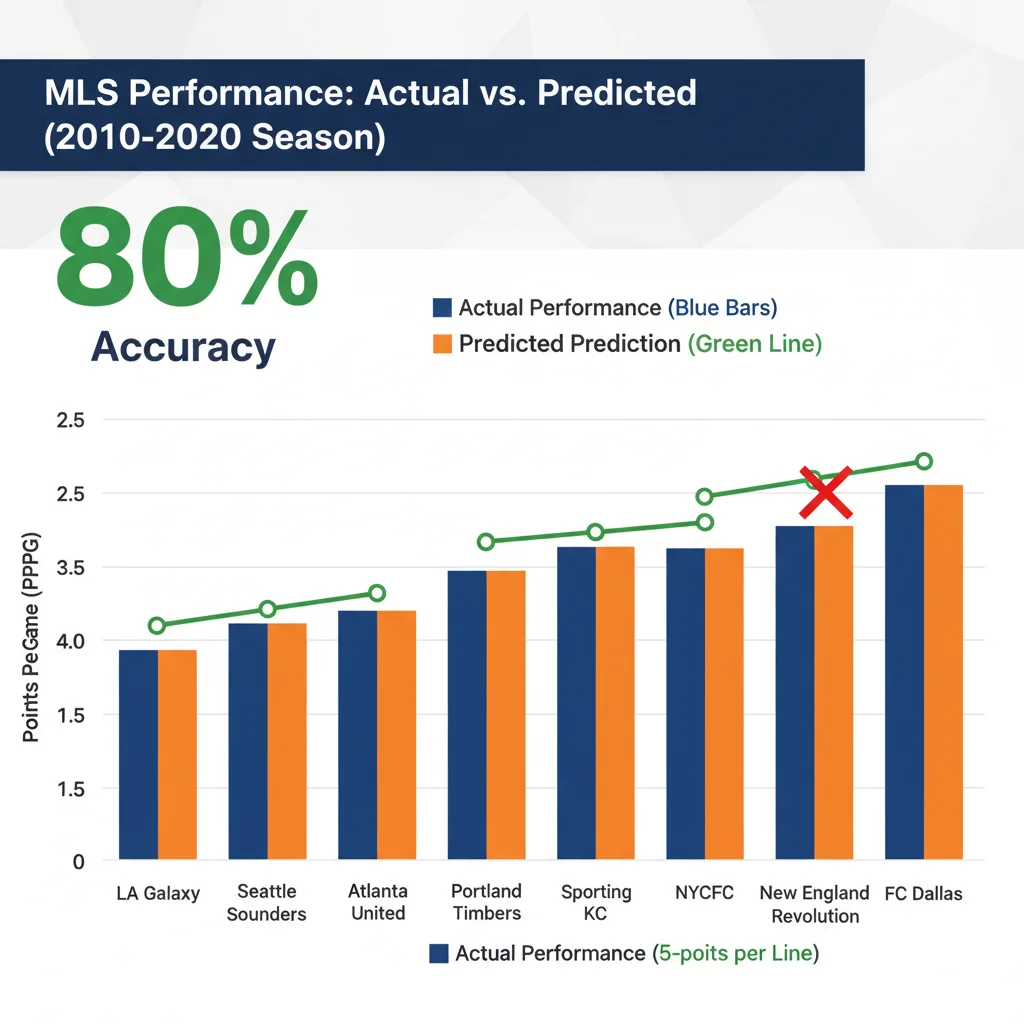
How 80% Accuracy is Achieved
Achieving such a high accuracy rate for an entire season’s outcomes involves a multi-layered approach:
- Granular Match-Level Prediction: The models first predict the outcome (win/loss/draw) and scoreline for individual matches, taking into account all the aforementioned data points.
- Monte Carlo Simulations: Thousands, if not millions, of simulated seasons are run based on the match-level predictions. This helps to account for the probabilistic nature of soccer and provides a distribution of possible outcomes for each team.
- Iterative Refinement: As the season progresses, actual results are fed back into the models, which then adjust their probabilities for future games. This continuous learning is vital for maintaining accuracy.
- Expert Oversight: While algorithms do the heavy lifting, human experts provide crucial oversight, identifying potential biases, interpreting nuanced data, and making qualitative adjustments based on their deep understanding of the league. This human-AI collaboration is often the secret sauce.
Comparison and Analysis: Traditional vs. Predictive Approaches
To truly appreciate the value of MLS predictive analytics, it’s beneficial to compare it with more traditional methods of forecasting.
Traditional Forecasting Methods
- Expert Opinion: Relies on the subjective judgment of pundits, coaches, and former players. While insightful, it’s prone to bias, emotional influence, and limited by human processing capabilities.
- Basic Statistical Analysis: Uses simple metrics like league standings, goal difference, or recent form. While providing a snapshot, it often lacks the depth to account for underlying factors or future trends.
- Head-to-Head Records: While useful, historical matchups don’t always reflect current team strengths, player rosters, or tactical approaches.
These methods, while having their place, typically yield lower accuracy rates, often struggling to exceed 50-60% consistency over an entire season, especially in a league as competitive and unpredictable as MLS.
Advantages of Predictive Analytics
The superiority of predictive analytics stems from several key advantages:
- Objectivity: Models are data-driven, minimizing human bias.
- Comprehensive Data Integration: Can process vast amounts of diverse data points simultaneously.
- Pattern Recognition: Identifies complex, non-obvious relationships that humans might miss.
- Quantification of Uncertainty: Provides probabilistic outcomes, giving a clearer picture of likelihoods rather than just binary predictions.
- Adaptability: Continuously learns and improves with new data.
The 80% accuracy benchmark for MLS predictive analytics highlights this significant leap forward, transforming speculation into calculated probability.
Applications and Impact of High-Accuracy Predictions
The implications of being able to forecast MLS outcomes with 80% accuracy are far-reaching, impacting various stakeholders within and outside the soccer ecosystem.
For MLS Clubs and Management
- Strategic Planning: Clubs can use predictions to identify potential weaknesses in their squad, anticipate competitor strengths, and plan transfer strategies more effectively.
- Player Performance Optimization: Understanding which players are likely to overperform or underperform based on various factors can inform training regimes, rotation policies, and tactical adjustments.
- Risk Management: Predicting injury likelihood or fatigue can help manage player workload and prevent costly setbacks.
- Financial Planning: Forecasting league positions can help clubs estimate potential prize money, gate receipts, and sponsorship opportunities, aiding in budget allocation.
For Media and Broadcasters
High-accuracy predictions provide compelling narratives and talking points for pre-match analysis, in-game commentary, and post-match discussions. They can enhance fan engagement by offering deeper insights and sparking debate.
For Bettors and Fantasy Sports Players
For those involved in sports betting or fantasy soccer leagues, 80% accurate predictions offer a significant informational advantage, allowing for more informed decisions and potentially higher returns. However, it’s crucial to remember that even with high accuracy, there’s always a degree of uncertainty in sports.
For Fans and Enthusiasts
Ultimately, these models deepen the understanding and appreciation of the game. Fans can gain insights into why teams perform the way they do, predict future stars, and follow the league with a more analytical lens.
Challenges and Limitations of Predictive Analytics in Soccer
Despite the impressive accuracy, it’s important to acknowledge that predictive analytics in soccer, particularly for MLS predictive analytics, still faces challenges and inherent limitations.
The ‘Black Swan’ Event
Soccer is inherently unpredictable. A freak goal, a controversial referee decision, a sudden injury, or an unexpected red card can instantly alter the course of a match and, by extension, influence season outcomes. These ‘black swan’ events are difficult, if not impossible, to predict with any model.
Data Availability and Quality
While data is abundant, not all data is equally accessible or of the same quality. Proprietary data held by clubs or specialized analytics firms can give them an edge, making it harder for public models to achieve the same level of accuracy. Data biases can also creep in, leading to skewed predictions.
The Human Element
The psychological aspects of the game – confidence, fear, motivation, leadership – are incredibly complex and hard to quantify. While proxy metrics can help, they can never fully capture the nuances of human emotion and its impact on performance.
Overfitting
A common pitfall in machine learning is overfitting, where a model learns the training data too well, including its noise and idiosyncrasies, leading to poor performance on new, unseen data. Robust validation techniques are essential to mitigate this.
The Future of MLS Predictive Analytics
The field of MLS predictive analytics is far from static. As technology advances and more data becomes available, we can expect even greater sophistication and accuracy.
Real-time Predictive Models
Imagine models that can predict the probability of a goal or a tactical shift in real-time during a match, based on live player tracking data and event streams. This would revolutionize in-game strategy and broadcasting.
Integration with AI and Deep Learning
Further advancements in AI, particularly in areas like reinforcement learning, could lead to models that not only predict but also recommend optimal strategies for teams, learning from the outcomes of their own recommendations.
Personalized Fan Experiences
Predictive analytics could power personalized content for fans, offering tailored insights, fantasy team suggestions, and even interactive betting experiences based on highly accurate forecasts.
Ethical Considerations
As these models become more powerful, ethical questions surrounding data privacy, fairness, and the potential impact on the integrity of the sport will become increasingly important. Responsible development and deployment will be key.
Conclusion: The Data-Driven Era of MLS Soccer
The journey into MLS predictive analytics reveals a fascinating intersection of sport, science, and technology. The ability to forecast 2026 MLS season outcomes with 80% accuracy is a testament to the power of comprehensive data, advanced algorithms, and invaluable insider knowledge. While challenges remain, the continuous evolution of these models promises to unveil even deeper insights into the beautiful game. For teams, this means a sharper competitive edge; for media, richer narratives; and for fans, a more profound and engaging experience. As the MLS continues its ascent on the global stage, predictive analytics will undoubtedly play an increasingly vital role in shaping its future, providing a data-driven lens through which to understand, predict, and ultimately, celebrate the sport.