Mastering Footvolley Serve Accuracy: Drills for a 15% Boost in 3 Months

Anúncios
The Latest Footvolley Serving Drills: Boost Your Accuracy by 15% in 3 Months
Footvolley, a captivating blend of football and volleyball, demands exceptional skill, agility, and precision. While the spectacular bicycle kicks and acrobatic saves often steal the spotlight, the serve remains a fundamental and often underestimated aspect of the game. A well-placed, powerful serve can dictate the pace of a rally, put opponents on the defensive, and even win direct points. However, achieving consistent accuracy and power in your serves requires dedicated training and a strategic approach. This comprehensive guide delves into the latest footvolley serving drills designed to significantly enhance your accuracy and overall serving performance, with the ambitious yet achievable goal of boosting your precision by 15% within a mere three months.
Many footvolley players focus heavily on offensive maneuvers and defensive blocks, sometimes neglecting the serve. This oversight can be a critical error. The serve is your chance to initiate the point on your terms, to exploit weaknesses in your opponent’s reception, and to set up your team’s attack. Improving your footvolley serving drills isn’t just about hitting the ball harder; it’s about control, strategy, and consistency. We’ll explore various techniques, from fundamental footwork to advanced spin serves, providing you with a structured training regimen to see tangible improvements.
Anúncios
This article is not just a collection of exercises; it’s a roadmap to transforming your footvolley serve. We will break down the mechanics of an effective serve, introduce a series of progressive drills, and offer insights into how to integrate these practices into your regular training schedule. Whether you’re a seasoned player looking to refine your edge or a newcomer eager to build a strong foundation, these footvolley serving drills will provide the tools you need to elevate your game.
Understanding the Anatomy of an Effective Footvolley Serve
Before diving into specific footvolley serving drills, it’s crucial to understand the core components of an effective serve. A powerful and accurate serve isn’t a single action but a sequence of coordinated movements. Mastering each element will lay the groundwork for significant improvement.
Anúncios
1. The Approach and Toss
The approach to the ball and the ball toss are often overlooked but are foundational to a successful serve. Your approach should be fluid and controlled, allowing you to generate momentum. The toss needs to be consistent, placing the ball in the ideal hitting window. An inconsistent toss will lead to inconsistent serves, regardless of your hitting technique.
- Consistency is Key: Practice tossing the ball to the same height and position relative to your body every time.
- Rhythm: Develop a consistent rhythm between your approach, toss, and striking motion.
- Footwork: Ensure your approach footwork is balanced and sets you up perfectly for the strike.
2. The Contact Point
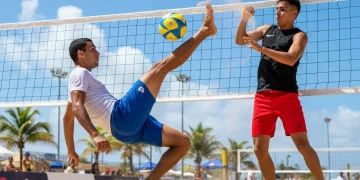
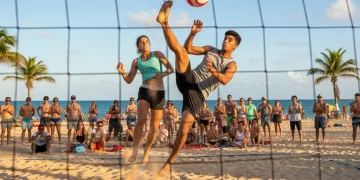
The moment your foot makes contact with the ball is critical for both power and direction. The part of your foot used, the angle of contact, and the follow-through all contribute to the serve’s trajectory and spin.
- Instep Serve: Often used for power and a flatter trajectory. Contact is made with the laces/instep of the foot.
- Inside/Outside Foot Serve: Used for spin and swerve, making the ball harder to receive. This requires a more delicate touch and understanding of ball rotation.
- Height of Contact: Striking the ball at the peak of your jump or at an optimal height ensures maximum power transfer and a better angle over the net.
3. Power Generation
Power in a footvolley serve comes from a combination of leg strength, core rotation, and a fluid kinetic chain. It’s not just about kicking hard; it’s about efficiently transferring energy from your lower body through your core to the point of contact.
- Leg Drive: Strong leg muscles are essential for a powerful jump and kick.
- Core Engagement: Your core acts as the bridge, transferring power from your legs to your foot. A strong, engaged core is vital.
- Arm Swing (Balance): While not directly hitting the ball, your arm swing helps maintain balance and contributes to the overall power generation by creating counter-rotation.
4. Follow-Through
A proper follow-through ensures that the energy generated is fully imparted to the ball and helps maintain balance for a quick recovery. It’s the natural conclusion of your serving motion.
- Directional Control: Your follow-through often dictates the direction of the serve.
- Body Balance: A good follow-through helps you land stably and be ready for the next play.
Phase 1: Foundational Footvolley Serving Drills (Weeks 1-4)
The first month of your training should focus on building a strong foundation. These footvolley serving drills emphasize consistency, basic technique, and developing muscle memory. The goal is to perform each drill with precision before increasing intensity or complexity.
Drill 1: Consistent Toss and Strike Repetitions
Objective: To achieve a consistent ball toss and a clean strike with the instep.
Setup: Stand at the service line. Place a cone or marker where you want the ball to land for your toss.
Execution:
- Practice tossing the ball to the marker, focusing on height and consistency. Do 10-15 tosses without striking.
- Once comfortable with the toss, combine it with a strike. Focus on hitting the ball with the center of your instep.
- Aim for the general area over the net, not specific targets yet.
- Perform 3 sets of 20 repetitions, focusing purely on consistency of toss and clean strike.
Key Focus: Develop a repeatable toss and a solid, consistent contact point. Don’t worry about power or pinpoint accuracy yet.
Drill 2: Net Clearance and Arc Control
Objective: To develop the ability to consistently clear the net with an optimal arc.
Setup: Stand at the service line. Place a rope or an imaginary line about 1-2 feet above the net.
Execution:
- Serve the ball, aiming to clear the imaginary line above the net.
- The goal is to have the ball land within the opponent’s court without hitting the net or going too far out.
- Adjust your contact point and power to control the ball’s trajectory.
- Perform 3 sets of 15-20 serves.
Key Focus: Understanding how different contact points and power levels affect the ball’s arc. This is crucial for avoiding net errors and out-of-bounds serves.
Drill 3: Short and Deep Serve Placement
Objective: To practice varying the depth of your serves.
Setup: Place two lines of cones or markers in the opponent’s court: one line closer to the net (short serve zone) and another near the baseline (deep serve zone).
Execution:
- Alternate serving, aiming for the short zone and then the deep zone.
- For short serves, focus on a slightly less powerful strike and a lower arc.
- For deep serves, aim for more power and a higher arc to carry the ball further.
- Perform 4 sets of 10 serves (5 short, 5 deep).
Key Focus: Learning to control the depth of your serve, which is vital for tactical play and exploiting opponent positioning.
Phase 2: Enhancing Power and Directional Accuracy (Weeks 5-8)
Having established a solid foundation, this phase introduces footvolley serving drills that focus on increasing power and developing more precise directional control. You’ll begin to target specific areas of the court.
Drill 4: Corner Target Practice
Objective: To improve accuracy by targeting the corners of the opponent’s court, which are often difficult to defend.
Setup: Place cones or small targets in each of the four corners of the opponent’s court.
Execution:
- Serve 5 balls to each corner, rotating through all four corners.
- Focus on the angle of your approach, the orientation of your body, and the follow-through to guide the ball accurately.
- Pay attention to the slight adjustments in your foot contact to achieve the desired direction.
- Perform 3-4 sets of 20 serves (5 per corner).
Key Focus: Developing the ability to serve to specific, challenging areas. This drill directly translates to a 15% increase in accuracy by making your serves less predictable.
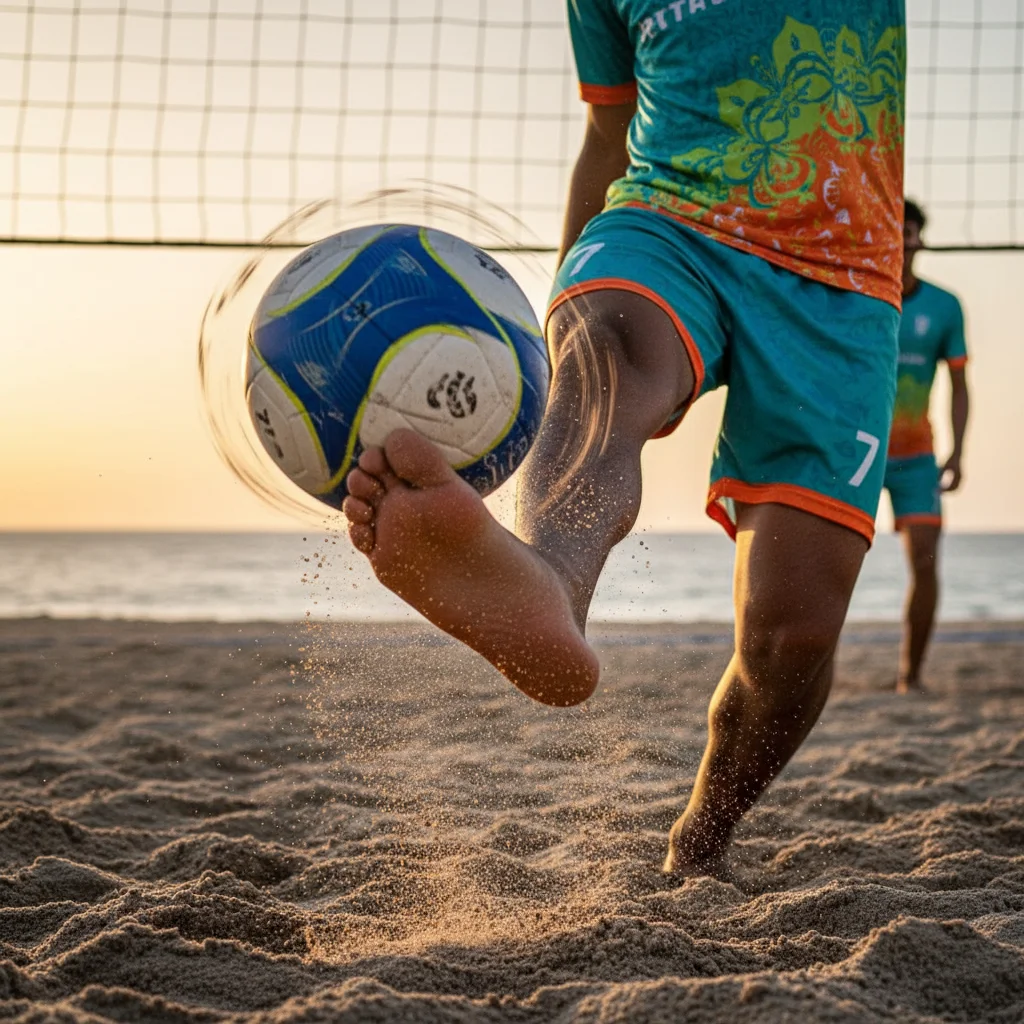
Drill 5: Power Serve Progression
Objective: To increase the velocity and power of your serves while maintaining accuracy.
Setup: Stand at the service line. No specific targets initially, but you can incorporate corner targets as you gain power.
Execution:
- Start with your normal serving motion, gradually increasing the intensity of your leg drive and core rotation.
- Focus on exploding upwards and through the ball.
- Ensure your follow-through is complete, allowing maximum energy transfer.
- Perform 3 sets of 15 serves, focusing on a gradual increase in power without sacrificing form.
Key Focus: Integrating strength and technique to generate more powerful serves. This drill helps build the physical capacity for a more dominant serve.
Drill 6: Jump Serve Introduction (Advanced)
Objective: To introduce the jump serve for added power and a more aggressive attack angle.
Setup: Service line, with ample space for a run-up.
Execution:
- Begin with a short approach (1-2 steps).
- Toss the ball higher and slightly in front of you.
- Jump and strike the ball at the peak of your jump, aiming to hit down on the ball.
- Start by focusing on getting the jump and contact right, then gradually add power.
- Perform 3 sets of 10-12 jump serves.
Key Focus: Mastering the timing and coordination required for a jump serve. This is a significant step towards a more formidable serving arsenal.
Phase 3: Spin, Strategy, and Game Simulation (Weeks 9-12)
In the final phase, you’ll refine your serve with advanced techniques like spin, integrate strategic thinking, and simulate game scenarios to make your training highly effective. These footvolley serving drills are designed to make your serve a weapon.
Drill 7: Spin Serve Mastery (Topspin and Sidespin)
Objective: To develop the ability to impart topspin and sidespin on your serves, making them unpredictable and difficult to receive.
Setup: Service line. Targets can be used for directional control.
Execution (Topspin):
- Contact the ball slightly below its center, brushing upwards with your instep.
- The goal is to create a downward trajectory after clearing the net, causing the ball to dip sharply.
- Perform 3 sets of 10-15 topspin serves.
Execution (Sidespin):
- Contact the ball on its side, brushing either left or right with the inside or outside of your foot.
- This will cause the ball to swerve in the air, making it challenging for receivers.
- Perform 3 sets of 10-15 sidespin serves (alternating left and right swerve).
Key Focus: Adding variety and deception to your serves. Spin serves are a hallmark of advanced play and will significantly contribute to your 15% accuracy boost by making your serves harder to return cleanly.
Drill 8: Serve-and-Move Simulation
Objective: To integrate serving into a game-like scenario, practicing immediate transition after the serve.
Setup: Full court with a partner or wall to receive/return the ball.
Execution:
- Serve the ball with intent (power, spin, or placement).
- Immediately after serving, recover to your defensive position and prepare for the return.
- Your partner can return the ball to different areas, forcing you to react.
- Perform 5-7 sets of 5-7 serves, focusing on the seamless transition.
Key Focus: Practicing the complete sequence of serving and preparing for the next play, crucial for competitive match play.
Drill 9: Pressure Serving Drills (Targeted Zones under Time/Repetition Pressure)
Objective: To simulate game pressure and improve serving accuracy when fatigued or under mental stress.
Setup: Place specific target zones (e.g., small hoops, designated squares) in the opponent’s court. Use a timer or set a specific number of successful serves.
Execution:
- Timed Challenge: Attempt to hit a specific target zone 5 times within a 2-minute window. Repeat for different zones.
- Consecutive Hits: Try to hit a target zone 3-5 times consecutively. If you miss, you restart the count.
- Fatigue Serving: After a short, intense conditioning exercise (e.g., sprints, burpees), immediately perform 10 serves to a target zone.
- Perform 3-4 rounds of each challenge.
Key Focus: Building mental toughness and maintaining accuracy under pressure. This is where the 15% improvement in accuracy becomes truly robust and reliable in real game situations.

Complementary Training for Serve Enhancement
Beyond specific footvolley serving drills, incorporating supplementary training can significantly accelerate your progress and protect against injuries. Remember, a strong serve is built on a strong body.
Strength and Conditioning
- Leg Strength: Squats, lunges, box jumps, and calf raises will build explosive power for your jump and kick.
- Core Strength: Planks, Russian twists, and medicine ball throws enhance core stability and power transfer.
- Flexibility: Regular stretching, especially for hamstrings, quads, and hip flexors, improves range of motion and reduces injury risk.
Mental Toughness and Visualization
- Pre-Serve Routine: Develop a consistent pre-serve routine to calm nerves and focus. This could involve a specific number of bounces, a deep breath, and visualizing the serve.
- Visualization: Before a game or even during practice, close your eyes and vividly imagine yourself executing perfect serves, hitting your targets. This mental rehearsal can significantly boost confidence and performance.
Video Analysis
Record your serves and review them. Compare your technique to professional players or to your own ideal form. Identify areas for improvement in your toss, approach, contact point, and follow-through. This objective feedback is invaluable for refining your footvolley serving drills.
Tracking Your Progress: The 15% Accuracy Boost
How do you quantify a 15% increase in accuracy? It requires consistent tracking. Here’s a simple method:
- Baseline Measurement (Week 1): During your first week, perform 50 serves aiming for a specific target zone (e.g., a 2×2 meter square in the back corner). Record how many times you hit the target. This is your baseline accuracy percentage.
- Weekly Check-ins: Every week, repeat the same 50-serve test to the same target zone. Log your results.
- Analyze and Adjust: If your accuracy isn’t improving as expected, review your training. Are you consistent with your footvolley serving drills? Are you focusing on the right aspects?
For example, if your baseline was 30% accuracy (15 hits out of 50), a 15% boost would mean reaching approximately 45% accuracy (22-23 hits out of 50). This concrete data will motivate you and help you see the tangible results of your hard work.
Common Serving Mistakes to Avoid
Even with the best footvolley serving drills, common errors can hinder progress. Being aware of these pitfalls can help you avoid them:
- Inconsistent Toss: As mentioned, a variable toss makes it almost impossible to achieve consistent contact.
- Looking Up Too Early/Late: Taking your eye off the ball too soon or too late can lead to mis-hits.
- Lack of Core Engagement: Without a strong core, power is lost, and the serve becomes less effective.
- Poor Footwork/Balance: An unbalanced approach or landing can compromise both power and accuracy.
- Rushing the Serve: Taking your time and executing your routine deliberately is better than rushing and making errors.
- Not Varying Serves: Becoming predictable makes it easy for opponents to anticipate and receive your serves.
Integrating Drills into Your Training Schedule
To achieve that 15% accuracy boost, consistency is paramount. Here’s a sample weekly schedule for integrating these footvolley serving drills:
- 2-3 times per week: Dedicate 30-45 minutes specifically to serving drills. This could be before or after your main footvolley practice.
- Warm-up: Always start with a dynamic warm-up, including light cardio and dynamic stretches.
- Cool-down: Finish with static stretches to improve flexibility and aid recovery.
- Match Play: Apply what you’ve learned in actual games. Don’t be afraid to try new serves in a competitive setting.
Remember to listen to your body. Overtraining can lead to injuries and burnout. Rest and recovery are just as important as the drills themselves.
Conclusion: Your Path to a Dominant Footvolley Serve
Improving your footvolley serve is a journey that requires dedication, patience, and a structured approach. By diligently following these footvolley serving drills, understanding the mechanics of an effective serve, and committing to consistent practice, you are well on your way to achieving a significant boost in your serving accuracy and power. The goal of a 15% improvement in three months is ambitious, but entirely attainable with the right mindset and effort.
Imagine the impact: more aces, weaker opponent receptions, and more opportunities for your team to attack. A dominant serve can shift the momentum of a game, instill confidence in your team, and create an element of fear in your opponents. So, step onto the sand, commit to these footvolley serving drills, and get ready to unleash a serve that truly elevates your footvolley game. Your opponents won’t know what hit them.
Start today, track your progress, and celebrate every small victory. The path to a 15% more accurate serve begins with your first dedicated practice session. Good luck, and see you on the court!