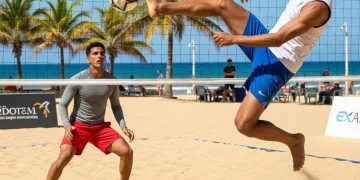
Master Footvolley Volley Drills: Elevate Your Aerial Game
Anúncios
Master Footvolley Volley Drills: Elevate Your Aerial Game with 5 Expert Techniques
Footvolley, a captivating blend of beach volleyball and soccer, demands exceptional aerial control, agility, and precision. Whether you’re a seasoned player looking to refine your skills or a newcomer eager to dominate the court, mastering your volley game is paramount. The ability to control the ball in the air, execute powerful spikes, and deliver accurate passes with various body parts is what separates good players from great ones. This comprehensive guide delves into essential footvolley volley drills that will significantly improve your aerial game, ensuring you’re always one step ahead of your opponents.
The beauty of footvolley lies in its dynamic nature. Unlike traditional volleyball where hands are used, footvolley relies on feet, chest, shoulders, and head. This unique constraint elevates the importance of body control and spatial awareness. Your aerial game, specifically your volleying technique, is the cornerstone of effective offense and defense. Without a solid volley, your ability to set up attacks, return serves, and defend against spikes will be severely limited. That’s why dedicating time to specific footvolley volley drills is not just beneficial, but absolutely necessary for anyone serious about the sport.
In this article, we will explore five expert footvolley volley drills designed to target different aspects of your aerial play. From fundamental ball control to advanced offensive maneuvers, each drill is meticulously crafted to enhance your touch, power, and strategic thinking. We’ll cover everything from proper warm-ups to cool-downs, ensuring you train effectively and safely. Get ready to transform your game and become a formidable force on the footvolley court!
Anúncios
Understanding the Fundamentals of Footvolley Volleying
Before diving into specific footvolley volley drills, it’s crucial to grasp the fundamental principles of volleying in footvolley. A successful volley isn’t just about hitting the ball; it’s about control, placement, and anticipating the next move. Here are the key elements:
- Body Positioning: Your body must be aligned with the ball’s trajectory. This often means quick adjustments and agile footwork to get into the optimal position before the ball reaches you. A good base and balanced posture are non-negotiable.
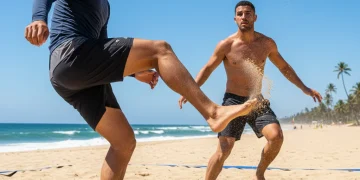
- Foot/Body Part Contact: Depending on the situation, you’ll use your instep, laces, chest, shoulder, or head. Each has a specific purpose. The instep is generally used for powerful, precise shots, while the chest and head are excellent for controlled passes or defensive volleys. Understanding when and how to use each part is a critical skill developed through footvolley volley drills.
- Ball Control and Touch: This is perhaps the most challenging aspect. It involves judging the speed and spin of the incoming ball and adjusting your contact to either cushion it for a pass or strike it with power for an attack. Soft touch for setting and firm touch for spiking are distinct skills.
- Follow-Through: Just like in soccer, a proper follow-through ensures power and direction. It’s not enough to just make contact; you must guide the ball to its intended target.
- Vision and Anticipation: Always keep your eyes on the ball and anticipate where it will go. This allows you to prepare your body and choose the appropriate technique. Good players read the game, not just react to it.
These fundamentals form the bedrock of all advanced footvolley volley drills. Consistent practice of these basics will naturally lead to improved performance in more complex scenarios. Remember, perfection comes from repetition and attention to detail.
Anúncios
Pre-Drill Warm-up: Essential for Performance and Injury Prevention
Before engaging in any footvolley volley drills, a thorough warm-up is non-negotiable. It prepares your muscles, increases blood flow, and enhances flexibility, significantly reducing the risk of injury. A good warm-up should last 10-15 minutes and include both dynamic stretches and light cardio.
Dynamic Stretches:
- Leg Swings: Forward and backward, and side to side, to open up the hips and hamstrings.
- Torso Twists: Gently rotate your upper body to warm up your core and obliques.
- Arm Circles: Forward and backward to prepare shoulder and arm muscles.
- High Knees and Butt Kicks: To get the heart rate up and engage leg muscles.
- Walking Lunges: To activate glutes and quads.
Light Cardio:
- Light Jogging: Around the court for 5 minutes.
- Shuffles and Backpedals: Mimicking game movements to activate relevant muscle groups.
A proper warm-up ensures your body is primed for the demands of footvolley volley drills, allowing you to execute each technique with maximum efficiency and power. Don’t skip this crucial step!
The 5 Expert Footvolley Volley Drills to Elevate Your Aerial Game
Now, let’s dive into the core of our training: the five expert footvolley volley drills. Each drill is designed to build upon fundamental skills and progressively challenge your aerial control and precision.
Drill 1: The Controlled Instep Volley (Precision & Touch)
This drill focuses on developing precise control with your instep, a primary contact point for setting and attacking in footvolley. It’s fundamental for any aspiring player and a cornerstone of effective footvolley volley drills.
Objective:
To improve accuracy, touch, and consistency when volleying with the instep.
Setup:
- Two players (or one player and a wall/rebounder).
- One ball.
- Cones or markers to define target areas.
Execution:
- Player A tosses the ball consistently to Player B, who is positioned 3-5 meters away.
- Player B uses their instep to volley the ball back to Player A, aiming for a specific target (e.g., Player A’s chest height).
- Focus on a soft touch initially, guiding the ball rather than striking it hard.
- Gradually increase the distance and the speed of the toss as control improves.
- Vary the height of the toss (low, medium, high) to practice adjusting body position.
- Introduce target zones for Player B to aim for, increasing the demand for precision.
Coaching Points:
- Keep your eye on the ball throughout its trajectory.
- Position your body directly under the ball, allowing for a natural extension of the leg.
- Use a relaxed ankle and a slight knee bend upon contact to absorb impact and guide the ball.
- Follow through in the direction you want the ball to go.
- Alternate between left and right feet equally.
This drill is critical for building the muscle memory required for accurate passing and setting, forming the basis of all advanced footvolley volley drills.
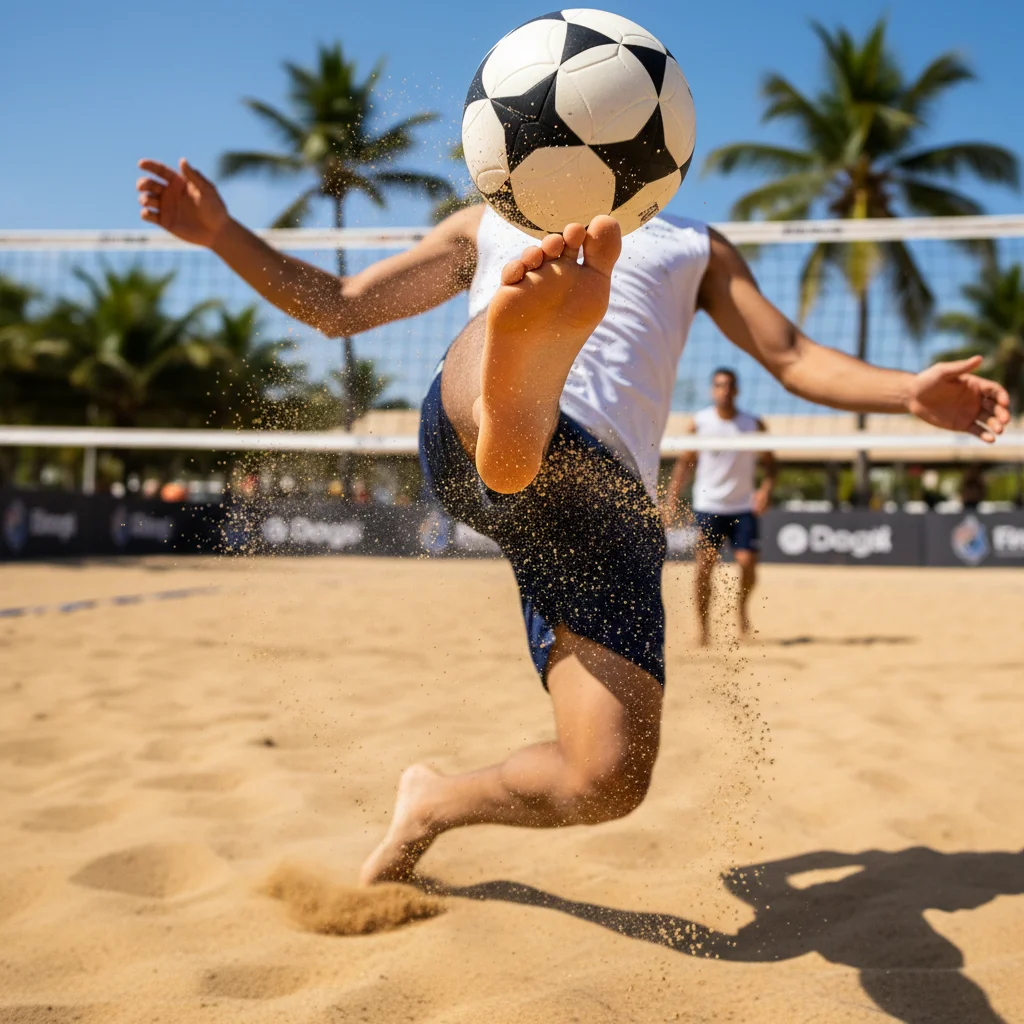
Drill 2: The Multi-Surface Volley (Versatility & Adaptation)
Footvolley often requires using various body parts to keep the ball in play. This drill hones your ability to adapt and use your chest, shoulder, and head effectively, making you a more versatile player.
Objective:
To develop proficiency in volleying with the chest, shoulder, and head for defensive plays and controlled passes.
Setup:
- Two players.
- One ball.
Execution:
- Player A tosses the ball to Player B, varying the height and angle.
- Player B must return the ball using a different body part each time (e.g., chest, then head, then shoulder, then instep).
- Start with predictable tosses and gradually make them more challenging, simulating game-like situations.
- Focus on receiving the ball softly and directing it back to Player A with control.
- Emphasize quick decision-making on which body part to use.
Coaching Points:
- Chest Volley: Arch your back slightly, puff out your chest, and absorb the impact to cushion the ball upwards. Aim for a controlled upward trajectory.
- Shoulder Volley: Use the flat part of your shoulder, ensuring a firm but controlled contact. This is often used for high balls where a chest volley isn’t feasible.
- Head Volley: Use your forehead for maximum control and power. Keep your neck stiff and use your core to generate power. Aim for a specific spot.
- Maintain balance throughout the movement.
Mastering this drill means you’ll be less likely to give away easy points, showcasing your comprehensive understanding of footvolley volley drills.
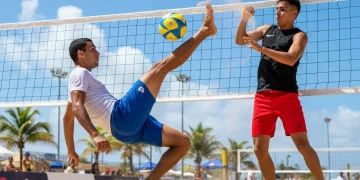
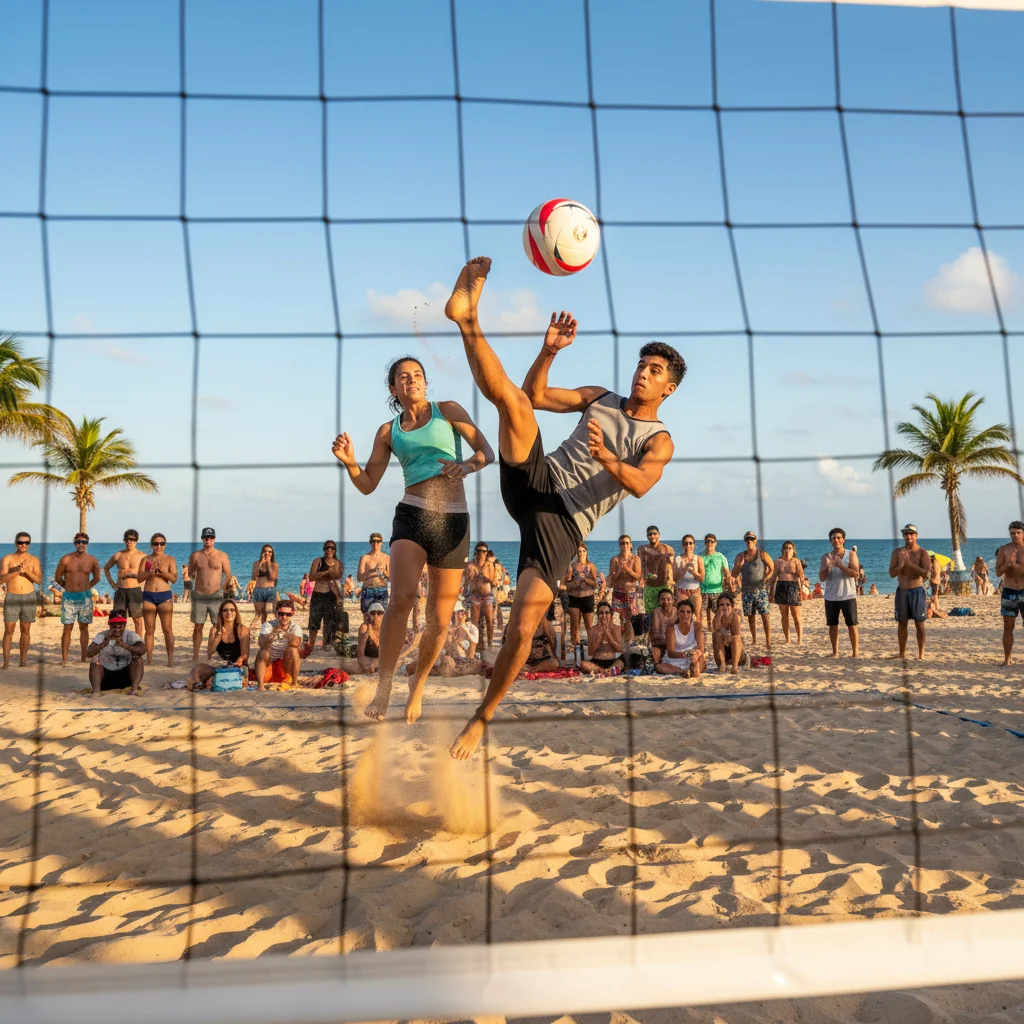
Drill 3: Aerial Attack & Spike Training (Power & Accuracy)
This drill is designed to enhance your offensive aerial game, specifically focusing on powerful and accurate spikes. A well-executed spike can be a game-changer.
Objective:
To improve the power, accuracy, and technique of overhead spikes using the instep or laces.
Setup:
- Two players (one setter, one spiker).
- One ball.
- A net or an imaginary net line.
- Target areas on the opposite side of the court (e.g., cones in the corners).
Execution:
- Player A (setter) tosses the ball high and slightly forward, mimicking a perfect set for a spike.
- Player B (spiker) approaches the net, jumps, and volleys the ball downwards into the target area on the opposite side.
- Start with a consistent set, then introduce variations in set height and placement to challenge the spiker.
- Focus on jumping at the right moment and striking the ball at the highest point possible.
- Alternate spiking with both feet.
Coaching Points:
- Approach: Use a dynamic approach, similar to a volleyball spike, to generate momentum.
- Jump: Time your jump to meet the ball at its apex.
- Contact: Strike the ball with the instep or laces, aiming for the top half of the ball to drive it downwards.
- Core Engagement: Use your core muscles to generate power and control.
- Landing: Land softly and be ready for the next play.
This is one of the most exciting footvolley volley drills, as it directly translates to scoring opportunities in a match.
Drill 4: Defensive Volley & Recovery (Agility & Reaction)
Not all volleys are offensive. Defensive volleys are crucial for keeping the ball in play and setting up your team for a counter-attack. This drill focuses on quick reactions and controlled defensive plays.
Objective:
To enhance quick reactions, agility, and the ability to execute controlled defensive volleys under pressure.
Setup:
- Two players (one attacker/feeder, one defender).
- Multiple balls (for continuous play).
- A net.
Execution:
- Player A (attacker) stands on one side of the net and hits various types of shots (spikes, drop shots, deep volleys) towards Player B (defender).
- Player B’s objective is to defend these shots using any appropriate body part (chest, head, foot) and return the ball with control over the net, ideally to Player A’s position.
- Vary the intensity and placement of Player A’s shots to challenge Player B’s reaction time and defensive skills.
- Focus on getting behind the ball and using a soft touch to lift it over the net.
Coaching Points:
- Stay low and ready in a defensive stance.
- Anticipate the direction and speed of the incoming shot.
- Prioritize getting the ball over the net and keeping it in play, even if it’s not a perfect pass.
- Communicate with your imaginary partner (if training alone) to simulate real game scenarios.
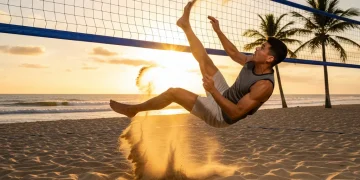
- Practice diving and sprawling for difficult saves.
This drill will significantly improve your court coverage and ability to handle unexpected shots, making you a more resilient player through dedicated footvolley volley drills.
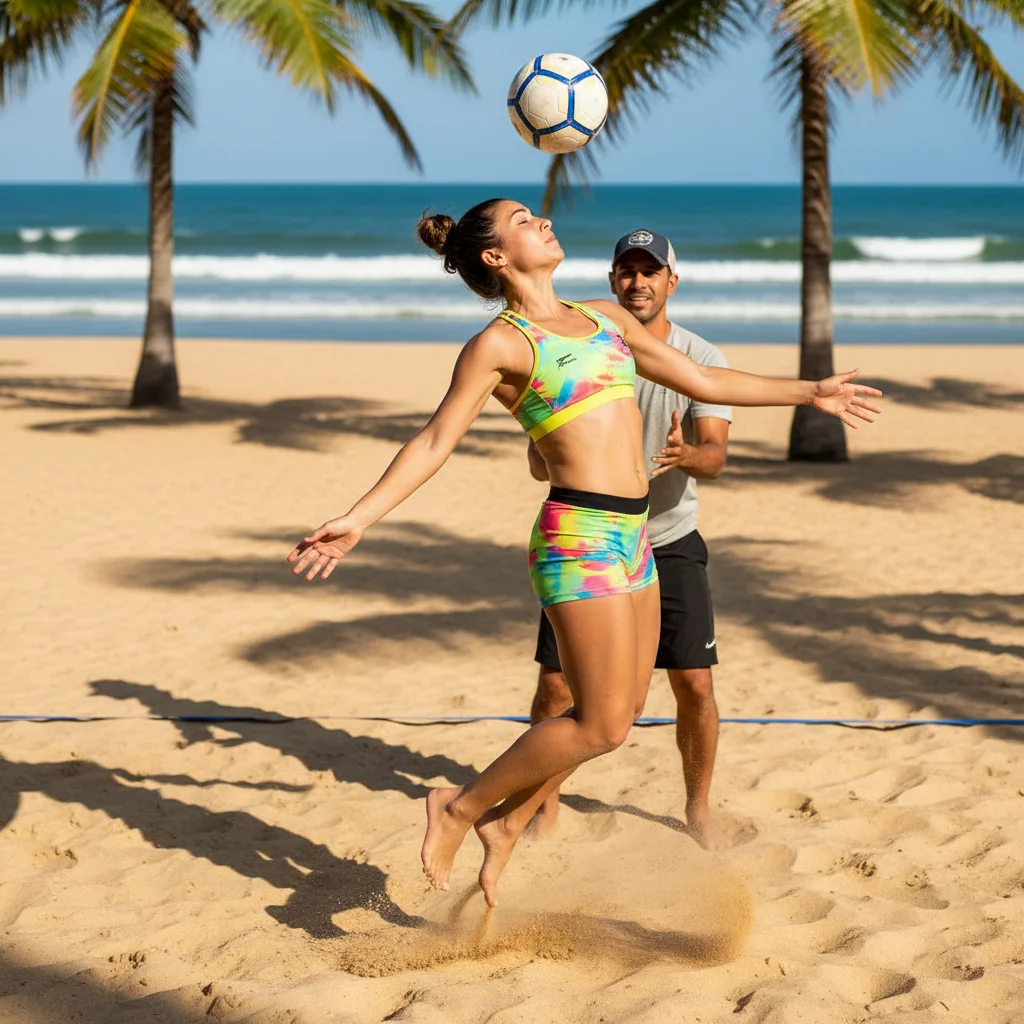
Drill 5: Game-Scenario Volley Flow (Strategic Application)
This drill integrates all learned skills into a dynamic, game-like sequence, emphasizing communication, teamwork, and strategic decision-making. It’s the culmination of all previous footvolley volley drills.
Objective:
To combine precision, versatility, power, and defensive skills in a continuous, flowing sequence that mimics game play.
Setup:
- Two or four players (ideal for simulating a match).
- One ball.
- A net and a full court.
Execution:
- Start with a serve or a controlled toss over the net.
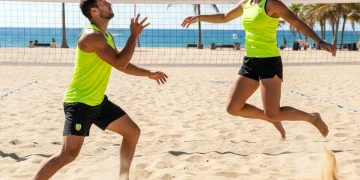
- Players must aim to get three touches on their side (pass, set, attack) before sending the ball over.
- Emphasize communication between partners: calling out ‘mine’, ‘yours’, ‘set’, ‘spike’.
- Encourage players to use all body parts as needed for defensive and offensive volleys.
- Vary the intensity and focus on different scenarios (e.g., focus on defensive volleys for 5 minutes, then offensive spikes).
- Keep score to add a competitive element.
Coaching Points:
- Communication: Constant verbal communication is key to avoiding errors and coordinating plays.
- Court Awareness: Always know where your partner, opponents, and the ball are.
- Strategic Volleying: Don’t just hit the ball; think about where you want it to go and why.
- Recovery: After each touch, immediately get back into a ready position.
- Fun: Keep the energy high and enjoy the flow of the game!
This drill is the ultimate test of your aerial game, bringing together all the elements practiced in the individual footvolley volley drills. It helps you develop game intelligence and the ability to make split-second decisions under pressure.
Integrating Footvolley Volley Drills into Your Training Routine
To maximize the benefits of these footvolley volley drills, it’s crucial to integrate them strategically into your regular training routine. Consistency is key, but so is variety.
- Frequency: Aim for at least 2-3 dedicated footvolley training sessions per week, with a significant portion allocated to these drills.
- Structure: Start each session with a thorough warm-up, then focus on 2-3 specific drills, followed by a game-scenario drill. Conclude with a cool-down.
- Progression: Begin with basic variations of each drill and gradually increase difficulty by adding distance, speed, target zones, and defensive pressure.
- Repetition with Purpose: Don’t just go through the motions. Each repetition should have a clear objective: better control, more power, improved accuracy.
- Feedback and Analysis: If possible, train with a partner or coach who can provide constructive feedback. Recording your sessions can also offer valuable insights into areas for improvement.
- Cross-Training: Complement your footvolley training with other activities that improve agility, core strength, and explosive power, such as plyometrics, yoga, and strength training. These will enhance your ability to perform the footvolley volley drills more effectively.
Remember that mastering footvolley is a journey, not a destination. Celebrate small victories and remain persistent in your efforts to improve. The more you practice these footvolley volley drills, the more natural and instinctive your aerial game will become.
Common Mistakes to Avoid in Footvolley Volley Drills
While practicing footvolley volley drills, players often fall into common pitfalls that hinder progress. Being aware of these can help you avoid them and accelerate your learning curve:
- Not Warming Up Properly: As mentioned, skipping the warm-up can lead to injuries and diminished performance. Your muscles need to be ready for the explosive movements footvolley demands.
- Hitting the Ball Too Hard, Too Soon: Especially in the initial stages of learning, prioritize control and touch over power. Once consistency is achieved, then gradually introduce more power.
- Lack of Body Positioning: Relying solely on arm or leg extension instead of moving your entire body to get into the optimal position results in awkward, uncontrolled volleys.
- Ignoring Non-Dominant Foot/Body Parts: Footvolley requires ambidexterity. Neglecting your weaker side will create a significant vulnerability in your game. Integrate both sides into all footvolley volley drills.
- Not Looking at the Ball: Taking your eyes off the ball even for a split second can lead to misjudgments in speed, spin, and trajectory. Keep your eyes glued to the ball until contact.
- Forgetting the Follow-Through: A truncated follow-through limits power and accuracy. Ensure your body continues its motion in the direction of the intended shot.
- Lack of Communication (in partner drills): Even in drills, communication is vital. It prepares your partner and simulates real game conditions, improving your collective performance in subsequent footvolley volley drills.
- Poor Recovery After Contact: After making a volley, don’t stand still. Immediately get back into a ready position, anticipating the next touch.
By consciously working to avoid these mistakes, you’ll make your footvolley volley drills more effective and see faster improvements in your aerial game.
Post-Drill Cool-down: Completing Your Training Cycle
Just as important as the warm-up, a proper cool-down helps your body recover, reduces muscle soreness, and improves flexibility. A 5-10 minute cool-down after your footvolley volley drills should include:
- Light Jog/Walk: A few minutes of very light activity to gradually bring down your heart rate.
- Static Stretches: Hold each stretch for 20-30 seconds, focusing on major muscle groups used in footvolley (hamstrings, quads, calves, hips, core, shoulders). Do not bounce.
- Deep Breathing: Helps to relax the body and mind.
This final step in your training cycle is essential for long-term athletic development and ensuring you’re ready for your next session of footvolley volley drills.
Conclusion: Dominate the Sand with Superior Aerial Skills
Mastering the art of volleying in footvolley is a journey that requires dedication, consistent practice, and a strategic approach to training. By diligently incorporating these five expert footvolley volley drills into your routine, you will undeniably elevate your aerial game. From developing pinpoint precision with your instep to executing powerful spikes and making crucial defensive plays with various body parts, each drill serves a vital purpose in crafting a well-rounded and formidable footvolley player.
Remember that true improvement stems from understanding the fundamentals, avoiding common mistakes, and consistently pushing your limits in a structured and safe manner. The sand court is your canvas, and these footvolley volley drills are your brushstrokes to paint a masterpiece of skill and athleticism. Embrace the challenge, communicate with your partners, and always strive for that perfect touch.
With commitment to these training methods, you’ll not only see a significant improvement in your individual performance but also contribute more effectively to your team’s success. So, grab your ball, hit the beach, and start transforming your footvolley game today. The sky’s the limit when your aerial control is second to none!