Beyond Expected Goals: Advanced Attacking Metrics for 2026 Soccer Analysis

Anúncios
The beautiful game of soccer, or football as it’s known to most of the world, is constantly evolving. With each passing season, the tactical nuances become more intricate, the physical demands more intense, and the analytical tools more sophisticated. As we look ahead to the 2026 World Cup and beyond, the way we evaluate player and team performance is undergoing a significant transformation. Gone are the days when simple goal and assist counts were sufficient. While these remains crucial, the modern analyst delves much deeper, utilizing advanced soccer metrics to uncover the true impact of every action on the pitch. This article will take an insider’s look at these cutting-edge attacking metrics, moving beyond the ubiquitous Expected Goals (xG) to provide a comprehensive framework for 2026 soccer analysis.
Expected Goals (xG) revolutionized soccer analysis, providing a probabilistic measure of shot quality and offering a more accurate reflection of offensive performance than mere shot counts. However, as with any foundational metric, its widespread adoption has paved the way for even more granular and insightful measurements. For the 2026 landscape, understanding these advanced metrics will be paramount for scouts, coaches, journalists, and passionate fans alike. They offer a richer narrative, revealing the often-unseen contributions that lead to successful attacking play. This deep dive into advanced soccer metrics will equip you with the knowledge to interpret the game at an elite level, identifying key strengths and weaknesses that traditional statistics might miss.
Anúncios
The Foundation: A Quick Refresher on Expected Goals (xG)
Before we venture into the more complex territories of advanced soccer metrics, it’s essential to briefly revisit xG. Expected Goals quantifies the likelihood that a shot will result in a goal, based on historical data from thousands of similar shots. Factors considered include shot location, body part used, type of assist, angle to goal, and defensive pressure. A shot with an xG of 0.5, for instance, is expected to be scored 50% of the time. This metric helps distinguish between a prolific scorer who takes high-quality shots and one who simply takes many low-quality shots. It also helps evaluate a team’s ability to create genuine scoring opportunities, irrespective of whether those opportunities are converted.
While xG is an invaluable tool, its limitation lies in its focus solely on the shot itself. It doesn’t fully capture the build-up play, the creative passes, or the defensive actions that contribute to getting a player into a shooting position. This is where the next generation of advanced soccer metrics comes into play, offering a more holistic view of attacking prowess. For 2026 analysis, relying solely on xG would be akin to reading only the final chapter of a complex novel; you’d miss the intricate plot development.
Anúncios
Expected Assists (xA): Quantifying Creativity
One of the most natural extensions of xG is Expected Assists (xA). Just as xG measures the probability of a shot becoming a goal, xA measures the probability that a pass will become a goal assist. This metric takes into account the quality of the shot taken after the pass. If a player makes a pass that leads to a high-xG shot, their xA value will be higher, regardless of whether the shot was actually scored. This is a crucial advanced soccer metric for evaluating playmakers and creative midfielders, as it highlights their ability to consistently create dangerous opportunities for their teammates.
Consider a scenario where a midfielder plays a perfect through-ball, putting a striker one-on-one with the goalkeeper. If the striker misses, the traditional assist count remains zero. However, xA would credit the midfielder for creating a high-quality chance. This allows for a more accurate assessment of a player’s creative output, separating the quality of the pass from the finishing ability of the receiver. For the 2026 World Cup, teams will be looking for players who consistently generate high xA, indicating a reliable source of goal-scoring opportunities.
Progressive Carries and Passes: Driving the Ball Forward
Modern soccer emphasizes verticality and progressing the ball into dangerous areas. Traditional pass completion rates, while useful, don’t differentiate between a safe sideways pass and a daring forward pass that breaks lines. This is where progressive carries and progressive passes become vital advanced soccer metrics.
- Progressive Pass: A pass that moves the ball significantly closer to the opponent’s goal. Typically, this is defined as a pass that travels at least 10 yards closer to the opponent’s goal than the previous touch, or a pass into the penalty box.
- Progressive Carry: A ball carry (dribble) that moves the ball significantly closer to the opponent’s goal. Similar distance criteria apply, often 10 yards closer or into the penalty box.
These metrics highlight players who are adept at advancing play and putting pressure on the opposition defense. A high volume of progressive passes and carries indicates a player who is not just retaining possession but actively seeking to penetrate the opponent’s territory. For analysts preparing for 2026, these stats are invaluable for identifying dynamic midfielders and wingers who can consistently transition play from defense to attack, or from midfield to the final third. They provide a deeper understanding of a player’s impact on a team’s attacking structure than simple passing percentages.
Key Passes and Shot-Creating Actions: The Genesis of Danger
While xA focuses on the pass leading to a shot, Key Passes and Shot-Creating Actions offer a broader view of a player’s involvement in creating shooting opportunities.
- Key Pass: A pass that directly leads to a shot. This is a more traditional metric but remains relevant.
- Shot-Creating Actions (SCA): This is a more expansive advanced soccer metric. It counts the two offensive actions directly leading to a shot, such as passes, dribbles, or drawing a foul. For example, a player who makes a progressive pass, which is then dribbled past a defender before a shot, would be credited with an SCA for the pass. If they also completed the dribble, they’d get another SCA for that. This metric acknowledges the multi-faceted nature of chance creation.
SCA is particularly powerful because it doesn’t limit itself to just passes. A player might dribble past three defenders to create space for a teammate’s shot, or win a foul in a dangerous area leading to a direct free-kick shot. These actions are crucial to attacking play but wouldn’t necessarily register high on xA or simple key pass counts. For 2026 team building, identifying players with high SCA numbers reveals individuals who are consistently involved in the most critical moments of attacking sequences, regardless of whether their final action is a pass or a dribble.
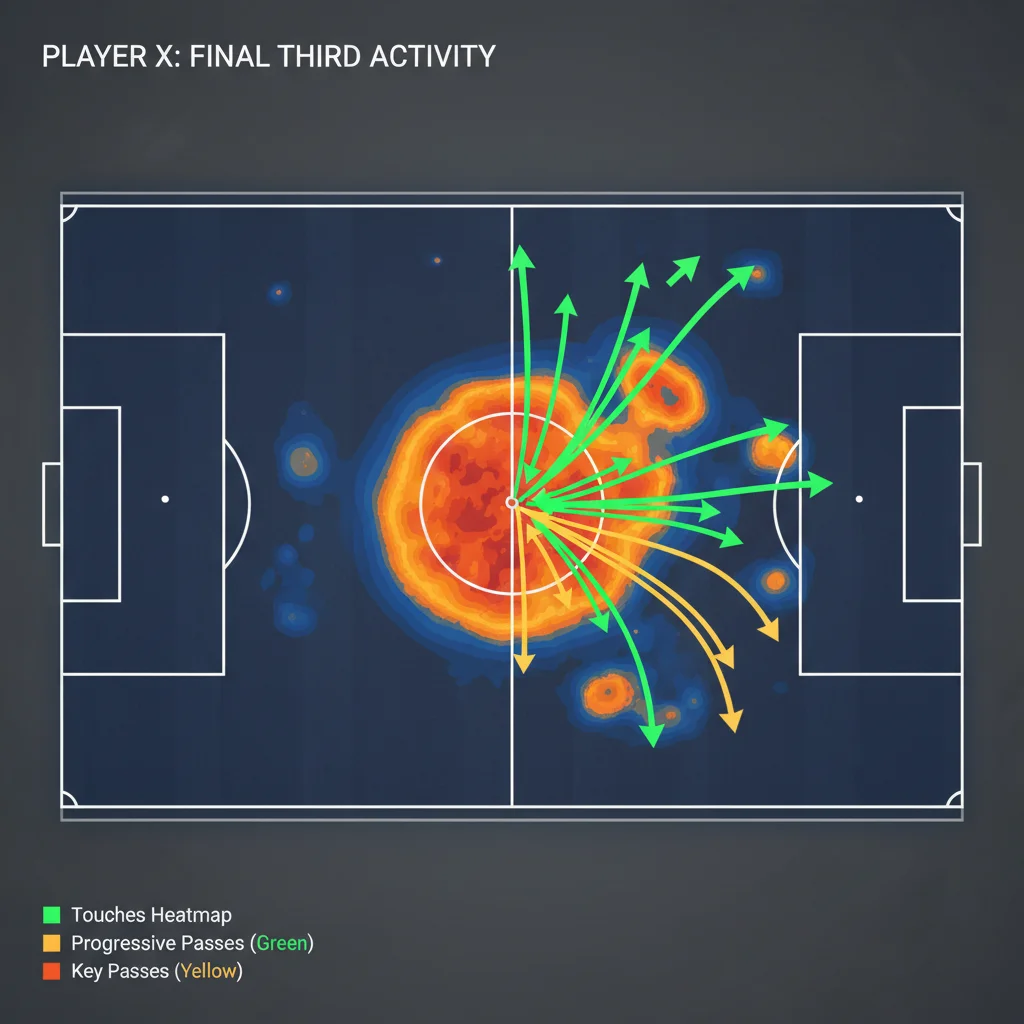
Goal-Creating Actions (GCA): The Ultimate Impact
Building on Shot-Creating Actions, Goal-Creating Actions (GCA) take it one step further. GCA counts the two offensive actions directly leading to a goal, such as passes, dribbles, or drawing a foul. This metric is the pinnacle of advanced soccer metrics for attacking output, as it directly correlates actions with the ultimate objective: scoring. A player might have a high xA, but if their teammates consistently fail to convert, their GCA might be lower. Conversely, a player with fewer xA but whose passes consistently lead to goals will have a higher GCA.
GCA provides a robust measure of a player’s direct contribution to goals. It helps differentiate between players who create good chances and players whose creations consistently result in goals. For 2026 scouting, GCA can be a critical indicator of a player’s clinical impact in the final third. It’s not just about getting into good positions; it’s about making the actions that directly lead to the ball hitting the back of the net.
Touches in the Box & Penalty Area Entries: Proximity to Goal
While some metrics focus on the quality of actions, others quantify the volume of presence in dangerous areas. Touches in the Box and Penalty Area Entries are simple yet effective advanced soccer metrics.
- Touches in the Box: The total number of times a player touches the ball within the opponent’s penalty area.
- Penalty Area Entries: The number of times a player carries or passes the ball into the opponent’s penalty area.
These metrics are particularly useful for evaluating strikers, attacking midfielders, and wingers who are tasked with getting into dangerous positions. A high number of touches in the box indicates a player who is consistently finding space in the most critical attacking zone. Similarly, frequent penalty area entries suggest a player who is effective at breaking down defensive lines and creating opportunities from wide or central positions. For 2026 tactics, teams will be looking for players who can consistently infiltrate the opponent’s box, as this significantly increases the probability of scoring.
Attacking Third Passes & Progressive Distance: Spacing and Progression
Beyond just getting into the box, the quality and direction of passes in the attacking third are vital. Advanced soccer metrics like Attacking Third Passes and Progressive Distance provide further insights.
- Attacking Third Passes: The total number of passes a player makes in the final third of the pitch. This shows involvement in offensive build-up.
- Progressive Distance (Carried/Passed): The total distance, in yards, that a player moves the ball towards the opponent’s goal through carries or passes. This metric quantifies the overall forward momentum a player provides to the team’s attack.
These metrics help paint a picture of a player’s role in sustained attacking pressure. A high number of attacking third passes, combined with significant progressive distance, indicates a player who is not only involved in offensive play but is also actively moving the team closer to goal. This is crucial for understanding how teams maintain pressure and break down stubborn defenses. As we approach 2026, the ability to consistently progress the ball under pressure will be a hallmark of top-tier attacking players.
Build-Up Play Involvement: The Unsung Heroes
Not every attacking action directly leads to a shot or a goal, but many are crucial in the build-up phase. This is where metrics like ‘Possession Chains Leading to a Shot/Goal’ or ‘Attacking Sequence Involvement’ come into play. These advanced soccer metrics track a player’s participation in sequences of play that ultimately result in a shot or a goal, regardless of whether they made the final pass or took the shot.
For example, a defensive midfielder might make a crucial pass from deep that initiates a move, which, after several subsequent passes and dribbles, leads to a goal. While they wouldn’t get an assist, these metrics would acknowledge their vital contribution to the attacking sequence. This is particularly important for 2026 teams looking for players who can influence the game from deeper positions, initiating attacks and controlling the tempo of offensive movements. It celebrates the often-overlooked contributions that are foundational to successful attacking play.
Defensive Actions in the Attacking Third: The Pressing Game
Modern soccer is characterized by high pressing and winning the ball back quickly in advanced areas. While seemingly defensive, these actions are crucial to attacking play. Metrics like ‘Successful Pressures in the Attacking Third’ or ‘Tackles/Interceptions in the Attacking Third’ are important advanced soccer metrics for evaluating players in a high-pressing system.
When a team wins possession high up the pitch, the distance to goal is shorter, and the opponent’s defense is often disorganized. Players who excel at these defensive actions in the attacking third effectively turn defense into attack, creating immediate scoring opportunities. For 2026 World Cup contenders, a team’s ability to implement an effective high press and have players capable of winning the ball back in dangerous areas will be a significant advantage. These metrics help identify the forwards and attacking midfielders who are not just goal-scorers but also relentless pressers.
Comparing and Contrasting: Holistic Player Evaluation for 2026
The true power of advanced soccer metrics lies not in analyzing them in isolation, but in combining them to form a holistic picture of a player’s attacking profile. For example:
- A player with high xG but low actual goals might be an unlucky finisher or needs to improve their composure.
- A player with low xA but high GCA might be making fewer chances, but those they do create are exceptionally high quality and often converted.
- A player with high progressive passes/carries but low touches in the box might be a fantastic ball progressor from deeper areas but needs to work on their final third penetration.
- A player with high SCA but low xA could be a great dribbler or foul-drawer, creating chances through individual brilliance rather than passing.
By comparing a player’s performance across these various advanced soccer metrics, analysts can identify specific strengths, areas for improvement, and even predict future performance more accurately. This multi-dimensional approach is what gives teams an edge in player recruitment and tactical planning for the 2026 cycle. It moves beyond the headline numbers to understand the underlying processes that drive success.
Team-Level Analysis: Building an Attacking Philosophy for 2026
These advanced soccer metrics are not just for individual player evaluation; they are equally powerful at the team level. By aggregating these statistics, coaches and analysts can understand their team’s attacking philosophy and identify areas for tactical adjustment.
- Does the team generate high xG but underperform in actual goals? This could indicate a need for better finishing training or a review of shot selection.
- Is the team creating a high volume of progressive passes but struggling with penalty area entries? This might suggest a need for more dynamic movement from forwards or creative solutions to break down compact defenses.
- Does the team have high GCA but low xA? This could mean they are clinical with the few chances they create, but perhaps need to generate more volume.
- Are defensive actions in the attacking third leading to shots and goals? If not, the pressing scheme might need refinement to better capitalize on turnovers.
For the 2026 World Cup, national teams and clubs alike will be leveraging these insights to craft their attacking strategies. Understanding which advanced soccer metrics correlate most strongly with success for their specific playing style will be key to optimizing performance. It allows for a data-driven approach to developing a coherent and effective attacking identity.
The Future of Soccer Analysis: AI and Machine Learning in 2026
As we march towards 2026, the application of Artificial Intelligence (AI) and Machine Learning (ML) will further enhance the utility of these advanced soccer metrics. AI can process vast amounts of data, identify complex patterns, and even predict outcomes with increasing accuracy.
- Event Detection: AI can more accurately identify and tag specific events on the pitch, improving the raw data quality for metrics.
- Contextual Analysis: ML models can add context to actions, understanding the defensive setup, player fatigue, and game state to provide even more nuanced metric values.
- Predictive Modeling: Beyond just describing what happened, AI can predict the likelihood of certain outcomes based on a player’s or team’s current metrics, aiding in scouting and in-game decision-making.
- Automated Scouting: AI could potentially flag players who excel in specific advanced soccer metrics, streamlining the scouting process for teams globally.
The integration of AI will not replace human analysts but empower them with more powerful tools, allowing for even deeper insights into attacking performance. The 2026 World Cup will undoubtedly showcase teams that have embraced these technological advancements, utilizing data to its fullest potential.
Conclusion: The Evolving Landscape of Attacking Excellence
The journey beyond Expected Goals reveals a rich tapestry of advanced soccer metrics that provide unparalleled insight into attacking performance. From Expected Assists and progressive movements to shot-creating actions and penalty area presence, these statistics offer a granular understanding of how goals are truly created. For anyone involved in soccer analysis, whether as a professional or an enthusiast, mastering these advanced metrics is crucial for staying ahead of the curve.
As we approach 2026, the teams and players who will dominate will be those who not only excel in traditional attacking outputs but also demonstrate proficiency across a spectrum of these advanced measures. The ability to consistently progress the ball, create high-quality chances, and directly contribute to goals through various actions will define attacking excellence. Embrace these advanced soccer metrics, and you’ll gain an insider’s perspective, transforming the way you watch, analyze, and appreciate the beautiful game. The future of soccer is data-driven, and understanding these metrics is your key to unlocking its deepest secrets.