Mastering Footvolley First Touch: Drills for 90% Success Rate by 2026
Anúncios
The exhilarating sport of footvolley demands a unique blend of athleticism, precision, and tactical acumen. As the sport gains global recognition and the 2026 competitions loom on the horizon, players are constantly seeking an edge. At the heart of every successful footvolley rally lies one crucial skill: the footvolley first touch. This initial contact with the ball dictates the entire flow of the game, setting up offensive plays, maintaining defensive pressure, and ultimately, determining success or failure.
Imagine a scenario where 90% of your first touches are perfect, placing the ball exactly where you want it for your partner to execute a devastating attack. This isn’t a pipe dream; it’s an achievable goal with dedicated training, the right mindset, and a systematic approach to drills. This comprehensive guide will delve deep into the art and science of the footvolley first touch, providing you with advanced drills and strategies designed to elevate your game and prepare you for peak performance in 2026.
Anúncios
The Unquestionable Importance of a Flawless Footvolley First Touch
Before we dive into the drills, it’s essential to understand why the footvolley first touch is not just another skill, but arguably the most critical one. In footvolley, unlike volleyball, you cannot use your hands. Every interaction with the ball, from receiving a serve to setting up an attack, relies on foot, chest, or head control. The first touch, in particular, sets the stage for the next two contacts. A poor first touch often leads to:
- Loss of Possession: An uncontrolled first touch can send the ball out of bounds or directly to your opponents.
- Weak Set-Up: If the ball isn’t placed accurately, your partner struggles to make an effective second touch, limiting attacking options.
- Defensive Vulnerability: A bad first touch puts your team immediately on the defensive, allowing opponents to capitalize.
- Increased Energy Expenditure: Chasing down an errant first touch drains energy that could be used for offensive maneuvers.
- Mental Frustration: Consistently struggling with the first touch can erode confidence and teamwork.
Conversely, a consistently excellent footvolley first touch provides:
Anúncios
- Optimal Set-Up: The ball is placed perfectly for your partner, allowing for powerful, strategic attacks.
- Control and Rhythm: It establishes a smooth flow in your team’s play, dictating the pace of the rally.
- Offensive Variety: A good first touch opens up a wider range of attacking options, keeping opponents guessing.
- Defensive Solidity: Even in defensive situations, a controlled first touch can turn defense into offense.
- Confidence and Team Synergy: Knowing your partner will deliver a good first touch builds trust and enhances overall team performance.
Achieving a 90% success rate on your footvolley first touch means that in almost every rally, you are giving your team the best possible chance to score or defend effectively. This level of consistency is what separates good players from elite competitors.
Understanding the Mechanics of an Ideal Footvolley First Touch
The perfect footvolley first touch isn’t just about kicking the ball. It involves a sophisticated interplay of body positioning, foot contact, absorption, and directional control. Let’s break down the key elements:
1. Anticipation and Positioning
Before the ball even reaches you, your brain should be processing its trajectory, speed, and spin. Great players anticipate where the ball will land and adjust their body position accordingly. This means:
- Early Movement: Don’t wait for the ball to be on top of you. Move to meet it.
- Optimal Angle: Position your body so you can comfortably use the desired part of your foot (or chest/head) to make contact.
- Balance: Maintain a low center of gravity and be ready to shift your weight.
2. Foot Contact and Surface Area
The part of your foot you use for the footvolley first touch depends on the ball’s trajectory and your desired outcome. Common contact points include:
- Instep (Lace Area): Ideal for softer, higher balls, allowing for greater control and lift.
- Sole of the Foot: Excellent for cushioning dropping balls and bringing them down gently.
- Inside of the Foot: Good for redirecting balls with precision, especially for passes to your partner.
- Outside of the Foot: Used for quick, subtle deflections or when needing to adjust direction quickly.
The key is to use a "soft" touch, almost like catching the ball with your foot, rather than striking it. This involves relaxing the ankle and knee to absorb the impact.
3. Absorption and Cushioning
This is where many players falter. Instead of stiffening up, you need to "give" with the ball. As the ball makes contact, allow your foot, ankle, and knee to absorb the force, effectively cushioning the ball. This kills the ball’s momentum and keeps it close to you. Think of it like catching an egg – you don’t snatch it, you cradle it.
4. Directional Control and Follow-Through
A successful footvolley first touch isn’t just about stopping the ball; it’s about directing it. You want to guide the ball to a specific spot, ideally a few feet in front of you and slightly to the side, setting up your partner for the second touch. This requires a subtle follow-through in the desired direction, using the momentum absorbed to give the ball a new, controlled trajectory.
Advanced Drills to Perfect Your Footvolley First Touch
Now, let’s get to the practical application. These drills are designed to isolate and improve each aspect of your footvolley first touch, building muscle memory and confidence. Remember to focus on quality over quantity initially, gradually increasing intensity and complexity.
Drill 1: Wall Ball Absorption & Control
Objective: Develop soft touch, absorption, and consistent directional control with various foot surfaces.
Setup: A sturdy wall, a footvolley ball. Stand 5-7 feet from the wall.
Execution:
- Instep Cushion: Gently kick the ball against the wall. As it rebounds, use your instep to cushion it, letting your foot, ankle, and knee absorb the impact. The ball should drop almost vertically at your feet. Alternate feet.
- Sole Trap: Repeat, but this time, let the ball bounce once after hitting the wall. As it descends, trap it softly with the sole of your foot, bringing it to a complete stop.
- Inside/Outside Redirect: Kick the ball to the wall. As it rebounds, use the inside of your foot to redirect it slightly to your left, then the outside of your foot to redirect it slightly to your right. Focus on precision and keeping the ball within a small imaginary square.
- Alternating Touch: Combine all three. Kick with your right, receive with your left instep. Kick with your left, receive with your right sole. Create a rhythmic flow.
Progression: Increase the distance from the wall, increase the power of your initial kick, or introduce a second ball for continuous play.
Drill 2: Partner Serve & Set
Objective: Simulate game-like receiving, focusing on anticipation, body positioning, and setting up your partner.
Setup: Two players, one net, one ball.
Execution:
- Player A serves the ball (overhand or underhand) from the baseline.
- Player B, positioned near the net, anticipates the serve and moves to receive it with a perfect footvolley first touch. The goal is to cushion the ball and direct it to a specific spot (e.g., 3 feet from the net, slightly to the right of Player B) for Player A to make a second touch.
- Player A then makes a controlled second touch (e.g., a chest pass or another foot pass) back to Player B, who repeats the first touch.
- Rotate roles after 10-15 successful sets.
Progression: Player A varies the serve (short, deep, left, right, with spin). Player B must adjust quickly. Introduce a target area (e.g., a hoop or marked square) where Player B must aim their first touch. Increase the speed of the serve.
Drill 3: High Ball Drop & Control
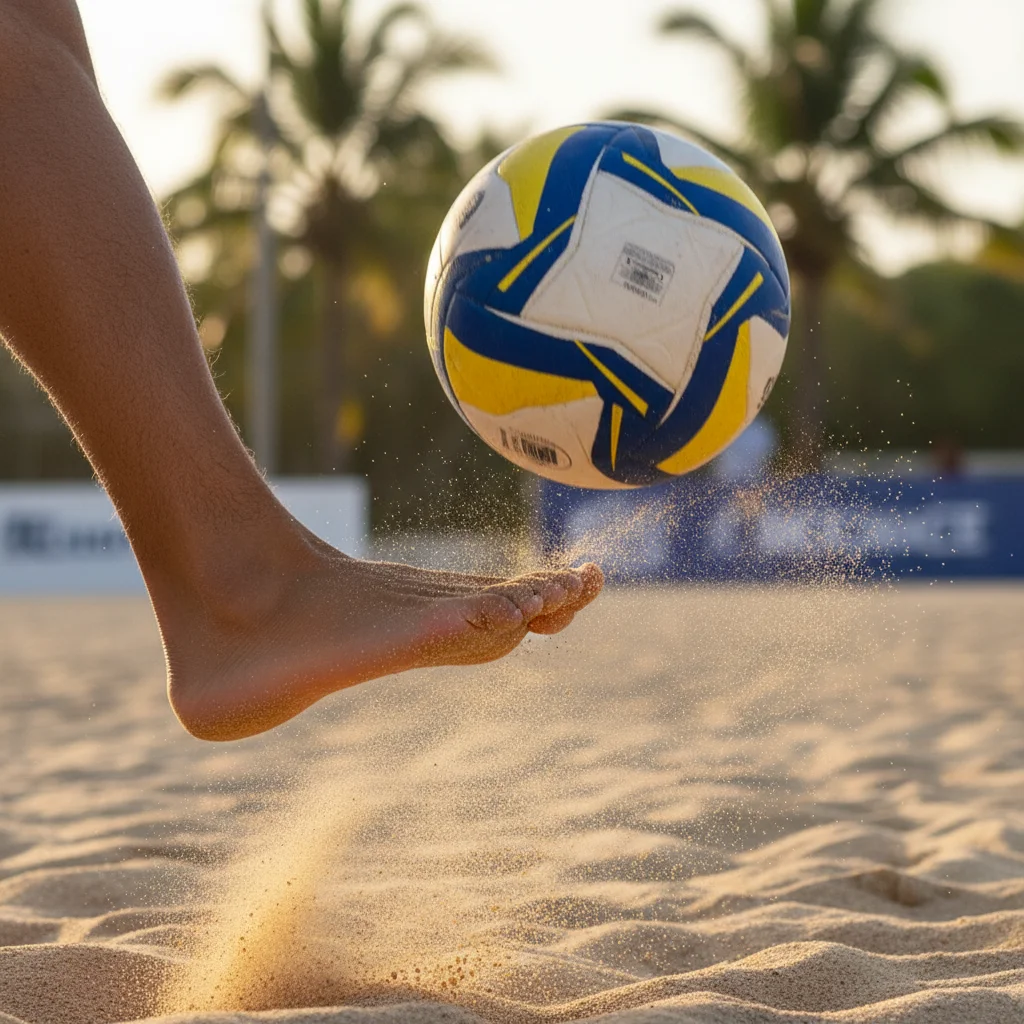
Objective: Master receiving high, arcing balls, which are common in footvolley, especially from serves or defensive clearances.
Setup: Two players, one ball. One player stands on a raised platform or a chair (if safe) or simply throws the ball high.
Execution:
- Player A tosses the ball high into the air, aiming for a specific spot near Player B.
- Player B positions themselves directly under the descending ball. As it drops, Player B uses their preferred first touch technique (instep, sole, chest) to cushion the ball, bringing it under control. The goal is to keep the ball within arm’s reach after the first touch.
- Player B then gently passes the ball back to Player A, who repeats the toss.
Progression: Player A varies the height and spin of the toss. Player B must control the ball and then immediately make a precise pass to a target (e.g., a cone or Player A’s hand). Introduce movement: Player B must run to the landing spot before making the first touch.
Drill 4: Dynamic Receiving Under Pressure
Objective: Integrate movement and quick decision-making into your footvolley first touch, simulating game conditions.
Setup: Three players (or two and a ball machine), one net, cones.
Execution:
- Player A (server) stands on one side of the net. Player B (receiver) and Player C (setter/attacker) are on the other side.
- Player B must quickly move to the ball, execute a precise footvolley first touch to set the ball up for Player C near the net.
- Player C then attempts a simulated attack (e.g., a foot spike or header).
- Rotate positions regularly.
Progression: Player A varies serve power and placement. Introduce an "opponent" (a fourth player or a coach) who applies light pressure or attempts to block, forcing Player B to make quicker, more precise decisions. Increase the pace of the drills, giving less time for recovery between serves.
Key Principles for Consistent Footvolley First Touch Improvement
Beyond the drills, adopting certain principles will accelerate your journey to a 90% success rate with your footvolley first touch.
1. Repetition, Repetition, Repetition
There’s no substitute for consistent practice. Dedicate specific training sessions solely to first touch drills. The more you repeat the correct movements, the more ingrained they become in your muscle memory.
2. Focus on Body Mechanics
Pay close attention to your body’s position relative to the ball. Are you balanced? Is your foot relaxed? Are your knees bent to absorb impact? Film yourself during drills and analyze your technique.
3. Softness and Absorption
This cannot be overstated. The goal is to "kill" the ball’s momentum, not redirect it powerfully. Think of your foot as a pillow, not a bat. Practice relaxing your ankle and knee at the moment of contact.
4. Vision and Anticipation
Keep your eyes on the ball at all times, from the moment it leaves the opponent’s foot until it makes contact with yours. Develop your ability to read the ball’s trajectory and spin early.
5. Varied Practice Environments
While beach courts are standard, practicing on different surfaces (grass, indoor court) can enhance your overall ball control and adaptability, making your footvolley first touch even more robust when you return to the sand.
6. Mental Toughness and Concentration
The first touch requires intense focus. Practice mindfulness and concentration during drills. Learn to shake off mistakes and stay present in the moment.
7. Strength and Conditioning
Strong core muscles, agile ankles, and powerful legs contribute significantly to your ability to get to the ball quickly and maintain balance during the first touch. Incorporate exercises like squats, lunges, plyometrics, and core work into your routine.
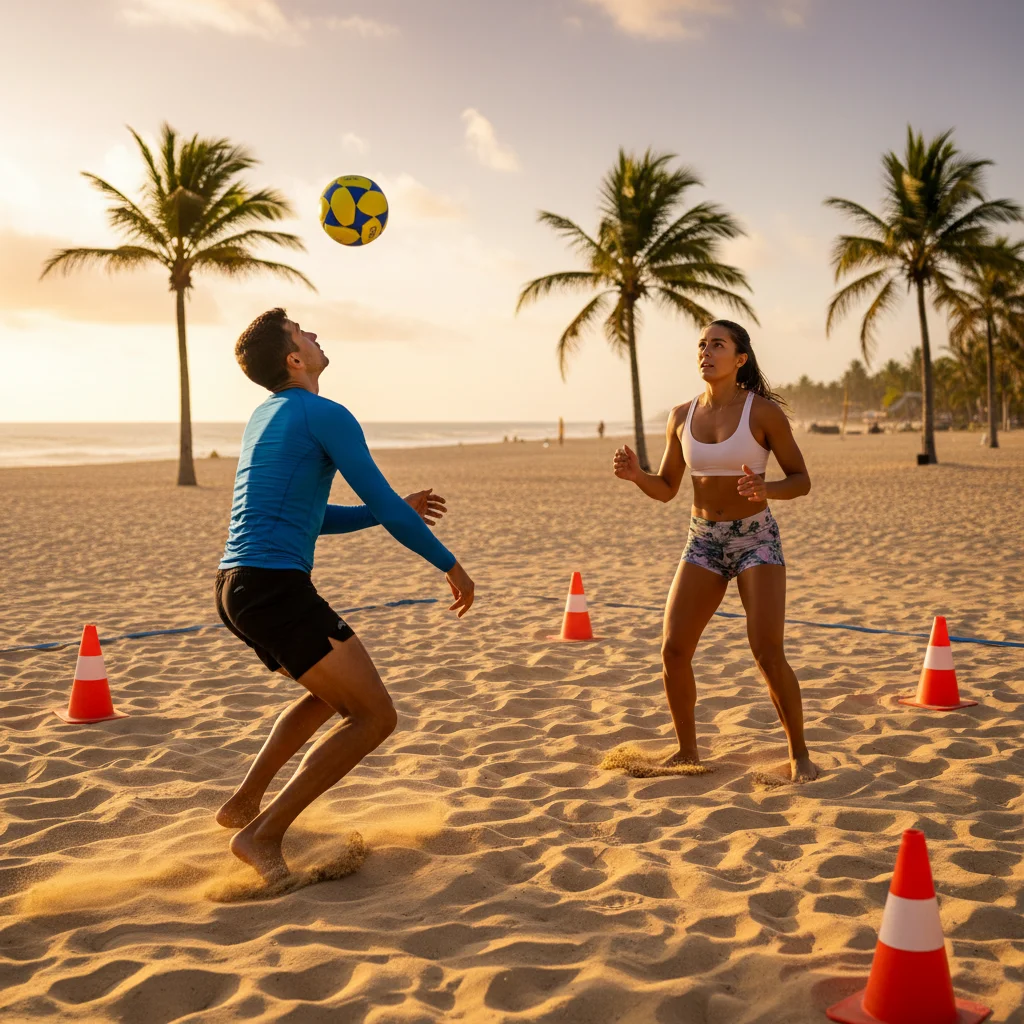
Integrating First Touch Training into Your Weekly Schedule
To achieve a 90% success rate by 2026, consistent, structured training is key. Here’s a sample weekly integration plan:
- Day 1: Technical Focus (60-90 minutes)
- Warm-up (15 min)
- Wall Ball Absorption & Control (30 min)
- High Ball Drop & Control (30 min)
- Cool-down (15 min)
- Day 2: Partner Drills (90-120 minutes)
- Warm-up (15 min)
- Partner Serve & Set (45 min)
- Dynamic Receiving Under Pressure (45 min)
- Cool-down (15 min)
- Day 3: Game Simulation & Scrimmage (120+ minutes)
- Focus on applying first touch skills in live game scenarios.
- Actively seek out challenging serves and receptions.
- Provide feedback to your partner on their first touch.
- Rest/Active Recovery: Ensure adequate rest for muscle recovery and injury prevention.
Remember to adjust this schedule based on your current fitness level, team training commitments, and personal goals. The intensity and duration of drills should gradually increase as your skills improve.
Analyzing Your Performance: Tools and Techniques
How do you know if you’re truly hitting that 90% success rate for your footvolley first touch? Objective analysis is crucial:
- Video Analysis: Record your training sessions and games. Review your first touches in slow motion. Look for common errors, areas for improvement, and consistent successes.
- Success Rate Tracking: During drills, have your partner or coach count successful first touches (defined as setting the ball perfectly for the second touch) versus unsuccessful ones. Keep a log to track progress over time.
- Feedback: Actively solicit feedback from your coach and teammates. They often notice things you might miss.
- Self-Assessment: After each touch, mentally (or verbally) assess its quality. What could have been better? What went well?
This data-driven approach will provide tangible evidence of your improvement and help you fine-tune your training regimen for the footvolley first touch.
Common Mistakes and How to Correct Them
Even seasoned players can fall into bad habits. Here are common errors related to the footvolley first touch and strategies to overcome them:
1. Stiff Leg/Ankle
Problem: The ball bounces off your foot uncontrollably, often too far away.
Correction: Consciously relax your ankle and bend your knee more at the moment of impact. Practice the "catching an egg" analogy. Wall ball drills focusing on absorption are excellent for this.
2. Poor Body Positioning
Problem: You’re always reaching or stretching, leading to awkward touches.
Correction: Emphasize early movement and getting your body behind the ball. Practice shadow footwork without the ball, focusing on quickly moving to the imaginary landing spot.
3. Looking Away from the Ball
Problem: You lose track of the ball’s trajectory just before contact, leading to misjudgments.
Correction: Train your eyes to stay glued to the ball. During drills, consciously remind yourself to "watch the ball all the way."
4. Inconsistent Contact Point
Problem: Sometimes you use the instep, sometimes the shin, leading to unpredictable touches.
Correction: Isolate specific contact points in drills. For example, dedicate a session to only instep touches, then another to only sole traps. Build consistency with each technique.
5. Lack of Follow-Through/Direction
Problem: The ball is cushioned but just drops, not going to the desired set-up spot.
Correction: After absorption, incorporate a subtle, controlled follow-through in the direction you want the ball to go. Use targets (cones, hoops) in drills to train precision.
Conclusion: Your Path to Footvolley First Touch Mastery by 2026
The journey to achieving a 90% success rate on your footvolley first touch by 2026 is a challenging but immensely rewarding one. It requires dedication, intelligent practice, and a relentless pursuit of perfection. By understanding the fundamental mechanics, diligently practicing advanced drills, and adhering to key training principles, you will transform your ball control and elevate your overall game.
Remember, every perfect first touch is a step closer to dominating the court, creating more scoring opportunities, and ultimately, securing victories in upcoming competitions. Start implementing these strategies today, analyze your progress, and commit to the process. Your opponents in 2026 will undoubtedly notice the difference. Good luck, and see you on the sand!