Master Footvolley Agility: 7 Drills for Quicker Court Movement in 2026
Anúncios
Footvolley is a sport that demands an extraordinary blend of skill, precision, and, perhaps most crucially, agility. As the game evolves and competition intensifies, especially looking ahead to 2026, players are constantly seeking an edge. That edge often comes down to who can react faster, cover more ground, and change direction more effectively. This is where mastering footvolley agility drills becomes not just an advantage, but a necessity. In this comprehensive guide, we’ll delve into 7 practical solutions designed to significantly enhance your court movement, making you a more formidable and dynamic player.
The essence of footvolley lies in its fluid, continuous motion. Unlike traditional volleyball where hands are used, footvolley relies solely on feet, chest, and head, demanding exceptional body control and spatial awareness. The rapid exchanges, unpredictable bounces, and small court size mean that every millisecond counts. Improving your agility directly translates to better ball control, more effective defensive plays, and more powerful offensive attacks. It allows you to get to the ball faster, position yourself optimally for a header or a chest pass, and recover quickly for the next play. Without superior agility, even the most skilled player can be outmaneuvered.
Anúncios
As we approach 2026, the level of play in footvolley is only expected to rise. Teams are becoming more strategic, and individual players are pushing the boundaries of physical capability. To stay competitive and truly excel, incorporating targeted footvolley agility drills into your training regimen is paramount. These drills aren’t just about running fast; they’re about developing explosive power, quick reflexes, balance, and the ability to stop, start, and change direction with unparalleled efficiency. They train your neuromuscular system to respond instantaneously to the demands of the game, transforming your movement from reactive to proactive.
This article will guide you through seven specific drills, each designed to target different aspects of agility relevant to footvolley. We’ll explain the ‘how’ and ‘why’ behind each drill, providing clear instructions and highlighting the benefits. Whether you’re a seasoned professional looking to fine-tune your performance or an aspiring player aiming to elevate your game, these footvolley agility drills will provide the foundation for quicker, more effective court movement. Get ready to transform your game and dominate the sand!
Anúncios
Understanding the Importance of Agility in Footvolley
Agility in footvolley is not merely about being fast; it’s a complex interplay of speed, coordination, balance, and reaction time. It’s the ability to accelerate, decelerate, and change direction quickly and efficiently without losing control or momentum. In a sport where the ball can come at you from any angle, with varying speeds and spins, superior agility is your best defense and often your most potent offense.
Why Agility is Your Competitive Edge:
- Rapid Court Coverage: Footvolley courts are relatively small, but the speed of play often makes them feel vast. Agility allows you to cover every inch, ensuring no ball is out of reach.
- Optimal Positioning: Being agile means you can always get into the best position to receive, pass, or attack the ball, maximizing your contact quality and minimizing errors.
- Quick Recovery: After an intense dive or a powerful shot, agility helps you recover your balance and readiness for the next play almost instantaneously.
- Enhanced Reaction Time: Drills focused on agility inherently improve your body’s ability to react to visual cues, translating directly to quicker responses on the court.
- Injury Prevention: A strong, agile body is more resilient. Improved balance and coordination reduce the risk of awkward landings, twists, and strains common in dynamic sports.
Consider a scenario where your opponent delivers a powerful, unexpected spike. A player with high agility can quickly shift their weight, sprint a few steps, and get their foot under the ball for a save, whereas a less agile player might be caught flat-footed. Similarly, when setting up an attack, the ability to quickly adjust your position to meet a teammate’s pass perfectly can be the difference between a point-scoring header and a missed opportunity.
The demands of footvolley are unique. The sandy surface adds an extra layer of challenge, requiring more power for propulsion and greater stability for balance. This makes specialized footvolley agility drills even more critical, as they train your body to adapt to these specific conditions. By focusing on multi-directional movement, explosive starts, and sudden stops, you prepare your body for the unpredictable nature of the game.
Furthermore, agility is a skill that can always be improved. It’s not just about inherent athletic ability. Through consistent, targeted training, any player can significantly enhance their agility, leading to a noticeable improvement in their overall game. The drills we’re about to explore are designed to do just that – provide a structured pathway to superior court movement, setting you up for success in 2026 and beyond.
7 Practical Footvolley Agility Drills for Quicker Court Movement
Now, let’s dive into the core of our training program. These seven footvolley agility drills are specifically chosen for their effectiveness in developing the critical movement skills required on the footvolley court. Remember to perform a proper warm-up before starting any of these drills and cool down afterward.
1. Cone Weaving Drill
Purpose: Improves lateral movement, quick changes of direction, and foot speed.
How to Perform:
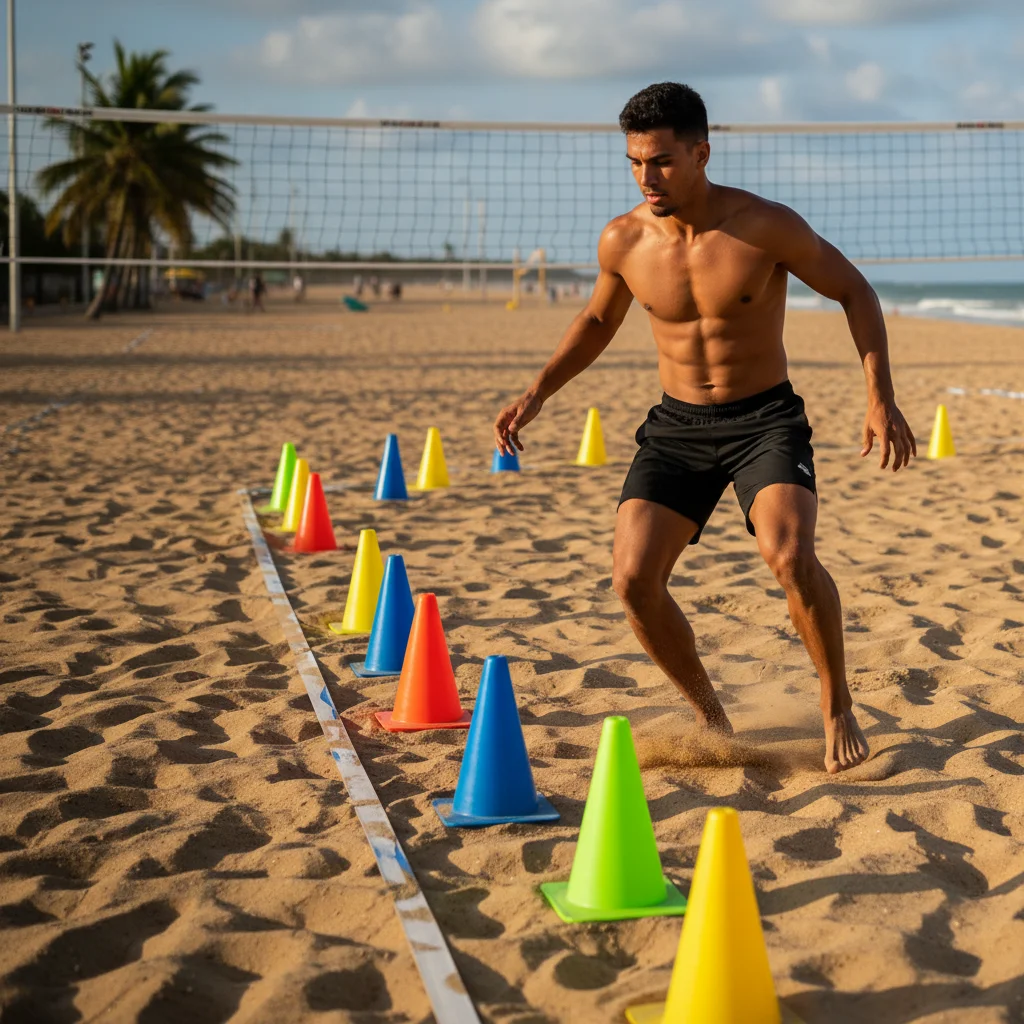
- Set up 5-7 cones in a straight line, approximately 3-4 feet apart.
- Start at one end and weave through the cones, moving laterally. Keep your body low, knees bent, and eyes up.
- Focus on quick, choppy steps, touching the ground lightly between each cone.
- Once you reach the end, immediately weave back to the start.
- Perform 3-5 sets, resting for 60-90 seconds between sets.
Footvolley Relevance: This drill mimics the rapid lateral adjustments needed to track the ball across the net or cover defensive zones. It builds the muscle memory for quick side-to-side shuffles.
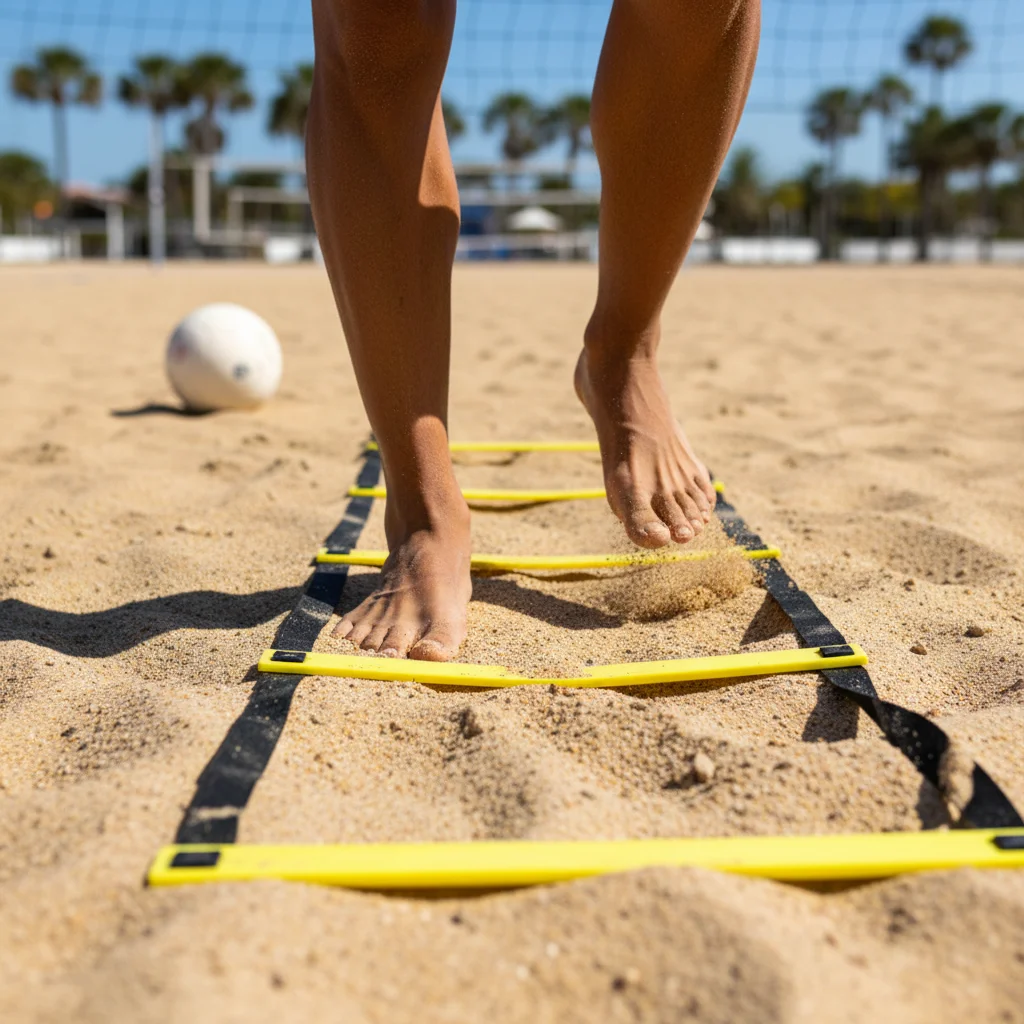
2. Agility Ladder Drills (Forward & Lateral)
Purpose: Enhances foot speed, coordination, rhythm, and quickness.
How to Perform:
- Forward Run: Place an agility ladder on the ground. Run through the ladder, placing one foot in each square (e.g., ‘in-in-out-out’ or ‘two feet in each square’). Focus on high knees and light, quick touches.
- Lateral Shuffle: Stand beside the ladder. Shuffle sideways through the ladder, placing one foot in and one foot out of each square, then switching. Keep your hips low and shoulders square.
Perform 2-3 variations of each (forward and lateral) for 3-4 sets each. Rest 60 seconds between sets.
Footvolley Relevance: The agility ladder is excellent for developing the fast, precise footwork needed for approaching the net, retreating for a save, or adjusting your stance for a header.
3. T-Drill
Purpose: Tests and improves multi-directional speed and change of direction ability.
How to Perform:
- Set up four cones in a ‘T’ shape: one cone (A) as the starting point, two cones (B & C) 5 yards left and right of a central cone (D), which is 10 yards directly in front of A.
- Start at cone A. Sprint to cone D.
- Shuffle left to cone B, touch it.
- Shuffle right past cone D to cone C, touch it.
- Shuffle left back to cone D.
- Backpedal from cone D to cone A.
Perform 4-6 repetitions, aiming for speed and precision. Rest 90 seconds between reps.
Footvolley Relevance: The T-drill simulates the varied movements in footvolley – sprinting forward for a ball, shuffling to cover a wide shot, and backpedaling to defend a lob.
4. Box Jump with Quick Release
Purpose: Develops explosive power in the legs and rapid deceleration/acceleration.
How to Perform:
- Stand in front of a sturdy box (12-24 inches high, depending on your ability).
- Explosively jump onto the box, landing softly with bent knees.
- Immediately jump back down to the starting side.
- Upon landing, quickly sprint 5-10 yards in a designated direction (e.g., sideways or forward).
Perform 3-4 sets of 5-8 repetitions. Rest 60-90 seconds between sets.
Footvolley Relevance: This drill builds the power needed for vertical jumps (e.g., for headers over the net) and the immediate acceleration required after landing or a quick defensive move.
5. Reaction Ball Drills
Purpose: Enhances visual processing, reaction time, and quick bursts of movement.
How to Perform:
- Use a reaction ball (a multi-faceted rubber ball with unpredictable bounce).
- Have a partner toss or bounce the ball against a wall or court, forcing you to react to its unpredictable trajectory.
- Focus on quickly moving to where the ball lands and controlling it (with foot, chest, or head) if possible, or simply touching it.
- Vary the distance and speed of the throws/bounces.
Perform for 2-3 minutes continuously, then rest for 1 minute. Repeat 3-5 times.
Footvolley Relevance: Directly improves your ability to react to unexpected ball movements, a common occurrence in footvolley due to spins, wind, and varied contact points.
6. Shuttle Runs (Suicides)
Purpose: Develops acceleration, deceleration, and the ability to change direction rapidly over varying distances.
How to Perform:
- Set up cones at 5, 10, and 15 yards from a starting line.
- Sprint from the start to the 5-yard cone, touch the ground, and sprint back to the start.
- Immediately sprint from the start to the 10-yard cone, touch the ground, and sprint back to the start.
- Finally, sprint from the start to the 15-yard cone, touch the ground, and sprint back to the start.
This completes one set. Perform 3-5 sets, resting 2-3 minutes between sets.
Footvolley Relevance: Mimics the stop-and-go nature of footvolley, where players often need to sprint short distances, stop, and immediately change direction to pursue the ball or get into position.
7. Partner Mirror Drill
Purpose: Enhances reactive agility, lateral movement, and defensive positioning.
How to Perform:
- You and a partner stand facing each other, about 3-5 feet apart.
- One person (the leader) moves laterally, forward, or backward within a designated area (e.g., 10×10 feet).
- The other person (the mirror) must mimic their movements precisely and quickly, staying the same distance apart.
- After 30-60 seconds, switch roles.
Perform 3-5 sets for each partner. Rest 60 seconds between sets.
Footvolley Relevance: This drill directly translates to defensive situations, allowing you to track an opponent’s movement, anticipate their next move, and maintain optimal defensive positioning.
Integrating Agility Training into Your Footvolley Regimen
Simply performing these footvolley agility drills once in a while won’t yield significant results. Consistency and proper integration into your overall training plan are key. Here’s how to make agility training a cornerstone of your footvolley preparation for 2026.
Frequency and Placement:
- 2-3 Times Per Week: Aim for 2-3 dedicated agility sessions per week. These can be separate sessions or integrated into your footvolley practice.
- Warm-up First: Always start with a dynamic warm-up (5-10 minutes of light cardio, dynamic stretches) to prepare your muscles and reduce injury risk.
- Early in Session: If combining with footvolley practice, perform agility drills early in the session when you are fresh and have maximum energy. Fatigue can compromise technique and increase injury risk.
Progression and Variation:
- Start Simple, Progress Gradually: Begin with fewer repetitions and sets, focusing on perfect form. As your agility improves, gradually increase the intensity, duration, and complexity of the drills.
- Increase Speed: Once comfortable with the movements, strive for maximum speed during the drills.
- Add Resistance (Carefully): For advanced athletes, light resistance bands around the ankles or waist can be used to increase intensity, but this should be done cautiously and with proper guidance.
- Vary Drills: Don’t stick to just one or two drills. Rotate through all seven (and potentially more) to challenge your body in different ways and prevent plateaus.
Focus on Quality Over Quantity:
It’s better to perform fewer repetitions with perfect form and maximum effort than many repetitions with sloppy technique. Agility is about efficient movement, and poor form can reinforce bad habits.
Listen to Your Body:
Agility training can be demanding. Ensure you’re getting adequate rest and nutrition. If you feel sharp pain, stop immediately. Overtraining can lead to injuries and hinder progress.
Incorporate Ball Work:
After your dedicated agility drills, integrate footvolley-specific ball work that requires quick movements. For example, practice receiving quick passes from various angles immediately after a shuttle run, or perform a set-up after a cone weave. This bridges the gap between pure agility training and game-specific scenarios, making your movements more instinctual.
Mental Aspect:
Agility isn’t just physical; it’s mental. Practice anticipating movements, reading body language, and making split-second decisions during drills. Visualization can also play a role in improving reaction time and confidence.
By consistently implementing these footvolley agility drills and following these integration guidelines, you’ll not only see a significant improvement in your court movement but also a boost in your overall confidence and performance. The goal for 2026 is not just to play, but to dominate, and superior agility is your ticket to achieving that.
Common Mistakes to Avoid in Agility Training
While the goal is to enhance your agility, certain pitfalls can hinder your progress or even lead to injury. Being aware of these common mistakes will help you maximize the effectiveness of your footvolley agility drills.
1. Neglecting Warm-up and Cool-down:
Mistake: Jumping straight into intense drills without preparing your body or finishing without proper recovery.
Solution: Always perform a dynamic warm-up (5-10 minutes of light cardio, leg swings, arm circles) before starting. Conclude with a static cool-down (holding stretches for 20-30 seconds) to improve flexibility and aid recovery.
2. Sacrificing Form for Speed:
Mistake: Trying to complete drills as fast as possible, even if it means sloppy footwork, poor balance, or inefficient movements.
Solution: Focus on perfect technique first. Speed will naturally increase as your form improves and your body becomes more efficient. Quality of movement is paramount over raw speed in the initial stages.
3. Skipping Core Strength Training:
Mistake: Believing agility is solely about leg speed, neglecting the role of the core.
Solution: A strong core is crucial for stability, balance, and transferring power during changes of direction. Incorporate planks, Russian twists, and other core exercises into your routine alongside footvolley agility drills.
4. Lack of Variety:
Mistake: Sticking to the same 1-2 drills every session, leading to plateaus and boredom.
Solution: Introduce variety by rotating through different drills that challenge various aspects of agility (lateral, linear, reactive). This keeps your body adapting and prevents training monotony.
5. Insufficient Rest and Recovery:
Mistake: Overtraining without allowing your body adequate time to recover and rebuild.
Solution: Listen to your body. Ensure you have rest days or active recovery days between intense agility sessions. Proper nutrition and hydration are also vital for muscle repair and energy replenishment.
6. Improper Footwear:
Mistake: Wearing shoes that don’t provide adequate support or grip for quick, multi-directional movements, especially on sand.
Solution: While footvolley is often played barefoot, if you use footwear for training, ensure it’s appropriate for the surface and provides good lateral support and cushioning to prevent injuries.
7. Ignoring Balance Training:
Mistake: Focusing solely on dynamic movement without addressing static and dynamic balance.
Solution: Incorporate balance exercises like single-leg stands, Bosu ball drills, or yoga poses. Good balance is the foundation for stable, efficient, and injury-free agile movements in footvolley.
By consciously avoiding these common errors, you can ensure your footvolley agility drills are safe, effective, and contribute significantly to your goal of quicker court movement and superior performance in 2026.
The Mental Game: Agility Beyond the Physical
While physical conditioning is undeniably crucial, true agility in footvolley extends beyond muscular strength and quick reflexes. The mental aspect plays an equally significant role, influencing your reaction time, decision-making, and overall court awareness. To truly master footvolley agility drills, you must also train your mind.
Anticipation and Reading the Game:
Agility isn’t just about reacting quickly; it’s about anticipating. A truly agile player often moves before the ball is even struck, based on their understanding of the game, their opponent’s tendencies, and their teammate’s positioning. This ‘pre-agility’ is developed through:
- Studying Opponents: Observe their serving patterns, hitting angles, and preferred offensive plays.
- Understanding Game Flow: Recognize common sequences of play and predict where the ball is likely to go next.
- Peripheral Vision: Train yourself to take in the entire court, including your partner and opponents, with minimal head movement.
Decision-Making Under Pressure:
In the heat of a footvolley match, you often have fractions of a second to decide where to move and how to contact the ball. Agility training, especially reactive drills, helps to hone this skill:
- Scenario Training: Incorporate drills that present unpredictable situations, forcing you to make quick decisions on the fly.
- Focus and Concentration: Practice maintaining intense focus throughout drills, simulating game pressure.
- Visualization: Mentally rehearse different game scenarios and your agile responses to them. This can prime your brain for quicker reactions during actual play.
Confidence and Poise:
A mentally strong player is a more agile player. Confidence allows you to commit fully to a movement without hesitation, and poise helps you maintain composure even when caught slightly out of position. Regular, successful completion of challenging footvolley agility drills builds this mental resilience.
Mind-Muscle Connection:
Developing a strong mind-muscle connection means your brain can more effectively and efficiently send signals to your muscles, resulting in faster and more precise movements. This connection is strengthened through mindful practice, where you actively think about the mechanics of your movement during drills.
By consciously integrating these mental aspects into your training, you’ll find that your physical footvolley agility drills become even more effective. You won’t just be moving faster; you’ll be moving smarter, making you an incredibly difficult opponent to beat and propelling you towards peak performance in 2026.
Conclusion: Your Path to Footvolley Dominance in 2026
The journey to becoming a dominant footvolley player in 2026 is multifaceted, requiring dedication, skill, and an unwavering commitment to continuous improvement. As we’ve explored, superior agility is not just a desirable trait; it’s a fundamental requirement for excelling in this dynamic and demanding sport. By consistently incorporating these 7 practical footvolley agility drills into your training regimen, you are laying the groundwork for unprecedented court movement and performance.
From the rapid lateral shuffles of the Cone Weaving Drill to the explosive power of the Box Jump, and the reactive quickness honed by the Reaction Ball, each exercise targets specific components of agility critical to footvolley. The T-Drill and Shuttle Runs prepare you for multi-directional sprints and stops, while Agility Ladder Drills refine your footwork. Finally, the Partner Mirror Drill sharpens your reactive defense, making you a formidable presence on the court.
Remember that the true power of these drills lies in their consistent application and intelligent integration into your broader training schedule. Prioritize proper warm-ups and cool-downs, focus on impeccable form over sheer speed, and always listen to your body to prevent injuries. Crucially, don’t overlook the mental dimension of agility. Training your mind to anticipate, react, and make split-second decisions is just as vital as training your muscles.
As the footvolley landscape evolves towards 2026, the players who will stand out are those who possess not only exceptional ball control but also the physical and mental quickness to outmaneuver their opponents. By committing to these footvolley agility drills, you’re not just practicing; you’re transforming your game, building resilience, and developing the competitive edge needed to conquer the sand. Step onto the court with confidence, knowing that your enhanced agility will allow you to reach every ball, make every save, and set up every attack with precision and speed. Your journey to footvolley dominance starts now!